
Key Takeaways
- Total hip replacement recovery in Pune follows a structured week-by-week timeline from day 1 to 12 months.
- Most patients are walking with support within 24 to 48 hours of surgery and go home within 3 to 5 days.
- Full functional recovery — returning to normal daily activities without assistance — takes 6 to 12 weeks for most patients.
- Return to low-impact sports (swimming, cycling) is typically permitted at 4 to 6 months.
- Hip implants last 15 to 25 years in most patients; 95% of implants survive 10 years (Industry estimate).
- Total hip replacement costs INR 1.5 lakh to 3.8 lakh in Pune depending on implant type and hospital (Industry estimate).
- Dr. Swaroop Salunkhe’s enhanced recovery protocol begins physiotherapy on day 1 post-surgery to maximise outcomes.
Total hip replacement recovery time in Pune is one of the most common questions patients ask before consenting to surgery. The fear of being bed-bound for months, dependent on family members or unable to return to work keeps many people delaying a procedure that could dramatically improve their quality of life.
The reality, under Dr. Swaroop Salunkhe’s enhanced recovery protocol at his Baner clinic, is far more encouraging than patients expect. This guide gives you an honest week-by-week breakdown of what recovery looks like — from the day of surgery through to your 12-month milestone.
Quick Facts
| Procedure | Total hip replacement (total hip arthroplasty) |
| Hospital stay | 3 to 5 days (standard), 2 days (enhanced recovery) |
| Physiotherapy starts | Day 1 post-operation |
| Return to normal daily activity | 6 to 12 weeks |
| Total cost, Pune | INR 1.5 lakh to 3.8 lakh (Industry estimate) |
| Implant longevity | 15 to 25 years in most patients |
Total Hip Replacement in Pune – Statistics 2025–2026
| Metric | Data Point | Source |
| Hip replacements annually, India | ~80,000 per year | Industry estimate |
| Average cost of THR, Pune | INR 1.5 lakh to 3.8 lakh | Industry estimate |
| 10-year implant survival | ~95% of hip implants | Industry estimate |
| Patient satisfaction post-THR | >90% report good/excellent outcome | Industry estimate |
| Patients walking by day 2 | >90% on enhanced recovery protocols | PubMed ERAS review |
| Ayushman Bharat coverage | THR covered for eligible beneficiaries | MoHFW India |
Pre-Operative Preparation: Getting Ready for Hip Replacement
Recovery starts before surgery. Dr. Salunkhe’s pre-operative protocol ensures patients arrive at theatre as fit as possible. Blood tests, ECG, cardiac fitness clearance and anaesthesia review are completed 2 to 4 weeks before the planned date.
Blood thinners are stopped 5 to 7 days before surgery. If you’re diabetic, your blood sugar must be well-controlled (HbA1c ideally below 8%). Smokers are advised to stop at least 6 weeks before surgery — smoking impairs bone healing and increases infection risk significantly. Arranging home support — who will help with cooking, bathing and transport — is discussed at the pre-admission clinic visit.
Day of Surgery: What to Expect
Most hip replacements are performed under spinal anaesthesia with light sedation. This means you’re awake but feel nothing below the waist. The procedure takes 60 to 90 minutes. Dr. Salunkhe uses a posterior or anterolateral approach depending on your hip anatomy and implant plan — he discusses the choice with you at the pre-operative consultation.
The damaged femoral head and acetabulum (hip socket) are removed and replaced with metal, ceramic or polyethylene components. The implant is press-fit (cementless) in most younger patients and cemented in elderly patients with osteoporotic bone.
In the recovery room, your pain is assessed and managed with a multimodal protocol — local infiltration anaesthesia (injected into the wound at surgery), scheduled paracetamol, anti-inflammatory medication and a nerve block if appropriate. Most patients describe postoperative pain as a 3 to 5 out of 10 — significantly less than anticipated.
Week-by-Week Total Hip Replacement Recovery Timeline
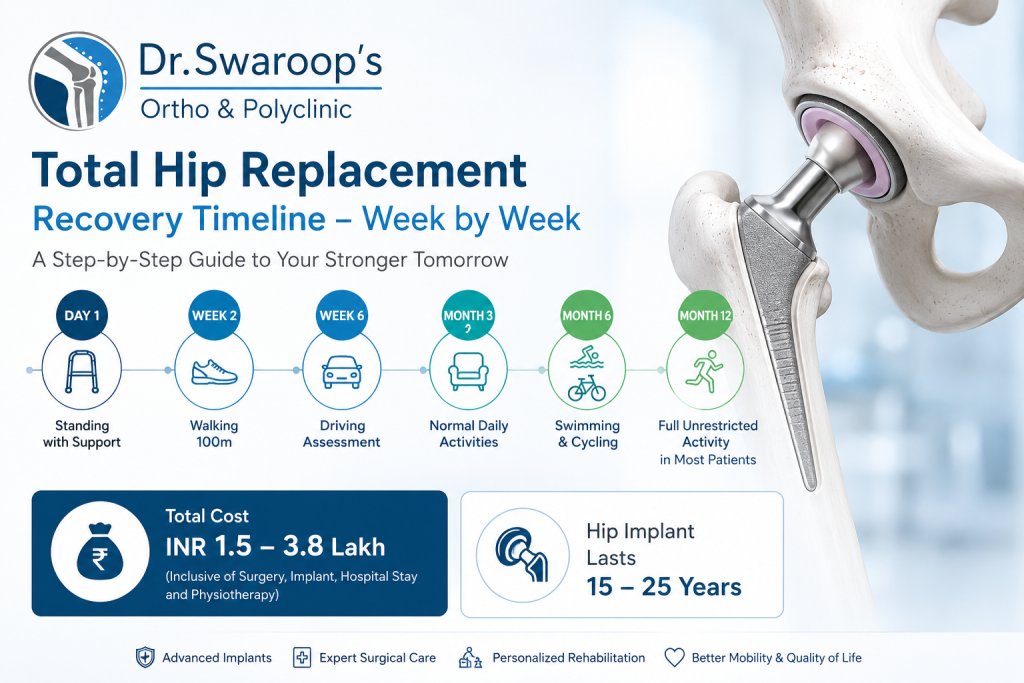
Total Hip Replacement: total hip replacement recovery time Pune
| Stage | Milestones | Physiotherapy Focus |
| Day 1 | Standing with support; walking 10–15m | Bed exercises, ankle pumps, standing balance |
| Day 2–3 | Walking to bathroom unassisted (frame) | Stair practice, hip ROM exercises |
| Day 3–5 | Discharge home | Home exercise programme given |
| Week 1–2 | Walking 100–200m; wound check at day 10 | Daily walking increase; avoid hip flexion > 90° |
| Week 3–4 | Driving assessment (auto); reduce frame | Gait training; muscle strengthening begins |
| Week 6 | Most daily activities resumed | Progression to walking without support |
| Month 3 | Review X-ray; return to desk work | Pool walking; cycling (stationary); aqua therapy |
| Month 4–6 | Swimming, cycling outdoors permitted | Sport-specific conditioning |
| Month 12 | Full unrestricted activity in most patients | Annual review; X-ray check |
Post-Operative Care: Pain Management at Home
Pain after hip replacement is very manageable with a structured medication protocol. At discharge, patients receive a prescription for paracetamol (regular dosing for 2 to 3 weeks), a short course of NSAIDs, blood thinning medication (low-molecular-weight heparin injections or rivaroxaban tablets for 4 to 6 weeks to prevent DVT) and laxatives (constipation is a common side effect of post-op medications).
Don’t wait for pain to become severe before taking medication — regular scheduled dosing keeps pain controlled at a manageable level, which is essential for participating in physiotherapy.
Hip Precautions: The Rules That Protect Your New Hip
After posterior approach hip replacement, precautions prevent dislocation of the new joint during the first 6 to 12 weeks while the soft tissue repair heals. The key rules are: don’t bend the hip beyond 90 degrees (no deep chairs, no floor-level sitting), don’t cross your legs, don’t rotate the leg inward. Raised toilet seats, long-handled grabbers and shower chairs are practical aids that make these precautions manageable in a typical Pune home.
Raghunath, a 67-year-old retired teacher from Pimple Saudagar (name changed), was walking to his local temple — a 400-metre walk — by week 8 after his hip replacement at Dr. Salunkhe’s Baner clinic. His main regret was waiting 3 years with worsening hip pain before agreeing to surgery.
Physiotherapy: The Engine of Recovery
Physiotherapy after total hip replacement is not optional — it’s the primary driver of outcomes. Dr. Salunkhe’s team prescribes a specific programme that progresses through three phases:
Phase 1 (Weeks 1 to 4): Pain and swelling management. Gentle hip range of motion. Bed exercises — gluteal sets, quadriceps sets, ankle pumps. Walking progression.
Phase 2 (Weeks 4 to 12): Strengthening. Standing hip abduction, extension exercises. Stationary cycling from week 6 (if comfortable). Balance and proprioception training.
Phase 3 (Months 3 to 12): Functional training. Stair climbing confidence. Return to sport activities. Pool walking from month 3.
When Should You Call the Clinic? Red Flags After Hip Replacement
Call Dr. Salunkhe’s emergency line or go to the hospital if you experience: sudden severe pain in the hip with a ‘clunk’ (possible dislocation), leg swelling and calf tenderness (possible DVT — blood clot), wound redness, warmth or discharge (possible infection), high fever (above 38.5°C) more than 48 hours after surgery, or numbness or weakness in the leg below the operation site.
Surgical Risks of Total Hip Replacement
Total Hip Replacement: Surgical Risks
| Risk | Rate (Approximate) | Management |
| Dislocation | 0.5–2% | Hip precautions for 6–12 weeks |
| DVT (blood clot) | 1–3% with prophylaxis | Anticoagulants + early mobilisation |
| Infection (deep) | 0.5–1% | Antibiotic prophylaxis; sterile technique |
| Leg length discrepancy | <1% significant | Templating + intraoperative check |
| Implant loosening (long-term) | ~5% at 15 years | Annual review; revision if symptomatic |
| Nerve injury | <1% | Careful surgical approach |
Cost and Insurance for Hip Replacement in Pune
Total hip replacement costs in Pune range from INR 1.5 lakh to 3.8 lakh. The implant itself accounts for INR 50,000 to 1.5 lakh depending on whether you choose an Indian, imported uncemented or ceramic-on-ceramic construct. Hospital charges cover theatre, anaesthesia and nursing. Dr. Salunkhe’s surgical fee adds to the total.
Ayushman Bharat Pradhan Mantri Jan Arogya Yojana covers total hip replacement surgery under its package for eligible beneficiaries. Most major TPA (Third Party Administrator) providers offer cashless hospitalisation at Dr. Salunkhe’s associated hospital facilities. CGHS covers hip replacement for eligible Central Government employees at empanelled facilities.
Baner Pune: Local Context for Hip Replacement Patients
Many hip replacement patients at Dr. Salunkhe’s Baner clinic come from Wakad, Kothrud, Aundh and Pimple Saudagar. The Baner location offers convenient access from the Pune-Mumbai Expressway via the Baner flyover. Home physiotherapy services can be arranged for patients from these areas who find travel difficult in the early post-operative weeks.
Pune’s flat terrain in areas like Balewadi Sports Complex and Aga Khan Palace grounds provides excellent walking surfaces for the progressive walking programme. The city’s general accessibility to parks and promenades — unlike the steep inclines of some hill-station areas — is genuinely helpful for hip replacement recovery walks.
Frequently Asked Questions
Q: How long does total hip replacement recovery take in Pune?
Most patients resume normal daily activities — walking, cooking, light household tasks — within 6 to 12 weeks. Return to desk work takes 4 to 6 weeks. Return to driving is typically at 6 to 8 weeks. Full unrestricted activity, including low-impact sports, is usually permitted by 4 to 6 months.
Q: What is the cost of total hip replacement in Pune?
Total hip replacement in Pune costs INR 1.5 lakh to 3.8 lakh depending on implant choice and hospital. Ayushman Bharat covers the procedure for eligible patients. Most private health insurance plans include joint replacement surgery in their inpatient coverage.
Q: When can I sleep normally after hip replacement surgery?
Sleeping on your back with a pillow between the knees is recommended for the first 6 weeks. Side-lying on the operated side is generally allowed from week 6 to 8 if comfortable. Sleeping on the non-operated side (with a pillow between the knees) is permitted earlier, usually from week 2 to 3.
Q: Can I sit on the floor after hip replacement?
Not for the first 3 to 6 months after surgery. Floor-level sitting requires hip flexion beyond 90 degrees which risks dislocation in the posterior approach. After 6 months, as soft tissues heal, this restriction is typically relaxed at Dr. Salunkhe’s 6-month review appointment.
Q: How long does a hip implant last?
Modern hip implants last 15 to 25 years in most patients, with 95% of implants functioning well at 10 years (Industry estimate). Ceramic-on-ceramic and highly cross-linked polyethylene bearings are used to maximise implant longevity in younger, active patients.
Q: Does Ayushman Bharat cover total hip replacement in Pune?
Yes. Total hip replacement is included in the Ayushman Bharat Pradhan Mantri Jan Arogya Yojana package for eligible beneficiaries. Carry your Ayushman Bharat card to the pre-admission appointment to confirm empanelment and initiate the cashless admission process.
Conclusion
Total hip replacement recovery time in Pune is not the prolonged, difficult experience many patients fear. With Dr. Swaroop Salunkhe’s enhanced recovery protocol — physiotherapy from day 1, structured milestones and clear communication — most patients are walking independently within 6 weeks and back to full daily life within 3 months.
If you’ve been living with hip pain — whether from osteoarthritis, avascular necrosis or previous injury — don’t let fear of recovery hold you back. Book a consultation with Dr. Swaroop Salunkhe at orthopedicclinicinpcm. His 16 years of orthopaedic experience, including international fellowship training, means you’re in expert hands from the first appointment to the 12-month review.

Dr. Swaroop Solunke
- Fellowship in Arthroplasty (Germany)- Bruderkrankenhaus St. Josef Paderborn, Germany.
- Fellowship in Primary and Revision Hip Replacement – Dr. Luigi Zagra IRCCS Instituto Orthopedia Galeazzi, Milan, Italy.
- Fellowship in Arthroplasty (Germany)- Bruderkrankenhaus St. Josef Paderborn, Germany.
- Fellowship in Robotic Knee Replacement – The Stone Research Foundation, San Francisco, California, USA.
- MS - Orthopaedics (Gold Medalist) – MGM Medical College and Hospital.
- MBBS – Dr. DY Patil University, Navi Mumbai.
- Member of Indian Medical Association (IMA)