
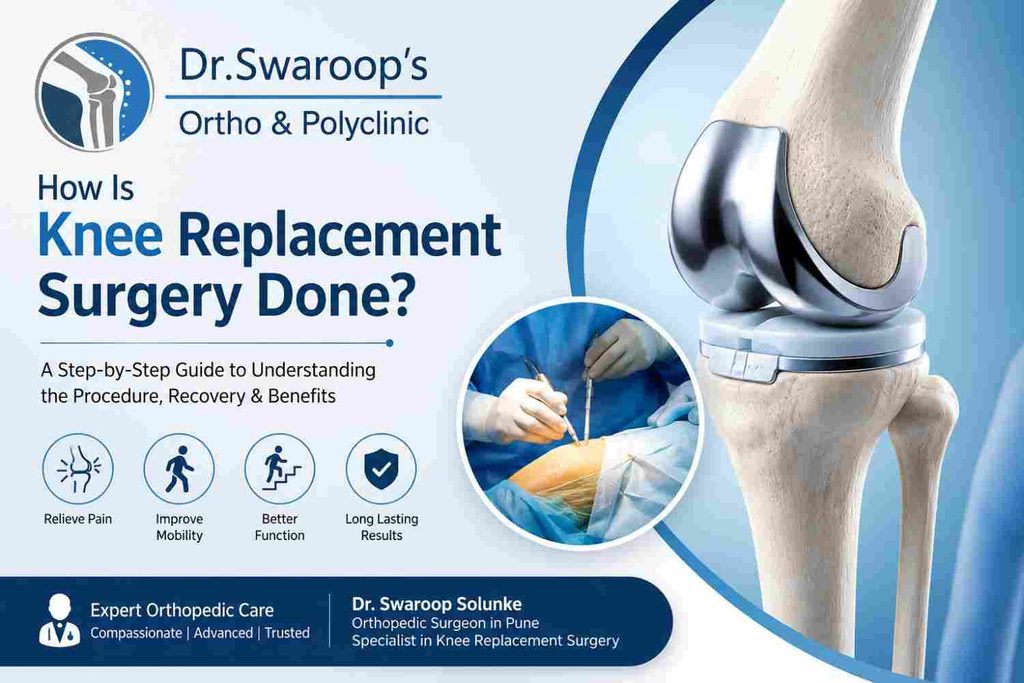
Knee replacement surgery is a procedure used to replace damaged surfaces of the knee joint with artificial components to reduce pain and improve movement. If you are searching for an orthopedic Doctor in Pune or considering treatment from a knee replacement surgeon in Pune, understanding what happens before, during and after surgery can make the decision much clearer. Dr Swaroop Solunke evaluates each patient’s knee condition, symptoms, imaging and overall health before determining whether knee replacement is appropriate.
Dr Swaroop Solunke Orthopedic Surgeon in Baner | Orthopedic Doctor in Baner
5.0•Orthopedic surgeon•OpenWebsite
•073854 86860
Knee replacement surgery is not simply about “replacing the whole knee.” In a total knee replacement, the damaged joint surfaces are carefully removed and resurfaced with artificial components designed to restore smoother movement. The exact technique, implant selection and rehabilitation plan depend on the patient’s individual condition.
What Is Knee Replacement Surgery?
Knee replacement surgery, also called knee arthroplasty, involves removing damaged portions of the knee joint and replacing the worn joint surfaces with artificial components.
The knee is formed mainly by the lower end of the thigh bone (femur), upper end of the shin bone (tibia) and kneecap (patella). Healthy cartilage allows these surfaces to move smoothly. Conditions such as advanced osteoarthritis can damage this cartilage, resulting in pain, stiffness and difficulty walking.
During a total knee replacement, the damaged surfaces of the femur and tibia are resurfaced with metal components, with a medical-grade plastic spacer placed between them. The underside of the kneecap may also be resurfaced depending on the individual case.
When Is Knee Replacement Recommended?
Knee replacement is generally considered when knee damage causes significant pain and interferes with everyday activities, particularly when non-surgical treatments are no longer providing adequate relief.
A person may experience:
- Persistent knee pain
- Difficulty walking
- Pain while climbing stairs
- Stiffness after sitting or resting
- Difficulty getting up from a chair
- Reduced knee movement
- Difficulty performing daily activities
- Knee deformity in advanced cases
However, having knee pain does not automatically mean that replacement surgery is required.
An orthopedic specialist first evaluates the severity of joint damage and considers treatments such as medication, physiotherapy, activity modification, weight management or other appropriate options. Knee replacement may be considered when symptoms remain significant despite appropriate non-surgical treatment.
How Is Knee Replacement Surgery Done?
Although the exact surgical approach can vary, a total knee replacement generally involves several important stages.
1. Pre-Surgery Evaluation
Before surgery, your orthopedic surgeon assesses your knee and overall health. This may include:
- Physical examination
- Assessment of knee movement and stability
- X-rays and other imaging when required
- Review of medical history
- Medication review
- Blood tests and other pre-operative investigations
- Anaesthesia assessment
The surgeon uses this information to understand the extent of joint damage and plan the procedure. For someone considering a knee replacement surgeon in Pune, this evaluation is an important part of the treatment process because the decision for surgery should be based on the individual’s symptoms, functional limitations, joint damage and general health—not simply an X-ray finding.
2. Anaesthesia Is Given
- On the day of surgery, the anaesthesia team determines the most appropriate type of anaesthesia.
- Depending on the patient and surgical plan, options can include general anaesthesia or regional/spinal anaesthesia. With general anaesthesia, the patient is asleep, while spinal or regional techniques numb the lower part of the body.
- The anaesthesia plan is discussed with the patient before surgery.
3. The Surgeon Accesses the Knee Joint
- Once anaesthesia has taken effect, the surgeon makes an incision over the knee to access the damaged joint.
- The surgical approach can vary depending on the patient’s anatomy, condition and the surgeon’s technique.
- The aim is to provide adequate access to the joint while allowing the surgeon to accurately prepare the damaged bone surfaces and position the implant.
4. Damaged Bone and Cartilage Are Removed
- This is one of the most important steps.
- The surgeon removes the damaged cartilage surfaces and a small amount of underlying bone from the affected areas of the femur and tibia.
- The goal is not to remove the entire bones. Instead, the damaged joint surfaces are carefully prepared so that the artificial components can accurately replace the worn surfaces.
5. The Femoral Component Is Positioned
- The damaged surface at the lower end of the femur is prepared to receive the femoral implant.
- A metal component is then positioned to recreate the smooth surface of the lower thigh bone.
- Accurate positioning and alignment are important because the implant needs to work with the other components of the replacement knee.
6. The Tibial Component Is Positioned
- The upper surface of the tibia is prepared in a similar way.
- A metal tibial component is positioned on the prepared bone surface.
- The surgeon carefully checks the alignment and stability of the components to help create a functional knee joint.
7. A Plastic Spacer Is Inserted
- A medical-grade plastic component called a polyethylene spacer is placed between the metal femoral and tibial components.
- This spacer provides a smooth gliding surface between the components and helps the artificial knee move during bending and straightening.
8. The Kneecap May Be Resurfaced
- Depending on the patient’s condition and the surgeon’s assessment, the underside of the patella may also be resurfaced.
- A plastic component can be placed on the prepared underside of the kneecap.
- Not every patient necessarily requires patellar resurfacing. The decision depends on factors such as the condition of the patellofemoral joint and the surgical plan.
9. Alignment and Knee Movement Are Checked
- Once the components are positioned, the surgeon checks the knee’s alignment, stability and range of movement.
- The goal is to ensure that the components work together properly and that the knee can bend and straighten appropriately.
- This is an important part of the procedure because implant positioning and overall balance can influence the function of the replacement knee.
10. The Incision Is Closed
- After the surgeon is satisfied with the implant positioning and knee function, the surgical incision is closed using appropriate closure techniques and covered with a dressing.
- The patient is then moved to the recovery area, where the medical team monitors recovery from anaesthesia and manages pain.
How Long Does Knee Replacement Surgery Take?
A knee replacement procedure commonly takes around 1 to 2 hours, although the actual duration can vary depending on factors such as the complexity of the case, the type of replacement and the patient’s individual anatomy. The overall hospital experience takes longer because it also includes preparation before surgery, anaesthesia, recovery and post-operative monitoring.
Total Knee Replacement vs Partial Knee Replacement
Not every patient needs the entire knee joint replaced.
Total Knee Replacement
- In a total knee replacement, the damaged surfaces of the femur and tibia are replaced with artificial components. The patella may also be resurfaced depending on the case.
- It is commonly considered when arthritis or other joint damage affects multiple compartments of the knee.
Partial Knee Replacement
- A partial knee replacement in pune may be appropriate when damage is limited to a specific compartment of the knee.
- Only the damaged portion is replaced, allowing more of the patient’s natural knee structures to remain.
- Whether total or partial replacement is appropriate depends on the location and extent of damage, ligament condition, knee alignment, symptoms and other clinical factors.
What Happens Immediately After Knee Replacement Surgery?
After surgery, the patient is monitored in a recovery area. Pain management is an important part of early recovery. Depending on the patient’s condition and hospital protocol, physiotherapy and assisted walking may begin relatively soon after surgery.
Patients may initially need:
- A walker or crutches
- Pain medication
- Physiotherapy
- Exercises to improve knee movement
- Support for daily activities
- Measures to reduce the risk of blood clots
Early movement and prescribed exercises are important components of rehabilitation.
What Is Recovery Like After Knee Replacement?
Recovery does not end when the surgery is completed. The rehabilitation period is an important part of achieving good function after knee replacement.
Physiotherapy generally focuses on:
- Restoring knee movement
- Strengthening the muscles around the knee
- Improving walking
- Reducing stiffness
- Gradually returning to daily activities
Recovery varies from person to person. Age, general health, muscle strength, pre-operative mobility and adherence to rehabilitation can all influence the recovery process.
The NHS notes that full recovery can take several months or longer, while recovery from partial knee replacement may be shorter than from total knee replacement.
Is Knee Replacement Surgery Painful?
- Some pain and discomfort after surgery are expected because the tissues need time to heal.
- However, pain management is an important part of modern knee replacement care. Doctors use appropriate medications and other measures to help control post-operative discomfort.
- As healing progresses, the pain associated with the original damaged joint is often significantly reduced, although recovery experiences vary between patients.
What Are the Risks of Knee Replacement Surgery?
Knee replacement is a commonly performed procedure, but like any major surgery, it carries potential risks. Possible complications include:
- Infection
- Blood clots
- Persistent pain or stiffness
- Difficulty with knee movement
- Implant-related problems
- Nerve or blood vessel injury
- Instability of the knee
- Problems requiring further treatment or surgery
The risk varies depending on factors such as age, general health and individual medical conditions. This is why a detailed pre-operative assessment and appropriate post-operative follow-up are important.
How Long Does a Knee Replacement Last?
- Modern knee replacement implants are designed to provide long-term function.
- The lifespan of an implant varies depending on factors such as implant type, activity level, body weight, age, bone quality and other individual circumstances. The NHS states that many knee replacements can last around 25 years, although individual results vary.
- Patients should therefore follow their surgeon’s advice regarding activity, rehabilitation and long-term joint care.
How Can You Prepare for Knee Replacement Surgery?
Preparing your body and home before surgery can make the early recovery period easier. Your surgeon may recommend:
- Maintaining a healthy weight where appropriate
- Strengthening the leg muscles before surgery
- Managing existing medical conditions
- Reviewing medications
- Stopping smoking if applicable
- Arranging assistance at home
- Preparing a safe walking environment
- Understanding the physiotherapy plan
Your healthcare team will provide instructions specific to your situation.
When Should You Consult an Orthopedic Surgeon?
If knee pain is affecting your ability to walk, climb stairs, sleep comfortably or perform everyday activities, it may be time to seek an orthopedic evaluation.
- You do not necessarily need knee replacement simply because you have arthritis. An orthopedic surgeon can assess your symptoms, physical examination findings and imaging to determine whether conservative treatment or surgery is appropriate.
- If you are looking for an orthopedic surgeon in Pune, an evaluation can help you understand the cause of your knee pain and the treatment options available.
- For patients considering knee replacement, Dr Swaroop Solunke provides orthopedic consultation and evaluates knee conditions to determine an appropriate treatment approach based on the individual patient’s needs.
Why Choosing the Right Knee Replacement Surgeon Matters
Knee replacement involves more than selecting an implant. Proper patient selection, surgical planning, accurate implant positioning, management of the surrounding soft tissues and structured rehabilitation all contribute to the overall treatment process.
When searching for a knee replacement surgeon in Pune, patients can discuss important questions such as:
- Is knee replacement appropriate for my condition?
- Would total or partial replacement be considered?
- What type of implant is suitable for me?
- What type of anaesthesia will be used?
- How long could my recovery take?
- What physiotherapy will I need?
- What precautions will I need to follow after surgery?
- What risks are relevant to my health condition?
Having these discussions helps patients make an informed decision together with their orthopedic team.
Frequently Asked Questions
1. How is knee replacement surgery done?
The surgeon removes damaged cartilage and bone from the affected joint surfaces, prepares the femur and tibia, positions artificial components, places a plastic spacer between them and checks alignment and movement before closing the incision.
2. Is the entire knee replaced during total knee replacement?
No. Total knee replacement primarily involves resurfacing the damaged joint surfaces of the femur and tibia. The kneecap may also be resurfaced depending on the individual case.
3. How long does knee replacement surgery take?
The surgical procedure commonly takes approximately 1 to 2 hours, although the duration varies depending on the individual case.
4. When can I walk after knee replacement?
Many patients are encouraged to begin standing and walking with assistance relatively soon after surgery, depending on their medical condition and the surgeon’s rehabilitation protocol.
5. How long does recovery take after knee replacement?
Recovery varies between individuals. Many people improve progressively over several weeks, but full recovery can take several months or longer.
6. Is knee replacement the only treatment for severe knee pain?
No. Depending on the diagnosis and severity, treatment may include physiotherapy, medication, lifestyle changes, injections or other options. Knee replacement is considered when appropriate non-surgical measures do not adequately control symptoms and joint damage is significant.
Important Points
- Understanding how knee replacement surgery is done can help remove much of the uncertainty surrounding the procedure. In a total knee replacement, the damaged joint surfaces are carefully prepared and replaced with artificial components designed to restore smoother movement and reduce pain.
- However, knee replacement is not automatically the right treatment for every person with knee pain. A thorough orthopedic assessment is essential to determine the cause of symptoms, severity of joint damage and most appropriate treatment.
- If persistent knee pain is affecting your mobility or daily life, consulting an experienced orthopedic surgeon in Pune can help you understand your treatment options. Patients considering knee replacement can discuss their condition and surgical suitability with Dr Swaroop Solunke, a knee and orthopedic specialist in Pune.

Dr. Swaroop Solunke
- Fellowship in Arthroplasty (Germany)- Bruderkrankenhaus St. Josef Paderborn, Germany.
- Fellowship in Primary and Revision Hip Replacement – Dr. Luigi Zagra IRCCS Instituto Orthopedia Galeazzi, Milan, Italy.
- Fellowship in Arthroplasty (Germany)- Bruderkrankenhaus St. Josef Paderborn, Germany.
- Fellowship in Robotic Knee Replacement – The Stone Research Foundation, San Francisco, California, USA.
- MS - Orthopaedics (Gold Medalist) – MGM Medical College and Hospital.
- MBBS – Dr. DY Patil University, Navi Mumbai.
- Member of Indian Medical Association (IMA)