Key Takeaways
- A slip disc (disc herniation) involves the inner gel of a spinal disc pressing on a nerve, causing radiating pain down the leg.
- A muscle pull stays local — sharp pain at a specific back muscle that worsens with movement and improves with rest.
- Lower back pain affects approximately 50 crore Indians and is the leading cause of disability globally (WHO 2023).
- The key differentiator is radiating pain: if pain goes below the knee into the leg or foot, a disc problem is likely.
- 90% of muscle pulls resolve in 4 to 6 weeks with rest and physiotherapy. Slip disc symptoms may persist for months without appropriate treatment.
- Red flags — leg weakness, bladder or bowel issues — require same-day emergency evaluation.
- MRI of the lumbar spine costs INR 4,000 to 8,000 in Pune and is the gold standard for diagnosing slip disc.
Slip disc vs. muscle pull symptoms in Pune — this is one of the most common questions patients ask when they wake up with back pain after lifting something heavy or sleeping in an odd position. The two conditions feel quite different once you know what to look for, but the confusion is understandable because both cause significant lower back pain.
This guide, reviewed by Dr. Swaroop Salunkhe, MBBS, MS (Orthopaedics), Baner Pune, walks you through the specific features of each condition, a simple self-assessment framework, and the red flags that mean you need to stop Googling and book an appointment today.
Quick Facts
| Slip disc (disc herniation) | Inner disc material presses on spinal nerve root |
| Muscle pull (strain) | Muscle fibres or ligaments stretched or torn |
| Most common level | L4–L5 and L5–S1 for disc herniation |
| MRI cost, Pune | INR 4,000 to 8,000 (Industry estimate) |
| Physiotherapy cost, Pune | INR 600 to 1,500 per session |
| Ayushman Bharat coverage | Spinal decompression surgery covered for eligible patients |
Pune Back Pain & Spinal Conditions Statistics 2025–2026
| Metric | Data Point | Source |
| Adults with lower back pain, India | Approx 50 crore individuals affected | WHO 2023 |
| Disc herniation in back pain patients | ~10–25% of LBP cases | PubMed meta-analysis |
| Recovery without surgery (disc) | ~90% improve with conservative care | ICMR data |
| Annual spinal surgeries, Pune | ~3,500 procedures (all types) | Industry estimate |
| MRI lumbar spine cost, Pune | INR 4,000 to 8,000 | Industry estimate |
| Physiotherapy course for back pain | 8 to 16 sessions, INR 600–1,500 each | Industry estimate |
What Is a Slip Disc? The Medical Reality
The spine has 24 vertebrae separated by intervertebral discs — cushions made of a tough outer ring (annulus fibrosus) and a gel-like centre (nucleus pulposus). A ‘slip disc’ (technically a disc herniation or prolapse) happens when the outer ring develops a tear and the inner gel bulges or leaks out, pressing against a nearby spinal nerve.
This pressure on the nerve is what causes the characteristic shooting pain, tingling or numbness that travels from the back down the buttock, thigh and sometimes all the way to the foot. This nerve pain pattern is called sciatica when it affects the sciatic nerve, which is the most commonly involved nerve in lumbar disc herniation.
The condition is most common at the L4–L5 and L5–S1 levels of the lumbar spine — the lower back region that bears the most mechanical load during lifting, twisting and sitting.
What Is a Muscle Pull? How It’s Different
A muscle pull (muscle strain or ligament sprain) is an injury to the soft tissues surrounding the spine — the back muscles, ligaments and fascia. It happens when these structures are overstretched or partially torn, usually during a sudden movement, heavy lifting or an awkward twist.
The key feature: the pain stays local. It doesn’t radiate down the leg. There’s a specific tender spot you can press on in the muscle. Movement makes it worse but pure rest makes it better. Anti-inflammatory medication, rest and gentle movement resolve most muscle pulls within 4 to 6 weeks.
Slip Disc vs. Muscle Pull: Side-by-Side Comparison
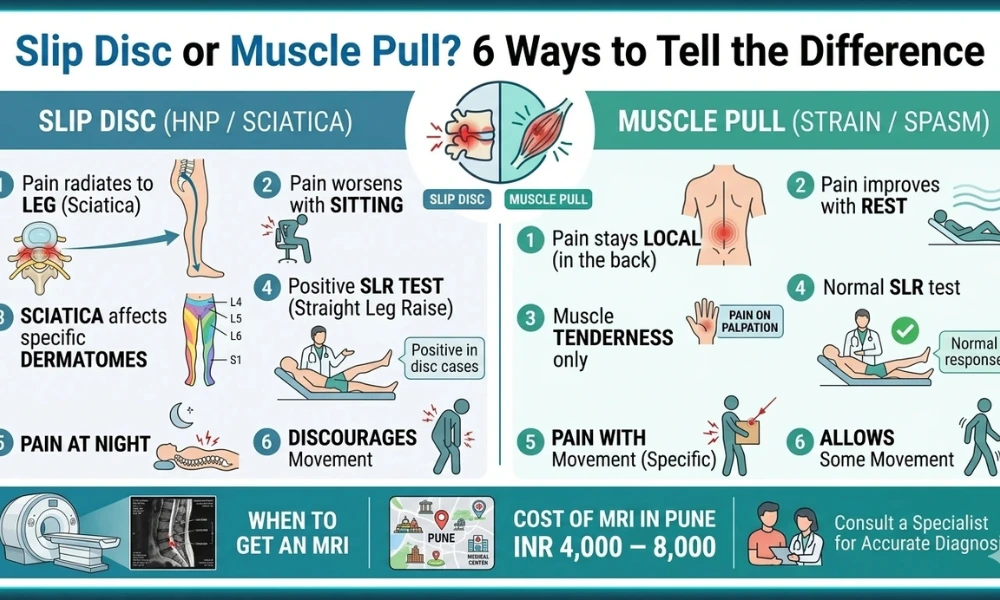
| Feature | Slip Disc | Muscle Pull |
| Pain location | Back + radiating down leg/foot | Local to back, doesn’t radiate |
| Onset | Often gradual or after lifting | Usually sudden during activity |
| Pain with sitting | Worse (increases disc pressure) | Variable; may ease with rest |
| Pain at rest / night | Often present and disturbing sleep | Eases with rest |
| Leg numbness / tingling | Common (nerve involvement) | Not present |
| Muscle tenderness | May have some, less focal | Focal tenderness on muscle |
| Straight leg raise test | Usually positive (>30°–70°) | Usually negative |
| Recovery time | Weeks to months | 4 to 6 weeks typically |
| Investigation needed | MRI lumbar spine | Clinical exam; X-ray if needed |
The Self-Assessment Guide: Which Do You Have?
This is not a substitute for clinical examination — but it can help you frame your symptoms before your appointment. Ask yourself these questions:
Does your pain go below your knee? If yes — likely a disc issue with nerve involvement. See an orthopaedic specialist.
Does sitting for more than 20 minutes make it significantly worse? Seated posture increases intradiscal pressure by approximately 40% compared to standing (PubMed). If sitting is your worst position, disc herniation is the more likely cause.
Can you find a specific painful spot on the muscle by pressing it? If there’s a focal trigger point that reproduces your pain when pressed, that’s more consistent with a muscle strain or ligament sprain.
Do you have any tingling, numbness or weakness in the leg or foot? These are neurological symptoms. They mean a nerve is involved and you need professional evaluation — not just rest.
Red Flags: Go to A&E Today, Don’t Wait
Most back pain is not an emergency. But these symptoms are. Go to an emergency orthopaedic consultation the same day if you have: sudden inability to pass urine or control bowel movements (this is cauda equina syndrome — a surgical emergency), rapidly progressive leg weakness, pain following a fall or road accident, or fever with back pain (possible spinal infection).
Treatment Options: Conservative vs. Surgical
For Muscle Pull
Rest for 48 to 72 hours, followed by gentle activity. Ice for the first 24 to 48 hours (15 minutes on, 15 off). NSAIDs like ibuprofen for 5 to 7 days under medical advice. A physiotherapy course of 8 to 12 sessions for core strengthening and postural correction. Most patients are back to normal function within 4 to 6 weeks.
For Slip Disc
The good news: 90% of lumbar disc herniations improve without surgery. The treatment ladder includes 6 to 12 weeks of physiotherapy (specific McKenzie exercises, core stability and neural mobilisation), NSAIDs and muscle relaxants under prescription, epidural steroid injections for severe nerve pain that doesn’t respond to physiotherapy, and surgery (microdiscectomy) reserved for neurological deficit, cauda equina syndrome or failure of 3 to 6 months of conservative treatment.
When to See Dr. Salunkhe in Baner, Pune
Book an appointment at Dr. Swaroop Salunkhe’s clinic if your back pain has lasted more than 2 weeks without improvement, if you have leg pain, numbness or weakness (even mild), if a previous episode of back pain is worsening, or if you’ve already had physiotherapy with no result and want a second opinion.
Patients from Wakad, Hinjewadi, Pimple Saudagar and Kothrud regularly visit Dr. Salunkhe’s Baner clinic for exactly this evaluation — an MRI review, clinical neurological examination and a clear, jargon-free treatment plan. Arvind, a 38-year-old IT professional from Hinjewadi (name changed), waited three months dismissing his leg pain as ‘gym soreness’ before his MRI confirmed a large L5–S1 disc herniation. Six weeks of physiotherapy and one epidural injection resolved his symptoms. Earlier evaluation would have shortened his suffering significantly.
Frequently Asked Questions
Q: How do I know if my back pain is a slip disc or just a pulled muscle in Pune?
A: The most reliable indicator is radiating pain. If the pain travels down your buttock, thigh or below the knee, it strongly suggests a disc issue with nerve compression. Pure muscle pulls stay localised in the back. An MRI is the definitive test for disc herniation.
Q: Can a slip disc heal on its own without surgery?
A: Yes. Approximately 90% of lumbar disc herniations improve with conservative management — physiotherapy, pain medication and time. Surgery is reserved for neurological deficits, cauda equina syndrome and cases that don’t improve after 3 to 6 months of appropriate conservative care.
Q: What is the cost of slip disc treatment in Pune?
Conservative management (physiotherapy + medication) typically costs INR 8,000 to 20,000 over 6 to 12 weeks. Epidural steroid injections add INR 6,000 to 12,000 per procedure. Microdiscectomy surgery ranges from INR 80,000 to 2.5 lakh depending on the facility (Industry estimate).
Q: Is it safe to exercise with a slip disc?
Specific exercises are not just safe — they’re the primary treatment. McKenzie extension exercises, core stabilisation and neural mobilisation have strong PubMed evidence for lumbar disc rehabilitation. The key is to do the right exercises with proper technique. A physiotherapist trained in spinal rehabilitation is essential.
Q: Does sitting at a desk all day cause slip disc?
Prolonged sitting doesn’t directly cause disc herniation, but it increases intradiscal pressure and weakens the surrounding musculature. Pune’s IT workers who sit for 8 to 10 hours daily without postural breaks have a higher risk of disc disease. Standing desks and hourly movement breaks significantly reduce this risk.
Conclusion
Understanding slip disc vs. muscle pull symptoms in Pune helps you make better decisions about your own back pain. Radiating leg pain means nerve involvement — don’t dismiss it. Local back soreness that improves with rest is usually muscular — treat it with physiotherapy and activity modification.
If you’re unsure, or if symptoms haven’t improved in two weeks, don’t guess. Book a clinical evaluation with Dr. Swaroop Salunkhe at orthopedicclinicinpcmc.com A 30-minute consultation with an MRI review gives you a definitive answer and a treatment plan — no more guessing, no more unnecessary worry.
Dr. Swaroop Solunke
- Fellowship in Arthroplasty (Germany)- Bruderkrankenhaus St. Josef Paderborn, Germany.
- Fellowship in Primary and Revision Hip Replacement – Dr. Luigi Zagra IRCCS Instituto Orthopedia Galeazzi, Milan, Italy.
- Fellowship in Arthroplasty (Germany)- Bruderkrankenhaus St. Josef Paderborn, Germany.
- Fellowship in Robotic Knee Replacement – The Stone Research Foundation, San Francisco, California, USA.
- MS - Orthopaedics (Gold Medalist) – MGM Medical College and Hospital.
- MBBS – Dr. DY Patil University, Navi Mumbai.
- Member of Indian Medical Association (IMA)