
Key Takeaways
- Carpal tunnel syndrome (CTS) is the most common peripheral nerve entrapment, affecting approximately 3 to 6% of the general adult population (PubMed).
- Women are 3 times more likely to develop CTS than men; it’s extremely common among Pune’s IT workforce.
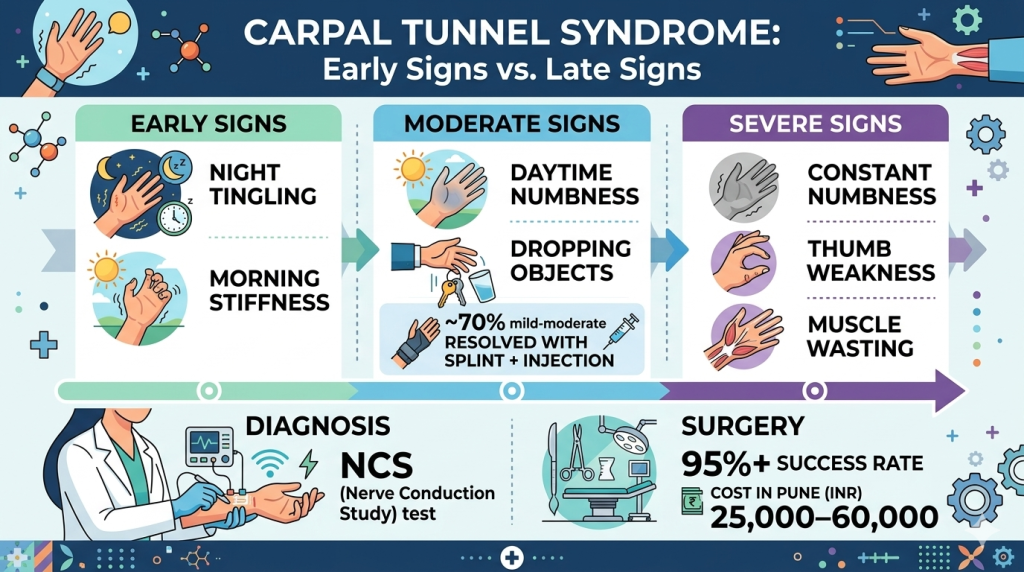
- Early signs: nighttime tingling and burning in the thumb, index and middle fingers that wakes you from sleep.
- Left untreated, CTS causes permanent nerve damage and thenar muscle wasting (thumb muscle loss) within 6 to 12 months.
- Non-surgical treatment (splints and corticosteroid injections) resolves approximately 70% of mild to moderate CTS cases.
- Carpal tunnel release surgery in Pune costs INR 25,000 to 60,000 and has a success rate above 95% (Industry estimate).
- Early diagnosis with a Nerve Conduction Study (NCS) is essential — don’t wait until grip weakness develops.
Carpal tunnel syndrome treatment in Baner Pune is something Dr. Swaroop Salunkhe’s clinic sees increasing demand for. It’s no coincidence — Pune’s booming IT sector, combined with extended typing, gaming and smartphone use, has made CTS significantly more prevalent in the 25 to 50 age group. What starts as occasional nighttime tingling can progress to permanent nerve damage if ignored.
This guide covers the early warning signs that patients most commonly dismiss, the full range of non-surgical and surgical treatment options, and what recovery looks like after carpal tunnel release surgery at Dr. Salunkhe’s Baner clinic.
Quick Facts
| Condition | Carpal tunnel syndrome (CTS) – median nerve compression |
| Most affected | Women 40–60; IT workers; diabetic patients |
| Key early symptom | Nighttime tingling/burning in thumb, index and middle fingers |
| Diagnostic test | Nerve Conduction Study (NCS) – INR 2,500 to 5,000 in Pune |
| Non-surgical success | ~70% mild-moderate cases resolve with splint + injection |
| Surgery cost, Pune | INR 25,000 to 60,000 (Industry estimate) |
Pune Carpal Tunnel Syndrome Statistics 2025–2026
| Metric | Data Point | Source |
| CTS global prevalence | 3–6% of adults | PubMed (Atroshi et al.) |
| Women vs. men risk | 3x more likely in women | PubMed |
| IT workers CTS incidence | Higher than average (Industry estimate) | Industry estimate |
| Nerve Conduction Study cost, Pune | INR 2,500 to 5,000 | Industry estimate |
| Carpal tunnel surgery cost, Pune | INR 25,000 to 60,000 | Industry estimate |
| Surgery success rate | >95% symptom relief | Industry estimate |
What Is Carpal Tunnel Syndrome? The Anatomy Explained
The carpal tunnel is a narrow passageway in the wrist formed by small wrist bones (carpals) on three sides and a tough band of tissue (flexor retinaculum) on the fourth. Nine tendons and the median nerve pass through this tunnel.
When the tunnel becomes crowded — due to tendon inflammation, fluid retention, wrist injury or repetitive strain — the median nerve gets compressed. This nerve supplies sensation to the thumb, index finger, middle finger and half of the ring finger. It also controls the thenar muscles at the base of the thumb that are responsible for grip and pinch strength.
Compression causes the classic symptoms: tingling, burning, numbness and, eventually, weakness. The symptoms are typically worse at night because lying flat increases blood volume in the wrist tissues, further compressing the already crowded tunnel.
Early Signs of Carpal Tunnel Syndrome You Shouldn’t Ignore
Nighttime Tingling
The earliest and most reliable sign. Patients describe being woken by a burning, tingling or ‘electric’ sensation in the thumb, index and middle fingers — usually between 2 and 5 am. Many shake their hand to relieve it, which temporarily helps.
Morning Hand Stiffness
Waking up with stiff, swollen-feeling fingers that take 15 to 30 minutes to loosen is characteristic of CTS. This is different from rheumatoid arthritis morning stiffness, which tends to affect all joints.
Dropping Objects
Patients start dropping cups, phones and car keys without warning. This reflects early weakness of the grip and pinch muscles controlled by the median nerve.
The Phalen’s Test — Do It Now
Flex both wrists fully and hold that position for 60 seconds (as if you’re trying to touch your forearms together with the backs of your hands). If you feel tingling, numbness or pain in the first three fingers within 60 seconds, this is a positive Phalen’s test — and you should book an appointment with Dr. Salunkhe for a formal evaluation and Nerve Conduction Study.
Who Is at Risk of Carpal Tunnel Syndrome in Pune?
Pune’s IT workforce is disproportionately affected. Extended keyboard and mouse use, combined with poor wrist posture (bent wrists while typing), increases median nerve pressure. Women are three times more likely than men to develop CTS — hormonal changes during pregnancy and menopause increase fluid retention in the carpal tunnel.
Diabetic patients have a higher risk due to diabetic peripheral neuropathy, which makes nerves more vulnerable to compression. Hypothyroid patients, pregnant women and those with rheumatoid arthritis also carry elevated risk.
Meena, a 34-year-old software developer from Wakad (name changed), dismissed her nighttime hand tingling for 8 months, assuming it was ‘phone overuse.’ By the time she visited Dr. Salunkhe’s Baner clinic, her NCS showed moderate to severe CTS with early thenar wasting. A timely corticosteroid injection and night splinting resolved her symptoms within 6 weeks — but the delay cost her months of lost productivity and sleep.
CTS Severity Grading and Treatment
| Grade | Symptoms | Treatment |
| Mild | Intermittent nighttime tingling only | Night splint 6–8 weeks |
| Moderate | Daytime tingling + grip weakness | Splint + corticosteroid injection |
| Severe | Constant numbness + thenar wasting | Surgical carpal tunnel release |
| After failed conservative Rx | Persistent despite splint + 2 injections | Surgery recommended |
Non-Surgical Treatment Options in Baner
Wrist Night Splint
A neutral-position wrist splint worn during sleep keeps the wrist straight, reducing median nerve pressure overnight. Most patients notice significant symptom reduction within 3 to 6 weeks. Splints are available at pharmacies in Baner, Wakad and Aundh for INR 400 to 1,200.
Corticosteroid Injection
A small injection of corticosteroid (e.g., methylprednisolone) directly into the carpal tunnel reduces local inflammation and swelling around the median nerve. It works within 24 to 72 hours and provides relief for 3 to 12 months. Most patients can have 1 to 2 injections in a year. Cost at orthopaedic clinics in Baner: approximately INR 1,500 to 4,000 per injection (Industry estimate).
Physiotherapy and Nerve Gliding Exercises
Nerve gliding exercises mobilise the median nerve within the tunnel, reducing adhesions. Tendon gliding exercises maintain tendon health. These are taught in 1 to 2 sessions and performed daily at home.
Surgical Treatment: Carpal Tunnel Release in Baner, Pune
When non-surgical treatment fails after 3 to 6 months, when NCS shows severe nerve compression or when there’s thenar muscle wasting, surgical release is indicated. Dr. Salunkhe performs carpal tunnel release as a day-care procedure under local or regional anaesthesia.
The procedure involves dividing the flexor retinaculum — the band of tissue forming the roof of the carpal tunnel — through a 2 to 3 cm incision at the wrist. This immediately decompresses the median nerve. Open release and endoscopic (minimally invasive) release are both available, with endoscopic offering a smaller scar and slightly faster return to work.
Surgery takes 20 to 30 minutes per hand. Patients go home the same day. The wound heals in 10 to 14 days. Tingling begins to resolve within days to weeks; grip strength returns over 2 to 3 months. Success rates exceed 95% for appropriate candidates.
Frequently Asked Questions
Q: What are the early signs of carpal tunnel syndrome?
The earliest sign is nighttime tingling, burning or numbness in the thumb, index finger and middle finger — often waking you between 2 and 5 am. Morning hand stiffness and occasional dropping of objects are also early indicators. A positive Phalen’s test (tingling within 60 seconds of wrist flexion) at home is a useful self-check.
Q: What is the cost of carpal tunnel syndrome treatment in Baner Pune?
Wrist splint: INR 400 to 1,200. Corticosteroid injection: INR 1,500 to 4,000. Nerve Conduction Study: INR 2,500 to 5,000. Carpal tunnel release surgery: INR 25,000 to 60,000 (all Industry estimate). Most health insurance plans cover the surgery.
Q: Can carpal tunnel syndrome cause permanent damage?
Yes. If left untreated for 6 to 12 months with severe compression, permanent nerve damage and thenar muscle wasting can occur. This is why early diagnosis and treatment are critical — don’t wait for grip weakness before seeking evaluation.
Q: Is carpal tunnel syndrome related to typing too much?
Repetitive keyboard and mouse use is a contributing factor, especially with poor wrist posture (bent wrists). However, CTS has many causes including hormonal changes, diabetes and anatomical variation. Ergonomic keyboard setups and regular stretch breaks reduce, but don’t eliminate, risk in desk workers.
Q: How long is recovery after carpal tunnel surgery in Pune?
The wound heals in 10 to 14 days. Tingling resolves within days to weeks after surgery. Grip strength returns fully over 2 to 3 months. Most patients return to desk work within 2 to 3 weeks and to manual work within 6 to 8 weeks.
Conclusion
Carpal tunnel syndrome treatment in Baner Pune is most effective when started early — before nerve damage becomes permanent and before thenar wasting sets in. Nighttime tingling is your body’s first warning. Don’t dismiss it as ‘phone overuse’ or ‘sleeping on your arm.’
Dr. Swaroop Salunkhe’s clinic in Baner offers NCS evaluation, corticosteroid injections and surgical release — all under one roof.
Book your consultation at orthopedicclinicinpcmc Your grip, your sleep and your work performance depend on your wrist nerves staying healthy.

Dr. Swaroop Solunke
- Fellowship in Arthroplasty (Germany)- Bruderkrankenhaus St. Josef Paderborn, Germany.
- Fellowship in Primary and Revision Hip Replacement – Dr. Luigi Zagra IRCCS Instituto Orthopedia Galeazzi, Milan, Italy.
- Fellowship in Arthroplasty (Germany)- Bruderkrankenhaus St. Josef Paderborn, Germany.
- Fellowship in Robotic Knee Replacement – The Stone Research Foundation, San Francisco, California, USA.
- MS - Orthopaedics (Gold Medalist) – MGM Medical College and Hospital.
- MBBS – Dr. DY Patil University, Navi Mumbai.
- Member of Indian Medical Association (IMA)