
Key Takeaways
- Frozen shoulder (adhesive capsulitis) causes pain and stiffness lasting 1 to 3 years if untreated.
- Approximately 2 to 5% of the global population develops frozen shoulder, with women aged 40–60 at highest risk (PubMed).
- The condition has 3 stages: freezing (pain-dominant), frozen (stiffness-dominant) and thawing (recovery).
- 7 specific home exercises can improve shoulder range of motion by 20 to 40% over 6 to 8 weeks (Industry estimate).
- Frozen shoulder home treatment exercises Pune can be started immediately but should be combined with professional evaluation.
- Steroid injections and physiotherapy resolve approximately 70% of cases without surgery.
- Arthroscopic capsular release is reserved for Stage 2–3 cases that don’t respond after 12 to 18 months.
Frozen shoulder home treatment exercises Pune are the first line of management for this painful and restrictive condition. Frozen shoulder, also called adhesive capsulitis, develops when the capsule surrounding the shoulder joint thickens and tightens. Reaching for a shelf, fastening a bra strap or even combing hair can become agonising.
Dr. Swaroop Salunkhe, MBBS, MS (Orthopaedics), Baner Pune, outlines in this guide the seven exercises most supported by evidence for home management. These exercises are safe to begin at the appropriate stage — but you should always get a clinical diagnosis first to confirm it’s genuinely frozen shoulder and not a rotator cuff tear or other condition that needs different treatment.
Quick Facts
| Condition | Frozen shoulder (adhesive capsulitis) |
| Who is most affected | Women aged 40–60; diabetic patients at 3x higher risk |
| Duration without treatment | 1 to 3 years |
| First-line treatment | Physiotherapy + home exercises + anti-inflammatory medication |
| Physiotherapy cost, Pune | INR 600 to 1,500 per session (Industry estimate) |
| Surgery needed | Approximately 10–15% of cases requiring arthroscopic release |
Pune Frozen Shoulder & Shoulder Pain Statistics 2025–2026
| Metric | Data Point | Source |
| Global frozen shoulder prevalence | 2–5% of general population | PubMed (Zuckerman & Rokito, 2011) |
| Diabetic patients risk | 3x higher than general population | Indian Journal of Medical Research |
| Resolution with physiotherapy alone | ~60–70% of cases | PubMed systematic review |
| Average recovery time (conservative) | 12 to 18 months | Industry estimate |
| Physiotherapy session cost, Pune | INR 600 to 1,500 | Industry estimate |
| Arthroscopic release cost, Pune | INR 50,000 to 1.1 lakh | Industry estimate |
Understanding the 3 Stages of Frozen Shoulder
Stage 1: Freezing (2 to 9 Months)
Pain is the dominant symptom. The shoulder hurts at rest and significantly worsens at night, often disrupting sleep. Range of motion is only mildly restricted at this stage. This is when anti-inflammatory medication and gentle pain-free exercises are most appropriate.
Stage 2: Frozen (4 to 12 Months)
Pain may plateau or slightly ease but stiffness worsens. Internal rotation (reaching behind the back) and abduction (raising the arm sideways) are significantly limited. This is the stage where most patients visit Dr. Salunkhe’s clinic and where structured physiotherapy produces the best results.
Stage 3: Thawing (5 to 24 Months)
Range of motion gradually returns. Pain is minimal. Strengthening exercises become the focus. Most patients recover to near-full function, though a small percentage retain some permanent restriction.
The 7 Home Exercises for Frozen Shoulder: Step-by-Step
Exercise 1: Pendulum Swing
Stand and lean forward slightly with the unaffected arm resting on a table for support. Let the affected arm hang freely. Gently swing it in small circles — clockwise for 20 rotations, then anticlockwise for 20 rotations. Gravity provides gentle traction without active muscle effort. This is safe in Stage 1 and 2.
Exercise 2: Towel Stretch
Hold a towel or dupatta behind your back with both hands. Use the good arm to gently pull the affected arm upward. Hold for 15 seconds, release and repeat 10 to 15 times. This promotes internal rotation — typically the most restricted movement in frozen shoulder.
Exercise 3: Finger Walk Up the Wall
Stand facing a wall about 60 cm away. Using your fingers, walk the hand up the wall as high as comfortable without shrugging the shoulder. Mark how high you reach each session. Aim to go slightly higher each day. This is an excellent progression exercise for Stage 2 and 3.
Exercise 4: Cross-Body Reach
Sit or stand. Use the good arm to lift the affected arm by the elbow and pull it gently across the chest. Hold for 15 to 20 seconds. Feel the stretch at the back of the shoulder. Repeat 10 to 15 times. This addresses posterior capsule tightness which is common in frozen shoulder.
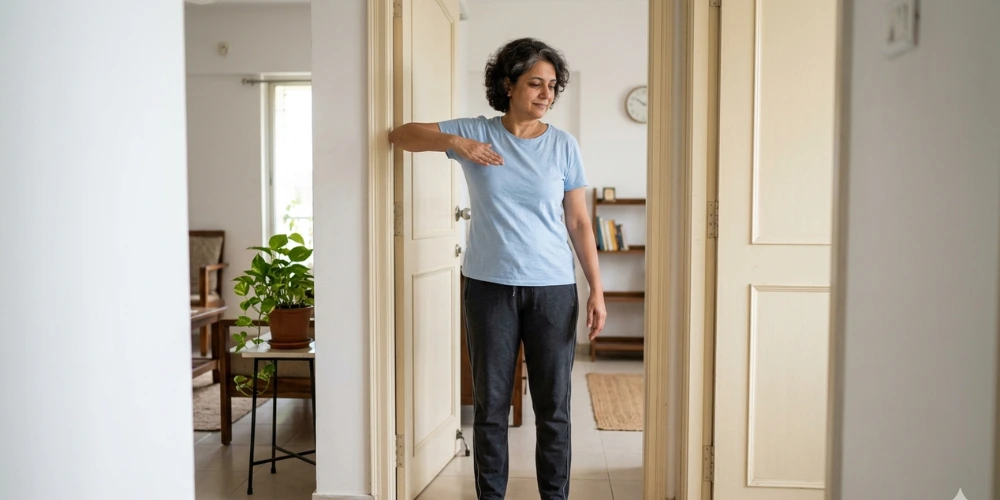
Exercise 5: Armpit Stretch
Stand facing a high shelf or door frame. Rest the affected hand on the surface at chest height. Bend your knees slightly, dipping the body. This gently opens the shoulder joint. Straighten back up. Repeat 10 to 15 times, gradually increasing the depth of the dip.
Exercise 6: Outward Rotation with a Stick
Hold a stick (a broomstick works well) with both hands, elbows bent at 90 degrees. Use the unaffected arm to push the stick sideways, rotating the affected arm outward. Hold at end-range for 15 seconds. This targets external rotation — often the last movement to return after frozen shoulder.
Exercise 7: Door Frame Stretch
Stand in a doorway and rest both forearms on the door frame at shoulder height. Step slightly through the doorway, feeling a gentle stretch across the front of both shoulders and the chest. Hold for 30 seconds. Repeat 3 to 5 times. This is excellent for the thawing stage when strengthening begins.
Important Safety Rules Before You Start
Never exercise through sharp, shooting, or severe pain (above 5 out of 10). Mild discomfort — a ‘2 to 3 out of 10’ pulling sensation — is acceptable. Always warm up the shoulder with a 10-minute warm-water shower or a heat pack before exercises. Don’t force end-range movement suddenly. Frozen shoulder responds to gradual, consistent effort — not aggressive stretching.
Priya, a 47-year-old schoolteacher from Aundh, started these exercises under Dr. Salunkhe’s guidance after being diagnosed with Stage 2 frozen shoulder. Within 8 weeks of daily practice, her overhead reach improved from 90 degrees to 140 degrees, and she was able to return to writing on the classroom board without pain.
Frozen Shoulder Treatment Options Comparison
| Treatment | Best Stage | Typical Duration | Cost in Pune (INR) |
| Home exercises (this guide) | Stage 1–3 | 6 to 18 months ongoing | Free |
| Supervised physiotherapy | Stage 1–3 | 8 to 20 sessions | 600–1,500/session |
| Corticosteroid injection | Stage 1 (pain phase) | 1 to 3 injections | 1,500–4,000/injection |
| Hydrodilatation | Stage 2 | 1 to 2 procedures | 8,000–20,000 |
| Arthroscopic capsular release | Stage 2–3 (refractory) | Single procedure | 50,000–1.1 lakh |
When to Stop Home Exercises and See Dr. Salunkhe in Baner
Home exercises have clear limits. Visit the clinic if: pain is waking you from sleep consistently for more than 2 weeks, you’ve been doing exercises for 6 weeks with no measurable improvement in range of motion, you develop numbness or tingling down the arm (which may suggest a different diagnosis), or you suspect a fall or injury may have caused a rotator cuff tear alongside the stiffness.
Frozen Shoulder in Pune’s Context: Baner and Nearby Areas
Frozen shoulder has a higher incidence in diabetic patients — and Pune has one of the highest urban diabetes rates in Maharashtra (Industry estimate). Residents of Baner, Wakad, Hinjewadi and Kothrud who have Type 2 diabetes should be particularly vigilant about shoulder stiffness, as their risk is three times higher than the general population.
Dr. Swaroop Salunkhe’s clinic in Baner diagnoses and manages frozen shoulder across all three stages. The clinic offers in-house physiotherapy, steroid injections and referral for hydrodilatation. Arthroscopic capsular release is available for refractory cases at the associated hospital facility.
Book Your Appointment Now
Frequently Asked Questions
Q: How long do frozen shoulder home treatment exercises in Pune take to show results?
Most patients notice measurable improvement in range of motion within 4 to 6 weeks of consistent daily exercise (15 to 20 minutes per day). Full recovery typically takes 6 to 18 months depending on the stage at presentation.
Can I do these exercises if I also have diabetes?
Yes, the exercises are safe for diabetic patients. However, diabetic patients should seek a clinical review first, as their healing response is slower and they may progress through stages faster. Blood sugar control also directly influences shoulder capsule inflammation.
Is frozen shoulder the same as a rotator cuff tear?
No. They are different conditions with different treatment paths. Frozen shoulder affects the joint capsule (inflammation and contracture), while a rotator cuff tear involves a tendon. They can coexist. An MRI scan is the definitive way to distinguish them.
What is the cost of physiotherapy for frozen shoulder in Baner Pune?
Supervised physiotherapy sessions at orthopaedic clinics in Baner cost approximately INR 600 to 1,500 per session (Industry estimate). A standard course is 8 to 20 sessions.
Does frozen shoulder ever require surgery?
Approximately 10 to 15% of patients who don’t respond to 12 to 18 months of conservative treatment benefit from arthroscopic capsular release — a minimally invasive procedure where the tight capsule is divided using a keyhole camera. Most patients achieve full range of motion within 3 to 6 months of this procedure.
What is the cost of physiotherapy for frozen shoulder home treatment exercises Pune Baner ?
A: Supervised physiotherapy sessions at orthopaedic clinics in Baner cost approximately INR 600 to 1,500 per session (Industry estimate). A standard course is 8 to 20 sessions.
Does frozen shoulder ever require surgery?
Approximately 10 to 15% of patients who don’t respond to 12 to 18 months of conservative treatment benefit from arthroscopic capsular release — a minimally invasive procedure where the tight capsule is divided using a keyhole camera. Most patients achieve full range of motion within 3 to 6 months of this procedure.

Dr. Swaroop Solunke
- Fellowship in Arthroplasty (Germany)- Bruderkrankenhaus St. Josef Paderborn, Germany.
- Fellowship in Primary and Revision Hip Replacement – Dr. Luigi Zagra IRCCS Instituto Orthopedia Galeazzi, Milan, Italy.
- Fellowship in Arthroplasty (Germany)- Bruderkrankenhaus St. Josef Paderborn, Germany.
- Fellowship in Robotic Knee Replacement – The Stone Research Foundation, San Francisco, California, USA.
- MS - Orthopaedics (Gold Medalist) – MGM Medical College and Hospital.
- MBBS – Dr. DY Patil University, Navi Mumbai.
- Member of Indian Medical Association (IMA)