
Key Takeaways
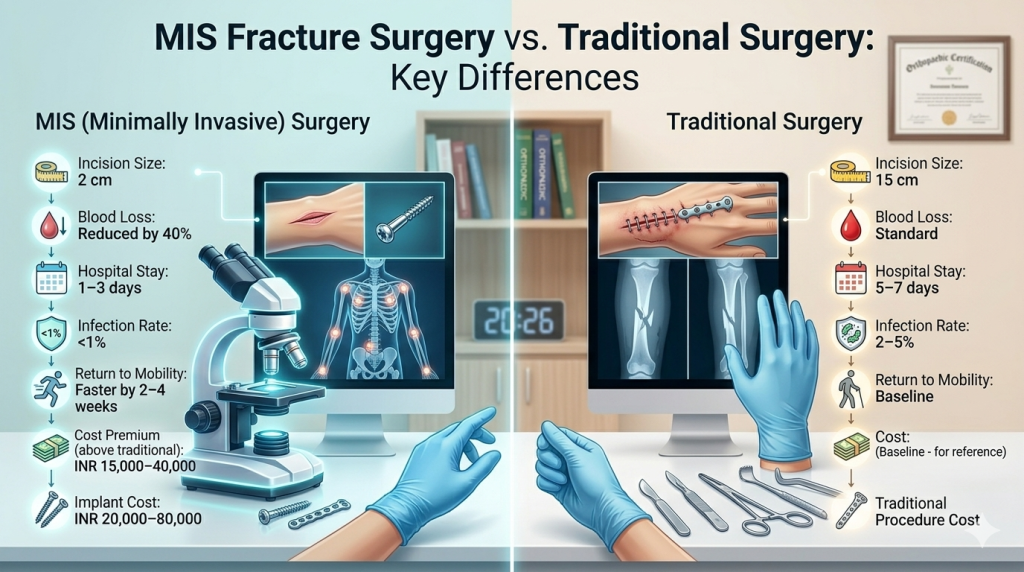
- Minimally invasive fracture surgery (MIS) uses small incisions (1 to 3 cm) instead of large open cuts, dramatically reducing soft tissue damage.
- In Pune, minimally invasive fracture surgery costs range from INR 60,000 to 2.5 lakh depending on fracture type and implant used (Industry estimate).
- Hospital stay is typically 1 to 3 days for MIS vs. 4 to 7 days for traditional open fracture surgery.
- Blood loss during MIS is approximately 30 to 40% lower than in open surgery, reducing transfusion needs.
- Post-operative infection rates are below 1% with proper technique (Industry estimate), significantly lower than open procedures.
- Most MIS fracture patients begin physiotherapy within 24 to 48 hours of surgery.
- Dr. Swaroop Salunkhe, Baner Pune, performs MIPO (Minimally Invasive Plate Osteosynthesis) and intramedullary nailing for long bone fractures.
Minimally invasive fracture surgery in Pune is changing how patients recover from broken bones. Traditional fracture surgery required large incisions to access the bone, expose it fully and fix it with plates and screws. The resulting tissue damage meant pain, slow healing, scarring and prolonged hospital stays.
Modern minimally invasive techniques — perfected over the last decade in global centres like the Paderborn fellowship facility where Dr. Swaroop Salunkhe trained — allow surgeons to fix fractures through tiny incisions using advanced imaging guidance. Patients go home sooner, scar less and get back on their feet faster.
Quick Facts
| MIS fracture surgery cost, Pune | INR 60,000 to 2.5 lakh depending on fracture complexity |
| Hospital stay | 1 to 3 days (MIS) vs. 4 to 7 days (open surgery) |
| Anaesthesia type | General or spinal anaesthesia |
| Common techniques | MIPO, intramedullary nailing, percutaneous screws |
| Return to partial weight bearing | Within 24–48 hours for most lower limb MIS |
| Ayushman Bharat | Fracture fixation surgery covered for eligible patients |
Pune Fracture Surgery Statistics 2025–2026
| Metric | Data Point | Source |
| Annual fractures requiring surgery, India | Over 10 lakh procedures annually | Industry estimate |
| Road traffic fractures, Pune | ~18,000 annually (all types) | Industry estimate |
| MIS vs open surgery blood loss | MIS reduces loss by 30–40% | PubMed meta-analysis |
| Average fracture surgery cost, Pune | INR 60,000 to 2.5 lakh | Industry estimate |
| Hospital stay MIS | 1 to 3 days | Industry estimate |
| Hospital stay open surgery | 4 to 7 days | Industry estimate |
What Is Minimally Invasive Fracture Surgery?
Minimally Invasive Plate Osteosynthesis (MIPO) and closed intramedullary nailing are the two most common MIS techniques for fracture fixation. In MIPO, a metal plate is slid under the skin through small stab incisions and secured to the bone with screws through separate tiny holes — without ever opening the fracture site itself.
Intramedullary (IM) nailing involves inserting a metal rod down the inside of the bone’s hollow canal — through a small entry point at the top of the bone — and locking it at both ends. This is particularly effective for femur (thigh bone) and tibia (shin bone) fractures.
Both techniques use fluoroscopy (a real-time X-ray imaging system in the operating theatre) to guide the surgeon’s instruments to exactly the right position without needing to visually expose the fracture. This means the fracture’s surrounding blood supply and soft tissue envelope are preserved — a factor critical to healing speed and infection prevention.
Pre-Operative Preparation for MIS Fracture Surgery
Before proceeding to surgery, Dr. Salunkhe’s team completes a thorough pre-operative workup. This includes an X-ray (and CT scan if needed for complex fractures), blood investigations (full blood count, clotting profile, renal function), ECG for patients over 40, and anaesthesia fitness clearance.
Blood thinners are stopped 5 to 7 days before elective surgery. Emergency fractures (same-day surgery) use a modified anticoagulation protocol. Diabetic patients receive adjusted insulin dosing. Patients are advised to fast for 6 to 8 hours before the procedure.
During the Procedure: What to Expect
MIS fracture surgery takes 60 to 120 minutes for most long bone fractures. You’ll be under spinal or general anaesthesia — the anaesthetist and Dr. Salunkhe will discuss which is most appropriate for your age, fracture type and medical background.
The procedure involves making 1 to 3 small incisions (typically 1 to 2 cm each), inserting the implant under fluoroscopic guidance, confirming alignment with intraoperative imaging, and closing the small incisions with absorbable sutures or clips. Most patients recall very little of the procedure and wake up in the recovery room with a firmly bandaged limb and, in many cases, remarkably less pain than they expected.
Post-Operative Care and Recovery Timeline
Day 1 to 2
Physiotherapy begins. For lower limb fractures, supervised standing and partial weight bearing starts within 24 to 48 hours. Pain is managed with a combination of local nerve blocks (acting from the operation) and oral paracetamol and short-course NSAIDs.
Week 1 to 2
Most patients go home within 1 to 3 days. Wound check at 10 to 14 days. Stitches or clips are removed. Physiotherapy continues — progressive weight bearing for lower limb fractures; range of motion for upper limb.
Week 4 to 6
X-ray confirms early fracture callus (new bone formation). Progressive loading increases. Return to desk work is typical at 4 weeks for lower limb fractures.
Month 3 to 6
Full weight bearing for most lower limb fractures. Return to manual activities at 3 to 4 months. Return to sport or heavy labour at 4 to 6 months depending on fracture location and individual healing. Implant removal (if needed) is considered after 12 to 18 months.
MIS vs. Traditional Open Fracture Surgery: Comparison
| Factor | MIS (MIPO / IM Nail) | Traditional Open Surgery |
| Incision size | 1 to 3 cm total | 10 to 20 cm |
| Blood loss | 30–40% less | Higher |
| Hospital stay | 1 to 3 days | 4 to 7 days |
| Post-op infection risk | < 1% | 2–5% |
| Physiotherapy start | Day 1–2 | Day 3–5 |
| Scar appearance | Minimal | Significant |
| Cost premium (MIS) | INR 15,000–40,000 extra | Baseline |
| Suitable for | Most long bone, periarticular fractures | Complex, severely displaced fractures |
Surgical Risks Table
Minimally Invasive Fracture Surgery: Surgical Risks
| Risk | MIS Rate | Management |
| Wound infection | < 1% | Antibiotic prophylaxis + aseptic technique |
| Implant failure | < 2% with correct indication | Regular X-ray follow-up |
| Malunion (malalignment) | < 3% in experienced hands | Intraoperative fluoroscopy control |
| DVT (blood clot) | ~1–3% without prophylaxis | Anticoagulant + early mobilisation |
| Nerve injury | < 1% | Careful surgical anatomy |
| Anaesthesia reactions | Rare | Pre-op screening + anaesthetist review |
Cost of Minimally Invasive Fracture Surgery in Pune
The cost of minimally invasive fracture surgery in Pune depends on the bone involved, the type of implant used and whether it’s an elective or emergency procedure. As a general guide: forearm fractures (radius/ulna) with MIPO run INR 60,000 to 1.2 lakh; tibia shaft fractures with IM nailing cost INR 80,000 to 1.8 lakh; femur fractures are INR 1.2 lakh to 2.5 lakh; complex periarticular fractures may exceed INR 2.5 lakh (all Industry estimate).
Implant cost alone accounts for INR 20,000 to 80,000 of the total. Imported implants from companies like Synthes or Stryker cost more but have a long track record. Indian-made implants (approved by CDSCO) are a cost-effective and well-validated alternative.
Insurance and Ayushman Bharat
Fracture surgery is typically covered under standard health insurance policies in India. Cashless hospitalisation is available at Dr. Salunkhe’s associated hospital facilities through major TPAs. Ayushman Bharat covers fracture fixation surgery for eligible beneficiaries — present your card at the time of admission to initiate the cashless process.
Baner Pune: Why Patients from Wakad, Hinjewadi and Aundh Choose Dr. Salunkhe
Dr. Swaroop Salunkhe’s international training in arthroplasty and reconstructive surgery at Paderborn, Germany, included high-volume MIS fracture fixation exposure. He brings those techniques to his Pune practice. Patients from Wakad, Balewadi and Pimple Nilakh routinely travel to the Baner clinic because of the combination of MIS expertise and clear communication — he explains exactly what implant will be used, why and what recovery will look like, before asking for consent.
Frequently Asked Questions
Q: What is the cost of minimally invasive fracture surgery in Pune?
A: Costs range from INR 60,000 to 2.5 lakh depending on the fracture location, complexity and implant used (Industry estimate). Femur and complex periarticular fractures are at the higher end. Most health insurance plans cover these procedures.
Q: How long do I stay in hospital after MIS fracture surgery?
A: Most patients are discharged within 1 to 3 days after minimally invasive fracture surgery. Compare this to 4 to 7 days for traditional open procedures. The shorter stay reduces costs and decreases the risk of hospital-acquired infections.
Q: Is minimally invasive fracture surgery available for all types of fractures?
A: MIS is suitable for most long bone fractures (femur, tibia, humerus, radius) and many periarticular fractures. Severely comminuted (shattered) fractures with bone loss may still require traditional open fixation. Dr. Salunkhe will assess your X-ray or CT scan and recommend the most appropriate technique.
Q: When can I go back to work after fracture surgery?
A: Desk work typically resumes at 2 to 4 weeks. Manual labour and sports return at 3 to 6 months, depending on the bone involved and healing rate. Physiotherapy guidance at Dr. Salunkhe’s clinic sets specific milestones for your return.
Q: Will the implant need to be removed after the fracture heals?
A: Implant removal is not always necessary. For most adults, plates and screws are left permanently unless they cause discomfort or the patient is young and active. In children, implants are typically removed after fracture healing. If removal is needed, it’s a short day-care procedure.
Conclusion
Minimally invasive fracture surgery in Pune is now the standard of care for most long bone fractures — smaller scars, faster recovery and fewer complications are not marketing claims; they’re outcomes supported by a strong evidence base.
Whether your fracture resulted from a road accident, a sports injury or a fall at home, Dr. Swaroop Salunkhe’s clinic in Baner offers state-of-the-art fracture management.
Book your consultation or emergency evaluation at orthopedicclinicinpcmc Get the right assessment, the right technique and a recovery plan you can actually follow.

Dr. Swaroop Solunke
- Fellowship in Arthroplasty (Germany)- Bruderkrankenhaus St. Josef Paderborn, Germany.
- Fellowship in Primary and Revision Hip Replacement – Dr. Luigi Zagra IRCCS Instituto Orthopedia Galeazzi, Milan, Italy.
- Fellowship in Arthroplasty (Germany)- Bruderkrankenhaus St. Josef Paderborn, Germany.
- Fellowship in Robotic Knee Replacement – The Stone Research Foundation, San Francisco, California, USA.
- MS - Orthopaedics (Gold Medalist) – MGM Medical College and Hospital.
- MBBS – Dr. DY Patil University, Navi Mumbai.
- Member of Indian Medical Association (IMA)