
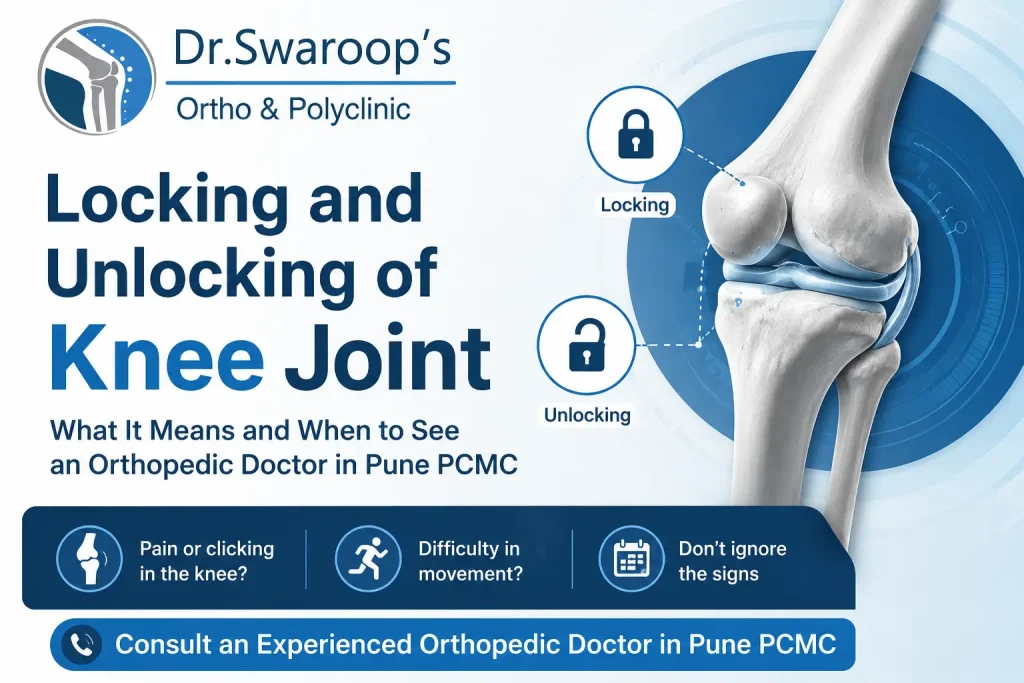
locking and unlocking of knee Joint occurs when the joint physically cannot straighten or bend past a certain angle, most commonly due to a torn meniscus, loose cartilage fragment, or a displaced bone body inside the joint. Sudden knee locking while walking or standing is a medical red flag that warrants prompt orthopedic evaluation in Pimpri Chinchwad.
If your knee has ever suddenly frozen in place mid-stride while walking through Wakad Market or climbing the overbridge near Nashik Phata, you know the panic that follows. You try to shift your weight, bend the knee, straighten it. Nothing moves. Then, after a few tense seconds or a gentle manipulation, it releases with a dull click.
This is not just an odd occurrence. It has a name, it has causes, and it has treatment. At Dr. Swaroop’s Ortho & Polyclinic in Wakad, Dr. Swaroop Solunke is orthopedic surgeon in pune see patients from across PCMC, Pune, including Hinjewadi, Nigdi, Pimple Saudagar and Pimpri, who have been putting up with this symptom for months before deciding to get it checked.
Here is the truth: a knee that locks and unlocks is rarely something you can wait out. The underlying cause almost always gets worse with time. And the longer you leave it, the more complex the fix becomes.
This article will tell you exactly what happens inside your knee when it locks, why it unlocks on its own, what causes it, how doctors distinguish true locking from pseudo-locking, and what your treatment options are. We will also tell you which warning signs demand same-week orthopedic attention rather than a wait-and-watch approach.
What Does Locking and Unlocking of the Knee Joint Actually Mean?
The knee is one of the most mechanically complex joints in the body. It is not a simple hinge. The femur (thigh bone), tibia (shin bone) and patella (kneecap) work together with two C-shaped cartilage pads called menisci, four major ligaments and a network of tendons. When everything functions normally, the knee bends and straightens through a full range of roughly 0 to 140 degrees without restriction.
Knee locking means the joint gets stuck at a fixed angle and cannot be moved beyond that point by normal muscle effort alone. This is called true locking. It has a mechanical cause inside the joint cavity itself.
Knee unlocking refers to the moment when the obstruction clears, either on its own or after the person wiggles and manoeuvres the leg into the right position. The knee suddenly releases, and the person can straighten or bend it again. This cycle of locking and unlocking is the defining clinical pattern that orthopedic surgeons look for.
True Locking vs Pseudo-Locking: A Critical Distinction
Not every knee that feels stuck is mechanically locked. There is an important clinical difference between the two types.
| Feature | True Locking |
| Feature | True Locking |
| What causes it | A physical obstruction inside the joint (torn meniscus, loose body, inflamed tissue) |
| Can the patient force it? | No. Forcing it causes sharp pain and does not work |
| Onset | Sudden, often during activity |
| Joint swelling | Usually present within hours |
| Imaging finding | Structural lesion visible on MRI or arthroscopy |
| Treatment needed | Often surgical (arthroscopy) |
Clinical pearl: If your knee locks completely and cannot be moved past a certain angle even with gentle manipulation, that is true locking until proven otherwise.
Book an orthopedic appointment in Pimpri Chinchwad the same week.
What Causes Knee Locking in Pimpri Chinchwad Patients?
Across our clinics in Wakad, Nigdi and Hinjewadi, these are the causes we see most frequently in patients presenting with locking and unlocking of the knee joint.
1. Torn Meniscus (Most Common Cause)
The meniscus is the shock-absorbing cartilage pad between the femur and tibia. When it tears, a flap or displaced fragment can get caught between the joint surfaces. This is the classic bucket-handle tear. The knee locks because the torn fragment physically jams the joint.
Meniscus tears are extremely common in Pimpri Chinchwad’s active population, including IT professionals in Hinjewadi who sit for long hours and then walk briskly, construction workers in Bhosari and Chinchwad who kneel and squat repeatedly, and middle-aged patients with early cartilage degeneration.
- Sudden sharp pain on the inner or outer side of the knee
- Swelling within 24 hours
- The knee locks when extended and has to be wiggled to release
- A clicking or catching sensation during the locking episode
2. Loose Body Inside the Joint
A loose body is a fragment of bone or cartilage floating freely inside the knee joint. It may come from osteochondritis dissecans (a condition where a segment of bone loses its blood supply and separates), from a chip fracture after trauma, or from advanced osteoarthritis where bone spurs break off.
Loose bodies are unpredictable. They may drift harmlessly for weeks and then move into the wrong position and jam the joint. Patients describe it as a marble inside the knee. When it migrates, the knee locks. When it drifts back, the knee unlocks.
3. Plica Syndrome
Plica are folds of synovial membrane (the tissue lining the joint). Most people have them without issue. But in some patients, particularly after overuse or minor trauma, the plica becomes thickened and inflamed. During knee movement, this thickened band catches between bones and causes a snapping, locking sensation.
Plica syndrome is commonly seen in young adults and is frequently misdiagnosed as a meniscus problem. The distinction matters because treatment is different.
4. Anterior Cruciate Ligament (ACL) Injury
A partial or complete ACL tear does not cause true locking by itself, but it causes a subjective sense of the knee giving way and then locking in a protective position due to muscle guarding. This is pseudo-locking secondary to instability.
However, ACL tears are often accompanied by meniscus tears (the unhappy triad of knee injuries). In those combined injuries, true locking can occur alongside the instability.
5. Osteoarthritis with Loose Cartilage Fragments
Advanced knee osteoarthritis causes cartilage to erode and break apart. Loose cartilage fragments within the joint can cause intermittent locking episodes. This is particularly relevant for patients above 55 years of age in PCMC, where osteoarthritis prevalence is significant.
6. Hoffa’s Syndrome (Fat Pad Impingement)
The infrapatellar fat pad sits just below the kneecap. When it becomes inflamed and enlarged (often from repeated minor trauma), it can get pinched between bones during knee extension. This causes a locking-like sensation in the front of the knee, particularly when straightening the leg fully.
7. Knee Locking Without Pain: What Does It Mean?
Knee locking without pain is a specific pattern that worries orthopedic surgeons more than painful locking. It typically points to a loose body or a degenerative cartilage flap that has lost nerve supply. Just because it does not hurt does not mean it is harmless. The fragment can damage the remaining cartilage surface with every locking episode, accelerating joint degeneration.
Knee Locking Diagnosis: What Happens at an Orthopedic Clinic in PCMC
When you visit Dr. Swaroop Solunke’s clinic in Wakad with knee locking complaints, the diagnostic process is structured and efficient.
Step 1 – Clinical History
The doctor will ask when the locking started, whether it is true locking or a giving-way sensation, whether the locking is painful, which angle the knee locks at, and whether there was any trauma or sporting injury preceding the symptom.
Step 2 – Physical Examination
Specific tests are performed to assess the meniscus, ligaments, and for the presence of a loose body or effusion.
- McMurray’s Test – rotational stress on the meniscus to reproduce the click and locking
- Apley’s Grind Test – compression with rotation to detect meniscus tears
- Thessaly Test – functional test performed in a standing position to reproduce symptoms
- Joint Line Tenderness – pressure along the medial or lateral knee line to localise the lesion
- Range of Motion Check – measuring exactly how far the knee extends and flexes before it locks
Step 3 – Imaging
X-rays are taken first to rule out fractures, advanced arthritis and loose bone fragments. They show bony loose bodies but cannot directly image soft tissue.
MRI of the knee is the gold standard for diagnosing meniscus tears, ligament injuries and soft tissue loose bodies. It is non-invasive and gives a clear map of what is happening inside the joint. Most patients coming to our Wakad clinic for knee locking undergo MRI before a treatment plan is finalised.
Treatment Options for Knee Locking in Pimpri Chinchwad
Treatment depends entirely on the cause confirmed by clinical examination and imaging.
Non-Surgical Treatment (For Pseudo-Locking and Mild Cases)
- Rest and activity modification during the acute inflammatory phase
- Physiotherapy to strengthen the quadriceps and hamstrings and improve joint stability.
- Anti-inflammatory medications to reduce swelling and pain
- Knee bracing for support during recovery.
- Intra-articular corticosteroid injection for plica syndrome or fat pad impingement
Important: Non-surgical treatment alone does not resolve true locking caused by a mechanical obstruction. If a torn meniscus flap or loose body is confirmed, conservative treatment will temporarily reduce inflammation, but the locking episodes will return.
Surgical Treatment: Knee Arthroscopy
Knee arthroscopy is the minimally invasive keyhole procedure used to treat most causes of true knee locking. Dr. Swaroop Solunke performs arthroscopic knee surgery at our Wakad clinic and partner hospitals in Pune.
Under arthroscopy, a camera is inserted into the knee through a small incision. The surgeon can see the joint surfaces in real time, remove or repair torn meniscus tissue, extract loose bodies, and address plica or fat pad impingement.
Most patients undergoing knee arthroscopy for locking:
- Are treated as day-care or short stay patients (no long hospitalisation)
- Begin walking with support within 24 to 48 hours.
- Return to desk work in 1 to 2 weeks.
- Return to full activity in 6 to 12 weeks depending on the specific procedure.
Meniscus Repair vs Meniscectomy
When the cause is a torn meniscus, the surgeon will evaluate whether the tear can be repaired (sutured back together) or requires partial removal (partial meniscectomy). Repair is always preferred when the tear is in the outer vascular zone of the meniscus. This preserves the shock-absorbing function of the meniscus and reduces long-term risk of arthritis.
Dr. Solunke’s fellowship training in arthroscopy and sports medicine means that meniscus preservation is always the primary goal in his surgical planning.
Warning Signs: When Knee Locking Needs Urgent Orthopedic Attention
Many patients in PCMC, Pimpri and Hinjewadi delay seeing a doctor, hoping the locking resolves on its own. These warning signs mean you should not wait:
- Complete inability to straighten the knee – true mechanical block requires assessment within days, not weeks.
- Significant swelling within 2 to 4 hours of the locking episode – this points to haemarthrosis or a meniscus root tear
- Locking after a sports injury or fall – possible fracture or ligament tear combined with structural damage
- Recurring locking 3 or more times per month – the loose body or torn flap is enlarging; delay increases joint damage.
- Knee locking in children or adolescents – osteochondritis dissecans or a discoid meniscus needs urgent evaluation; these conditions affect growing bone.
- Locking with loss of sensation or severe muscle weakness – neurological involvement cannot be ruled out without examination.
Knee Locking in PCMC: Who Is Most at Risk
Pimpri Chinchwad’s population is a mix of industrial workers from the MIDC belt, IT professionals from Hinjewadi Phase I, II and III, military and defence personnel from areas near Dehu Road Cantonment and a rapidly growing elderly population in residential areas like Pradhikaran, Tathawade and Ravet.
Industrial and construction workers who kneel, squat and carry loads are at significantly higher risk of meniscus tears and knee locking. Repeated compressive loading without adequate rest accelerates cartilage breakdown.
IT professionals in Hinjewadi and Wakad who sit at desks for 8 to 10 hours, then switch to vigorous weekend activities like football or cycling, face acute meniscus injuries from this stop-start pattern of activity.
Older residents above 55 in areas like Nigdi and Pimpri Chinchwad proper are more likely to experience locking from degenerative meniscus tears or loose bodies secondary to osteoarthritis rather than from acute injury.
Dr. Swaroop’s Ortho & Polyclinic at Wakad is centrally positioned to serve all these patient groups. The clinic is accessible from the Wakad-Hinjewadi corridor, the Aundh-Ravet road, and the old Pune-Mumbai highway connecting Pimpri and Chinchwad.
Can Knee Locking Be Prevented?
Not all causes are preventable, particularly degenerative ones. But the following measures significantly reduce the risk of traumatic meniscus tears and loose body formation in active adults:
- Warm up before physical activity – cold muscles and stiff tendons increase the torque on meniscal cartilage during cutting and pivoting movements.
- Strengthen the quadriceps and hamstrings – strong thigh muscles act as dynamic shock absorbers for the knee joint.
- Maintain a healthy body weight – each kilogram of excess weight adds approximately 3 to 4 kilograms of load to the knee with each step.
- Use appropriate footwear for sport and work – shoes with poor lateral support increase twisting forces on the knee during walking and running.
- Avoid extreme and sudden loading of the knee without preparation – weekend warriors who go from zero to intense activity are a high-risk group.
- Address knee pain early – ignoring minor catching sensations or mild swelling allows small tears to propagate into large ones that cause frank locking.
Frequently Asked Questions About Knee Locking in Pimpri Chinchwad
1. My knee locks and then unlocks on its own. Should I see a doctor or wait?
You should see an orthopedic doctor in Pimpri Chinchwad as soon as possible. Intermittent locking that resolves on its own does not mean the underlying problem is minor. It usually means a torn meniscus flap or loose body is intermittently getting caught in the joint. Every locking episode causes further cartilage damage. An MRI will confirm what is happening, and the earlier it is treated, the simpler and less invasive the procedure.
2. Can a torn meniscus cause my knee to lock without any swelling?
Yes. Not all meniscus tears produce immediate swelling. Degenerative meniscus tears, which are common in patients over 40, often cause clicking, catching, and locking without significant swelling. The absence of swelling does not reduce the urgency of evaluation. A clinical examination and MRI will confirm the tear regardless of whether swelling is present.
3. Is knee arthroscopy the only treatment for knee locking?
Not always. Pseudo-locking caused by pain or muscle spasm responds well to physiotherapy, bracing and anti-inflammatory treatment. Plica syndrome and fat pad impingement may settle with conservative care. However, if clinical examination and MRI confirm a mechanical cause such as a torn meniscus or a loose body inside the knee, arthroscopic surgery is typically recommended because conservative treatment cannot remove or repair the physical obstruction causing the lock.
4. Can knee locking happen in young people and children in Pune?
Yes, and it should be taken more seriously in younger patients. In children and teenagers, osteochondritis dissecans and discoid meniscus are common causes of knee locking. In young adults aged 18 to 35, sports injuries including ACL tears with associated meniscus damage are frequent causes. Young patients in PCMC involved in football, cricket, and kabaddi are particularly susceptible. Early diagnosis protects the growing joint and avoids long-term complications.
5. How long is recovery after knee arthroscopy for a locked knee?
Recovery varies by the specific procedure. For arthroscopic removal of a loose body, most patients walk with support within 24 to 48 hours and return to office work in 7 to 10 days. For meniscus repair (where the torn tissue is sutured rather than removed), recovery takes 6 to 8 weeks with protected weight bearing for the first few weeks to allow the repair to heal. Partial meniscectomy recovery falls between these two. Dr. Solunke’s team provides a structured physiotherapy protocol post-surgery to ensure safe and full recovery.
MEDICAL DISCLAIMER
This blog is intended for general health education only and does not constitute medical advice, diagnosis, or treatment. All information provided is based on established orthopedic literature and clinical practice. Knee locking is a medical symptom that requires individual evaluation by a qualified orthopedic surgeon. Please consult Dr. Swaroop Solunke or a licensed orthopedic specialist before making any medical decisions. Do not self-diagnose or self-treat on the basis of this content.
Book a Knee Consultation at Dr. Swaroop’s Ortho & Polyclinic, Wakad
Serving patients from Wakad, Hinjewadi, Nigdi, Pimple Saudagar, Aundh, and all of Pimpri Chinchwad
Dr. Swaroop Solunke
- Fellowship in Arthroplasty (Germany)- Bruderkrankenhaus St. Josef Paderborn, Germany.
- Fellowship in Primary and Revision Hip Replacement – Dr. Luigi Zagra IRCCS Instituto Orthopedia Galeazzi, Milan, Italy.
- Fellowship in Arthroplasty (Germany)- Bruderkrankenhaus St. Josef Paderborn, Germany.
- Fellowship in Robotic Knee Replacement – The Stone Research Foundation, San Francisco, California, USA.
- MS - Orthopaedics (Gold Medalist) – MGM Medical College and Hospital.
- MBBS – Dr. DY Patil University, Navi Mumbai.
- Member of Indian Medical Association (IMA)