
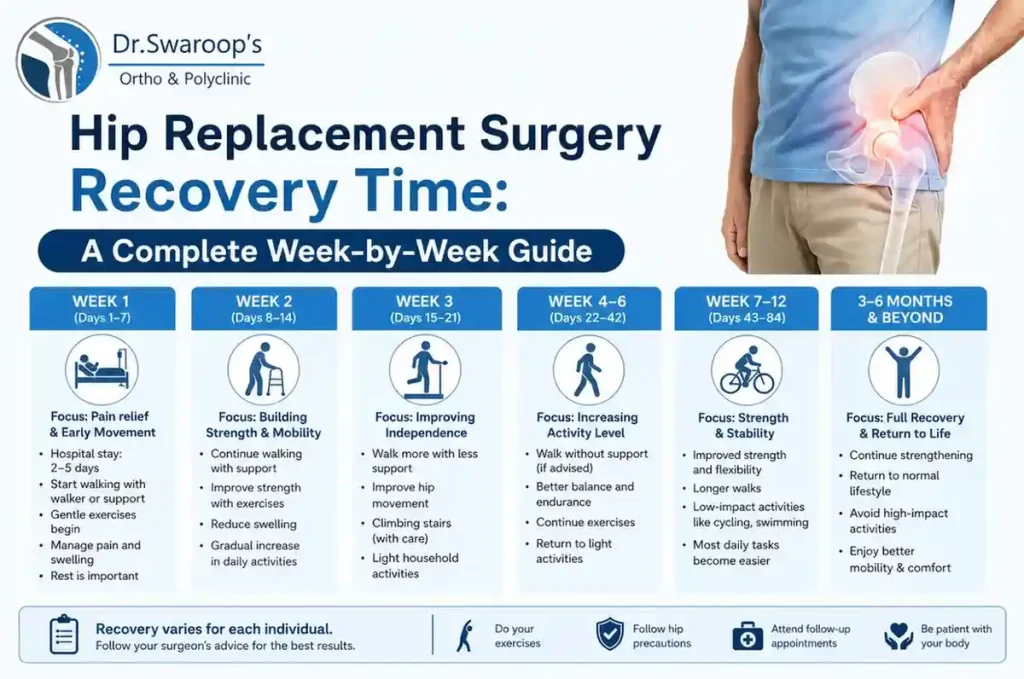
Hip replacement surgery recovery time depend on patient Condition,Most patients recover from hip replacement surgery in 3 to 6 months. Walking with support begins within 24 hours of surgery. By 6 weeks, most people handle daily tasks independently. Full return to activities like walking, driving, and stairs typically happens between 6 weeks and 3 months. Complete bone and muscle recovery takes up to 12 months.
hip replacement surgery recovery time changes lives. That sounds dramatic, but ask anyone who spent two years avoiding stairs, sleeping badly from pain, and giving up morning walks — and they’ll tell you the surgery was the turning point. Still, one of the first questions patients ask is: How long will recovery actually take?
The honest answer is that it depends. Your age, fitness level, the type of implant used, and whether you had robotic-assisted surgery all play a role. But there is a general timeline most patients follow, and knowing it in advance makes the whole process far less frightening.
Hip Replacement Surgery Recovery Time line at a Glance
| Recovery Stage | Timeframe | Key Milestones |
| Hospital stay | Days 1 to 4 | First steps with walker, pain management, physiotherapy begins |
| Early home recovery | Weeks 1 to 2 | Walking indoors with walker, wound care, light exercises |
| Building strength | Weeks 3 to 6 | Transition to cane, stairs with railing, driving (left hip) |
| Returning to daily life | Weeks 6 to 12 | Desk work, driving (right hip), walking without support |
| Getting back to normal | Months 3 to 6 | Swimming, cycling, light sports, no assistive device |
| Full recovery | Months 6 to 12 | Complete bone integration, return to all activities |
Week-by-Week Hip Replacement Recovery Timeline
Understanding what to expect at each stage helps you prepare mentally and physically. Below is a realistic recovery schedule based on what patients typically experience after total hip replacement.
Days 1 to 3: Right After Surgery
You will wake up in the recovery room with a bandage over the incision and a catheter in place. The nursing staff will start you sitting upright on the same day as surgery. Physical therapy begins within 12 to 24 hours in most hospitals.
This surprises a lot of patients. Many expect to lie flat for days. But early movement is intentional. Getting up quickly reduces the risk of blood clots, improves circulation, and actually speeds up the entire recovery.
Pain is managed with a combination of local anaesthesia, nerve blocks, and oral medications. Most patients rate their pain at a manageable level by day two.
What you can do by day 3:
- Sit in a chair with assistance
- Walk short distances with a walker
- Use the bathroom with support
- Bend the hip to about 90 degrees
Week 1 to 2: Going Home
Most patients are discharged between day 2 and day 4. Before you leave, the physiotherapy team will make sure you can safely climb a few steps and move with a walker or crutches.
At home, your main job is to rest, move a little, and protect the hip. You need to avoid bending forward past 90 degrees, crossing your legs, and twisting your foot inward. These movements can dislocate the new joint in the early weeks.
Recovery milestones at 2 weeks:
- Walking with walker or crutches inside the home
- Managing basic hygiene with some help
- Light exercises like ankle pumps, heel slides, and calf raises
- Wound check and suture removal (if non-absorbable stitches were used)
Weeks 3 to 6: Building Strength
This is when many patients notice the biggest shift. The pain starts to ease significantly. You start moving with more confidence. Some people transition from a walker to a cane around week 3 or 4.
Physiotherapy sessions focus on strengthening the hip muscles that were cut or stretched during surgery. The gluteus medius — the main stabiliser of your hip — needs consistent work to recover properly. Weakness here is actually the most common reason people walk with a slight limp even after the hip itself has healed.
What most patients can do by week 6:
- Walk with a single cane or without support (depending on strength)
- Climb stairs with a railing
- Sit in a regular chair comfortably
- Drive (left hip surgery) — right hip surgery patients usually wait a few more weeks
- Sleep more comfortably, though some positions still need adjustment
Weeks 6 to 12: Returning to Daily Life
At the 6-week mark, your surgeon will typically do a formal review. For most patients, this is when activity restrictions are lifted or significantly relaxed. You can return to driving (right hip) and light work from home. Many people return to desk jobs around this time.
Physiotherapy continues, with exercises becoming more demanding. Walking distance increases gradually. Patients aim to add 5 to 10 minutes of walking per day each week.
Milestones at 3 months:
- Walking without any assistive device
- Returning to office work or light physical jobs
- Resuming activities like swimming and cycling
- Significant reduction in pain during daily activities
Months 3 to 6: Getting Back to Normal
By 3 to 4 months, most people feel close to normal in their daily lives. The limp (if any) resolves. Stiffness after sitting disappears. Climbing stairs feels natural. Return to golf, light hiking, or recreational sports is typically cleared somewhere between 3 and 6 months.
Months 6 to 12: Complete Recovery
Full biological healing — where the bone has completely integrated with the implant — takes about 12 months. Most people don’t notice this phase because they’re already feeling well. But it’s why high-impact activities like running or contact sports are generally avoided for the full year.
Factors That Affect How Fast You Recover
Recovery isn’t one-size-fits-all. Several things can push your timeline faster or slower.
Most hip replacements go smoothly. But it helps to know the warning signs.
| Factor | How It Affects Recovery |
| Age | Younger patients heal faster, but fit older patients do very well too |
| Pre-surgery fitness | Stronger muscles before surgery = faster recovery after |
| Body weight | Excess weight adds load on the healing joint and slows progress |
| Surgery type | Robotic-assisted surgery typically means less pain and faster walking |
| Surgical approach | Anterior vs posterior approach each have different recovery curves |
| Physiotherapy compliance | The single biggest controllable factor in how fast you recover |
What Slows Down Recovery? Common Complications to Know
Most hip replacements go smoothly. But it helps to know the warning signs.
| Complication | Warning Signs | What to Do |
| Blood clot (DVT) | Calf swelling, warmth, or pain | Contact your surgeon immediately |
| Wound infection | Redness, discharge, or fever after day 3 | Call your surgeon, may need antibiotics |
| Hip dislocation | Sudden sharp pain, leg won’t move | Go to emergency immediately |
| Implant loosening | Persistent groin pain during walking | Schedule a review with your surgeon |
| Leg length difference | One leg feels longer or shorter | Usually resolves; mention at follow-upIf you notice anything unusual during recovery, the right move is always to call your surgeon rather than wait and see.If you notice anything unusual during recovery, the right move is always to call your surgeon rather than wait and see. |
If you notice anything unusual during recovery, the right move is always to call your surgeon rather than wait and see.
Recovery Tips That Actually Help
- Prepare your home before surgery. Move commonly used items to waist height. Remove rugs. Set up a firm chair in the rooms you’ll spend most time in. A toilet riser and grab bars in the bathroom are genuinely helpful.
- Sleep on your back in the early weeks. A pillow between your knees helps if you want to sleep on your side, but check with your surgeon first based on your approach type.
- Walk little and often, not long and rare. Short walks every couple of hours are better than one long walk once a day. They keep the circulation going and prevent stiffness.
- Ice, then move. Ice reduces swelling. Then gentle movement keeps the joint mobile. Doing them in the wrong order is a common mistake.
- Don’t skip the boring exercises. Ankle pumps and calf raises might feel pointless. They reduce clot risk. Do them.
- Be patient with the limp. A slight limp in the first 6 weeks is normal and not a sign that something is wrong. The gluteus medius muscle needs time to rebuild its strength.
Testimonials from Patients of Dr. Swaroop Solunke
“I had my hip replaced at 67 and was genuinely terrified. Dr. Solunke spent more time explaining things at my consultation than most doctors spend in an entire appointment. By day three after surgery I was walking in the corridor. I was back to my morning walk by month two. The pain I had been living with for three years was simply gone.”
— Rekha Mehta, 67, Wakad
“I kept putting off my surgery because I didn’t know what to expect. A friend recommended Dr. Solunke and I finally went. He told me exactly what would happen at each stage. The robotic approach he used meant less pain afterward than I expected. Four months later I’m walking 3 kilometres every morning.”
— Suresh Patil, 71, Hinjewadi
“My mother had her hip replacement done by Dr. Solunke at 74 years old. We were nervous about her age and recovery. He was thorough, patient, and always available when we called. She was walking with a cane at 3 weeks and without one by 2 months. We can’t thank him enough.”
— Priya Kulkarni (daughter), Pimple Saudagar
“I chose Dr. Solunke specifically because he had international fellowship training in hip replacement from Germany and Italy. That mattered to me. The surgery was smooth, the recovery was exactly as he described, and the follow-up care was excellent. I’m back to driving and gardening at 4 months.”
— Ashok Joshi, 63, Aundh
Why Patients in Pune Trust Dr. Swaroop Solunke for Hip Replacement Surgery
Not all hip replacement surgeons have the same training. Dr. Swaroop Solunke is the best Orthopedic surgeon in pune completed fellowship training in hip and knee arthroplasty at Bruderkrankenhaus St. Josef Paderborn in Germany and an additional fellowship in primary and revision hip replacement under Dr. Luigi Zagra at IRCCS Instituto Ortopedia Galeazzi in Milan, Italy. He also holds a fellowship in robotic knee replacement from the Stone Research Foundation in San Francisco.
He is an MS Orthopaedics gold medalist from MGM Medical College and Hospital and has 16 years of overall orthopedic experience, including 11 years as a specialist. He has performed over 2,500 joint replacements and trauma surgeries across Pune and PCMC.
What patients particularly mention is that Dr. Solunke is the surgeon at every stage. The doctor at the consultation is the doctor in the operating theatre and the doctor at follow-up. In a field where that is not always the case, it matters.
Clinic locations: Wakad (primary), Aundh, Hinjewadi, Pimple Saudagar, Nigdi, Shivaji Nagar, and Pimpri.
Contact: 7385486860 | dr.swaroopsolunke@gmail.com | orthopedicclinicinpcmc.com
Frequently Asked Questions About Hip Replacement Recovery
1.How long does hip replacement surgery take?
The surgery itself typically takes 1.5 to 2.5 hours. Preparation and anaesthesia add time on either side, so you can expect to be in the operating theatre for 3 to 4 hours total.
2. When can I walk after hip replacement?
Most patients take their first steps with a physiotherapist within 12 to 24 hours of surgery. Walking with a walker or crutches continues for 3 to 6 weeks depending on progress.
3. How long is the hospital stay after hip replacement?
Typically 2 to 4 days. Some patients go home earlier if they are fit and have good home support.
4. When can I drive after hip replacement surgery?
For left hip surgery, most surgeons clear driving around 3 to 4 weeks. For right hip surgery, this usually takes 6 to 8 weeks because the right foot operates the brake.
5. Will I need physiotherapy at home?
Yes. Outpatient physiotherapy or home sessions begin almost immediately after discharge. Regular sessions for at least 6 to 8 weeks are standard.
6. Is robotic hip replacement better?
Robotic-assisted surgery allows more precise implant positioning, which reduces the risk of malalignment and typically results in less post-operative pain and faster recovery. For suitable cases, it offers meaningful advantages.
7. When can I return to work after hip replacement?
| Job Type | Typical Return to Work |
| Desk / computer work | 4 to 8 weeks |
| Light standing (teacher, retail) | 8 to 12 weeks |
| Heavy physical labour | 4 to 6 months |
| Driving (left hip) | 3 to 4 weeks |
| Driving (right hip) | 6 to 8 weeks |
Your surgeon will advise based on your specific role and recovery progress.
8. What exercises should I do during recovery?
In the early weeks: ankle pumps, heel slides, quad sets, and short walks. As strength returns: bridges, mini squats, and step exercises. A physiotherapist will guide you through the progression.
9. Can I sleep on my side after hip replacement?
Generally not in the first 6 weeks. After that, sleeping on the non-operated side with a pillow between the knees is usually acceptable. Always confirm with your surgeon based on the surgical approach used.
This article is for general information purposes. For advice specific to your situation, please consult Dr. Swaroop Solunke directly at orthopedicclinicinpcmc.com or call 7385486860.
Dr. Swaroop Solunke — MS Orthopaedics (Gold Medalist), fellowship-trained orthopedic surgeon with international training in hip and knee arthroplasty from Germany, Italy, and the USA. He practices at Dr. Swaroop’s Ortho & Polyclinic across multiple locations in Pune and PCMC.

Dr. Swaroop Solunke
- Fellowship in Arthroplasty (Germany)- Bruderkrankenhaus St. Josef Paderborn, Germany.
- Fellowship in Primary and Revision Hip Replacement – Dr. Luigi Zagra IRCCS Instituto Orthopedia Galeazzi, Milan, Italy.
- Fellowship in Arthroplasty (Germany)- Bruderkrankenhaus St. Josef Paderborn, Germany.
- Fellowship in Robotic Knee Replacement – The Stone Research Foundation, San Francisco, California, USA.
- MS - Orthopaedics (Gold Medalist) – MGM Medical College and Hospital.
- MBBS – Dr. DY Patil University, Navi Mumbai.
- Member of Indian Medical Association (IMA)