
Key Takeaways
- Osteoporosis affects an estimated 5 crore Indians and causes over 5 lakh fractures annually in India (ICMR 2023).
- Bone density peaks between age 25 and 30 and declines by 0.5 to 1% per year after 40 — faster in post-menopausal women.
- Vitamin D deficiency affects approximately 70% of urban Indian adults, directly impairing calcium absorption (Industry estimate).
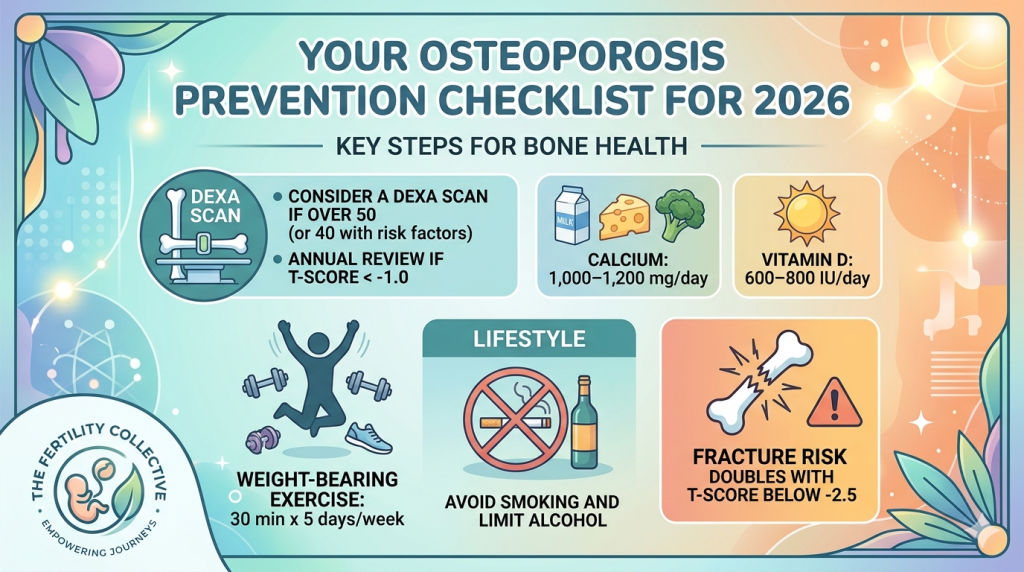
- A daily calcium intake of 1,000 to 1,200 mg and vitamin D of 600 to 800 IU significantly reduces fracture risk.
- Weight-bearing exercise 5 days a week (30 minutes) is one of the strongest non-pharmacological bone-density preservers.
- A DEXA scan (bone densitometry) costs INR 2,000 to 4,500 in Pune and is the gold standard for diagnosis.
- Dr. Swaroop Salunkhe’s Baner clinic offers bone density assessment and a personalised prevention plan for adults over 40.
An osteoporosis prevention plan adults Pune is not something to delay until a fracture happens. Bones lose density silently — there are no symptoms until a fall results in a wrist, hip or spine fracture that could have been prevented. Starting the new year with a concrete bone health plan is one of the smartest health decisions an adult over 40 in Pune can make.
This guide, reviewed by Dr. Swaroop Salunkhe, MBBS, MS (Orthopaedics), uses ICMR data and NHP India guidelines to give you a practical, science-backed prevention plan that covers nutrition, exercise, lifestyle and screening.
Quick Facts
| Condition | Osteoporosis (low bone mineral density) |
| Who’s most at risk | Post-menopausal women; men over 70; vitamin D deficient adults |
| India prevalence | Estimated 5 crore affected (ICMR 2023) |
| DEXA scan cost, Pune | INR 2,000 to 4,500 (Industry estimate) |
| Daily calcium target | 1,000–1,200 mg (adults over 50) |
| Ayushman Bharat | Covers hip fracture surgery for eligible beneficiaries |
Pune Osteoporosis & Bone Health Statistics 2025–2026
| Metric | Data Point | Source |
| Osteoporosis prevalence, India | ~5 crore individuals | ICMR 2023 |
| Fractures from osteoporosis, India | Over 5 lakh annually | ICMR 2023 |
| Vitamin D deficiency, urban India | ~70% of adults below sufficient levels | Industry estimate |
| Hip fracture 1-year mortality, India | ~20–30% in elderly patients | Indian Journal of Medical Research |
| DEXA scan cost, Pune | INR 2,000 to 4,500 | Industry estimate |
| Bisphosphonate treatment cost, Pune | INR 800 to 3,500/month | Industry estimate |
Understanding Osteoporosis: What Actually Happens to Your Bones
Bone is living tissue — it’s constantly broken down and rebuilt in a cycle called remodelling. When you’re young, building outpaces breakdown, reaching peak bone mass around age 25 to 30. After age 35 to 40, the balance shifts and bones slowly lose density.
In women, oestrogen normally protects bones. At menopause, oestrogen levels drop sharply, accelerating bone loss by 1 to 2% per year for the first 5 to 7 years. This is why post-menopausal women represent the largest group of osteoporosis patients. Men lose bone more gradually and typically present with osteoporosis about 10 years later than women.
The real danger is a fragility fracture — a break caused by a force that wouldn’t normally break a healthy bone, like a minor fall or even a cough in severe cases. The hip, wrist and vertebrae are most vulnerable.
Your Nutrition Plan: Calcium and Vitamin D
Calcium
Calcium is the primary mineral component of bone. Adults over 50 need 1,000 to 1,200 mg per day. Good Indian food sources include ragi (finger millet — one of the highest plant-based calcium sources with 344 mg per 100g), til (sesame seeds), dairy products like dahi and paneer, rajma, leafy greens like methi and palak. Most Pune adults, however, don’t get enough calcium through diet alone and may need supplementation.
Vitamin D
Vitamin D enables the body to absorb calcium from the gut. Without adequate vitamin D, even a high-calcium diet doesn’t fully protect bone. The recommended intake is 600 to 800 IU daily for adults, and up to 2,000 IU for those diagnosed with deficiency. Pune’s urban lifestyle — air-conditioned offices, covered skin, overcast monsoon seasons — means that industry estimates suggest up to 70% of urban adults are deficient. Dr. Salunkhe recommends checking your vitamin D level with a simple blood test at your annual review.
Other Key Nutrients
Protein supports the collagen framework of bone. Magnesium and zinc play roles in bone mineralisation. Vitamin K2 directs calcium to bone rather than soft tissue. A balanced Indian diet with pulses, nuts, seeds, dairy and seasonal vegetables covers most of these bases.
Exercise: The Most Underrated Bone Builder
Weight-bearing and resistance exercise stimulates bone cells (osteoblasts) to build new bone. This is one of the most powerful and side-effect-free interventions for osteoporosis prevention. The key is doing it consistently.
Best Exercises for Bone Health
Brisk walking (30 minutes, 5 days a week) is the most accessible weight-bearing exercise for Pune adults. Jogging, stair climbing, dancing (including garba!) and resistance training with weights or resistance bands all build bone density. Yoga improves balance and reduces fall risk, which is equally important for preventing fractures even if bone density is already low. Swimming and cycling, while excellent for cardiovascular health, are not weight-bearing and don’t build bone density as effectively.
Exercise Safety Over 40
Start any new exercise programme gradually. If you have existing joint problems, consult Dr. Salunkhe before starting impact activities. Patients with moderate osteoporosis (T-score below -2.0) may need to avoid high-impact activities to prevent a stress fracture.
Osteoporosis Prevention: Lifestyle Factor Impact
| Factor | Impact on Bone Density | Recommendation |
| Weight-bearing exercise | Increases density by 1–3% per year | 30 min x 5 days/week |
| Adequate calcium | Slows annual loss | 1,000–1,200 mg/day from food + supplement |
| Vitamin D (sufficient) | Improves calcium absorption by 30–40% | Check blood level; supplement if < 30 ng/ml |
| Smoking | Decreases density; increases fracture risk | Stop smoking – no safe level |
| Alcohol (> 2 units/day) | Interferes with bone remodelling | Limit to < 1 unit/day |
| Corticosteroid use | High-risk factor for secondary osteoporosis | Annual DEXA if on steroids > 3 months |
Bone Density Testing: The DEXA Scan
A DEXA (Dual-Energy X-ray Absorptiometry) scan measures bone mineral density at the hip and lumbar spine. It takes about 20 minutes, uses minimal radiation and gives a T-score — the standard diagnostic metric. A T-score above -1.0 is normal. Between -1.0 and -2.5 is osteopenia (low bone mass). Below -2.5 is osteoporosis.
Who should get a DEXA scan? Women over 50 and men over 70. Adults over 40 with risk factors (family history of osteoporosis, long-term steroid use, early menopause, low body weight, smoking, vitamin D deficiency). Anyone who has had a fragility fracture at any age.
DEXA scans are available in Pune at several radiology centres, with costs ranging from INR 2,000 to 4,500 (Industry estimate). Dr. Salunkhe reviews bone density reports at the Baner clinic and prescribes a personalised prevention or treatment plan based on results.
Medical Treatment: When Prevention Isn’t Enough
If your DEXA scan shows established osteoporosis (T-score below -2.5) or if you’ve already had a fragility fracture, lifestyle changes alone may be insufficient. Medical treatment includes bisphosphonates (alendronate, zoledronic acid) which slow bone breakdown, denosumab injections for high-risk patients, calcium and vitamin D supplementation at therapeutic doses, and hormone replacement therapy (HRT) for post-menopausal women in selected cases, after individual risk-benefit discussion.
Osteoporosis prevention plan adults Pune
Pune’s winters, while brief, significantly reduce outdoor activity for many residents. Patients in Baner, Wakad and Hinjewadi — many of whom work late shifts and exercise minimally — face compounding risks from vitamin D deficiency and a sedentary lifestyle. The festive eating seasons (Diwali, Ganesh Festival) can paradoxically include calcium-rich sweets (sesame-based laddoos, dairy desserts) but also excess sugar and alcohol that interfere with bone metabolism.
Dr. Swaroop Salunkhe’s orthopaedic clinic in Baner provides bone health assessments including DEXA review, vitamin D and calcium blood panels and a personalised exercise prescription. Annual reviews are recommended for patients over 50 or those with identified risk factors.
Frequently Asked Questions
Q: At what age should I start an osteoporosis prevention plan adults Pune?
A: Start bone-health habits — adequate calcium, vitamin D, weight-bearing exercise and not smoking — as early as possible. Formal screening with DEXA is recommended for women over 50 and men over 70, or earlier for those with risk factors. The earlier you start, the more bone mass you preserve.
Q: Can osteoporosis be reversed with treatment?
A: Osteoporosis can’t be fully reversed, but medical treatment can significantly slow further bone loss and, in some cases, partially rebuild bone density. Bisphosphonates have shown 3 to 8% increases in bone density at the hip and spine in clinical trials. The main goal of treatment is fracture prevention, not a perfect T-score.
Q: Is ragi really better than milk for calcium?
A: Ragi contains approximately 344 mg of calcium per 100g, making it one of the richest plant-based calcium sources in Indian cuisine. Milk contains around 120 mg per 100ml. However, absorption rates differ — dairy calcium is generally better absorbed. The best approach is a varied diet combining both sources.
Q: Does Ayushman Bharat cover osteoporosis treatment?
A: Ayushman Bharat covers surgical procedures like hip fracture surgery for eligible beneficiaries. Medication (bisphosphonates) and DEXA scans are generally not covered under the standard package. CGHS covers DEXA scans and medication for Central Government employees at empanelled centres.
Q: How much does osteoporosis treatment cost in Pune?
A: DEXA scan: INR 2,000 to 4,500. Monthly bisphosphonate tablets (e.g., alendronate): INR 200 to 600. Annual IV zoledronic acid infusion: INR 3,000 to 8,000. Consultation with orthopaedic specialist: INR 500 to 800 (all Industry estimate).
Conclusion
An osteoporosis prevention plan for adults in Pune doesn’t need to be complex or expensive. Consistent calcium and vitamin D intake, regular weight-bearing exercise and an annual bone health review after age 50 can dramatically reduce your lifetime fracture risk.
This new year is the right time to start. Don’t wait for a fracture to take bone health seriously.
Book your bone density assessment and consultation with Dr. Swaroop Salunkhe at orthopedicclinicinpcmc testimonials. His team in Baner offers DEXA report reviews, blood panels and a personalised prevention plan in a single visit.

Dr. Swaroop Solunke
- Fellowship in Arthroplasty (Germany)- Bruderkrankenhaus St. Josef Paderborn, Germany.
- Fellowship in Primary and Revision Hip Replacement – Dr. Luigi Zagra IRCCS Instituto Orthopedia Galeazzi, Milan, Italy.
- Fellowship in Arthroplasty (Germany)- Bruderkrankenhaus St. Josef Paderborn, Germany.
- Fellowship in Robotic Knee Replacement – The Stone Research Foundation, San Francisco, California, USA.
- MS - Orthopaedics (Gold Medalist) – MGM Medical College and Hospital.
- MBBS – Dr. DY Patil University, Navi Mumbai.
- Member of Indian Medical Association (IMA)