
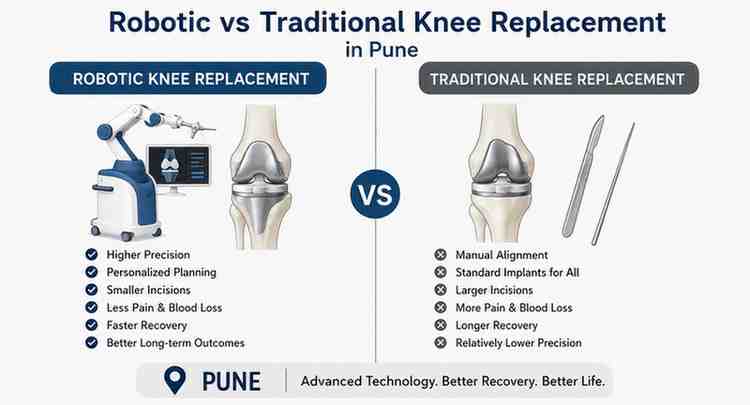
| Key Takeaways : 1. Robotic knee replacement uses 3D CT based planning for sub millimetre implant accuracy, while traditional surgery depends on manual jigs and the surgeon’s trained judgement. 2. Both techniques give reliable and long lasting results when performed by an experienced orthopaedic surgeon. 3. Robotic surgery often means less soft tissue disturbance, lower early pain scores and a faster first two weeks of recovery. 4. Traditional knee replacement remains a proven and cost effective option with decades of clinical evidence behind it. 5. Robotic surgery in Pune typically costs around Rs. 50,000 more than the standard procedure. 6. Dr. Swaroop Solunke, US fellowship trained in robotic knee replacement surgeon Also Hip Replacement surgeon , Joint replacement surgeon performs both techniques and helps patients choose based on knee anatomy, activity level and budget. |
| Clinic: Dr. Swaroop’s Ortho and Polyclinic, Wakad, PCMC, PuneSurgeon: Dr. Swaroop Solunke, MS Orthopaedics (Gold Medalist), US fellowship in robotic knee replacement, German fellowship in hip and knee arthroplastyExperience: 2,500 plus joint and trauma surgeries performed Standard single knee replacement: Rs. 1.7 lakh to Rs. 2.5 lakhRobotic add on cost: approximately Rs. 50,000 over the standard procedureTypical surgery duration: 60 to 90 minutes per knee |
Robotic or traditional knee replacement, which should you choose in Pune? Both approaches give dependable long term results in trained hands. Robotic surgery adds 3D CT based planning for precise implant placement, which can mean less pain and a faster early recovery. Traditional surgery relies on the surgeon’s experience with proven manual instruments and remains a solid choice for most patients.
This comparison comes from Dr. Swaroop’s Ortho and Polyclinic in Wakad, PCMC. Dr. Swaroop Solunke is US fellowship trained in robotic knee replacement and performs both techniques regularly, so this guide weighs the real differences rather than favouring one method over the other.
Robotic vs Traditional Knee Replacement: At a Glance
| Parameter | Robotic Knee Replacement | Traditional Knee Replacement |
| Planning method | 3D CT based virtual model before surgery | X-ray based templates and manual jigs |
| Implant alignment accuracy | Sub millimetre precision | Depends on surgeon’s manual skill |
| Soft tissue handling | More precise, often less disruption | Standard exposure and cuts |
| Average blood loss | Generally lower | Slightly higher on average |
| Early pain levels (Industry estimate) | Often lower in the first week | Moderate, well managed with medication |
| Typical hospital stay | 2 to 3 days | 3 to 4 days |
| Surgery cost in Pune (single knee) | Rs. 2.2 lakh to Rs. 3.0 lakh approx. | Rs. 1.7 lakh to Rs. 2.5 lakh |
What Is Robotic Knee Replacement?
Robotic knee replacement uses a CT scan of your knee to build a 3D model before surgery. Dr. Solunke plans the implant size, position and alignment on this model in advance. During surgery, a robotic arm guides the bone cuts within the planned boundaries while the surgeon controls every movement. The robot does not operate on its own. It acts as a precision guide that keeps the cuts within a fraction of a millimetre of the plan.
This planning stage helps balance the ligaments around the knee more accurately, which affects how natural the joint feels after healing. Robotic assistance is particularly useful for knees with significant deformity, previous fractures or unusual anatomy.
What Is Traditional Knee Replacement?
Traditional or manual knee replacement uses X-ray based templates and mechanical jigs to guide the bone cuts. The surgeon relies on training, experience and intraoperative judgement to achieve correct alignment and ligament balance. This technique has been refined over several decades and remains the standard approach worldwide, with a strong long term track record.
For a large majority of patients with straightforward knee arthritis and normal anatomy, traditional knee replacement gives results that are just as durable as the robotic method.
Accuracy and Implant Alignment
The main technical difference lies in planning accuracy. Robotic systems can place implants within about one degree of the planned angle and under one millimetre of the planned position. Traditional surgery, in experienced hands, typically achieves alignment within two to three degrees. For most patients this difference does not change the final outcome, but for complex knees with severe bowing, prior injury or unusual bone shape, the extra precision of robotic planning can matter more.
Pain, Blood Loss and Early Recovery
Because robotic cuts are more precise, there is often less disturbance to the soft tissue around the knee. Patients frequently report lower pain scores in the first week and reach milestones such as walking with a stick or climbing a few steps slightly earlier. Traditional knee replacement patients recover well too, and with modern multimodal pain management, both groups are usually walking with support within the first two days after surgery.
Recovery Timeline: Robotic vs Traditional
| Recovery Milestone | Robotic Knee Replacement | Traditional Knee Replacement |
| Walking with support | Day 1 to 2 | Day 2 to 3 |
| Climbing stairs without support | Around week 3 | Week 4 to 5 |
| Back to desk work | Week 3 to 4 | Week 4 to 6 |
| Driving resumes | Week 4 to 5 | Week 5 to 6 |
| Full activity including travel | Week 8 to 10 | Week 10 to 12 |
Long Term Outcomes: Is One Better Than the Other?
Long term studies comparing robotic and traditional knee replacement show similar implant survival rates at ten years when both are performed by an experienced surgeon. The choice of technique matters less than the surgeon’s skill, the patient’s bone quality and how well the rehabilitation plan is followed. Dr. Solunke advises patients that neither method is universally better. Each has a role depending on the individual knee.
Cost Comparison in Pune (2026)
| Procedure | Approximate Cost Range |
| Standard single knee replacement | Rs. 1.7 lakh to Rs. 2.5 lakh |
| Robotic single knee replacement | Rs. 2.2 lakh to Rs. 3.0 lakh |
| Robotic add on over standard surgery | Approximately Rs. 50,000 |
| Bilateral knee replacement (both knees, traditional) | Rs. 4.3 lakh to Rs. 5.5 lakh |
Final cost depends on implant brand, hospital category, room type and length of stay. Most major mediclaim and corporate insurance plans in Pune cover knee replacement, including the robotic add on in many cases. It is worth checking your policy terms before surgery.
Who Should Choose Robotic Knee Replacement?
- Patients with significant knee deformity, bow leg or knock knee alignment
- Patients who have had a previous fracture or surgery around the knee
- Younger, active patients who want the highest possible implant precision
- Patients willing to pay the additional robotic fee for extra accuracy
Who Should Choose Traditional Knee Replacement?
- Patients with straightforward osteoarthritis and normal knee anatomy
- Patients who prefer a technique with the longest clinical track record
- Patients working within a tighter budget
- Patients undergoing bilateral surgery where cost adds up across both knees
Dr. Swaroop Solunke’s Approach at Wakad, PCMC
Dr. Swaroop Solunke is a US fellowship trained orthopaedic surgeon in robotic knee replacement and holds a German fellowship in hip and knee arthroplasty. He has performed over 2,500 joint and trauma surgeries at Dr. Swaroop’s Ortho and Polyclinic in Wakad. Because he is trained in both techniques, he examines your X-rays, knee alignment and lifestyle needs before recommending robotic or traditional surgery rather than defaulting to one method for every patient.
Every consultation includes a physical examination, a review of your X-rays or MRI, and a clear explanation of expected recovery time and cost for the technique best suited to your knee.
Knee Replacement Support Across Wakad, PCMC and Western Pune
Patients travel to Dr. Swaroop’s Ortho and Polyclinic from across Wakad, Hinjewadi, Nigdi, Pimple Saudagar and Aundh for both robotic and traditional knee replacement. The clinic’s location in Wakad makes it convenient for IT professionals and senior citizens living along the Hinjewadi to Aundh stretch to attend pre-surgery consultations, physiotherapy sessions and post-operative reviews without long travel. Patients living further away, including Chinchwad, Chakan and Nigdi, are also guided on nearby physiotherapy support for the weeks after discharge.
Frequently Asked Questions
Q.1 Is robotic knee replacement always better than traditional surgery?
Not always. Robotic knee replacement surgery in pune offers greater planning precision, which helps most with complex or deformed knees. For straightforward arthritis in a normally aligned knee, traditional surgery gives comparable long term results at a lower cost.
Q.2 How much more does robotic knee replacement cost in Pune?
Robotic surgery in Pune typically costs around Rs. 50,000 more than standard knee replacement, which itself ranges from about Rs. 1.7 lakh to Rs. 2.5 lakh for a single knee, depending on implant and hospital category.
Q.3 Does robotic surgery mean a shorter hospital stay?
Often yes, by around a day. Robotic patients typically stay 2 to 3 days compared with 3 to 4 days for traditional surgery, though this varies with age, general health and how surgery is tolerated.
Q.4 Can both knees be replaced in the same sitting?
Yes, bilateral knee replacement is possible for suitable patients and typically costs Rs. 4.3 lakh to Rs. 5.5 lakh for the traditional approach. Dr. Solunke assesses fitness for bilateral surgery on a case by case basis.
Q.5 Is robotic knee replacement covered by insurance?
Most major mediclaim and corporate insurance plans cover knee replacement in India, and many also cover the robotic add on. Coverage details vary by policy, so it is best to verify with your insurer before scheduling surgery.
Q.6 How soon can I walk after knee replacement?
Most patients start walking with support on the first or second day after surgery, whether robotic or traditional, as part of the clinic’s early mobilisation protocol.
Q.7 Who is not a good candidate for robotic knee replacement?
Patients with certain bone conditions, prior hardware that interferes with the robotic pins, or those unwilling to pay the additional fee may be better suited to traditional surgery. Dr. Solunke discusses suitability during the initial consultation.
| Book a Knee Replacement Consultation Visit Dr. Swaroop’s Ortho and Polyclinic in Wakad, PCMC for a personal assessment with Dr. Swaroop Solunke, US fellowship trained in robotic knee replacement, to find the right option for your knee and budget. |

Dr. Swaroop Solunke
- Fellowship in Arthroplasty (Germany)- Bruderkrankenhaus St. Josef Paderborn, Germany.
- Fellowship in Primary and Revision Hip Replacement – Dr. Luigi Zagra IRCCS Instituto Orthopedia Galeazzi, Milan, Italy.
- Fellowship in Arthroplasty (Germany)- Bruderkrankenhaus St. Josef Paderborn, Germany.
- Fellowship in Robotic Knee Replacement – The Stone Research Foundation, San Francisco, California, USA.
- MS - Orthopaedics (Gold Medalist) – MGM Medical College and Hospital.
- MBBS – Dr. DY Patil University, Navi Mumbai.
- Member of Indian Medical Association (IMA)