
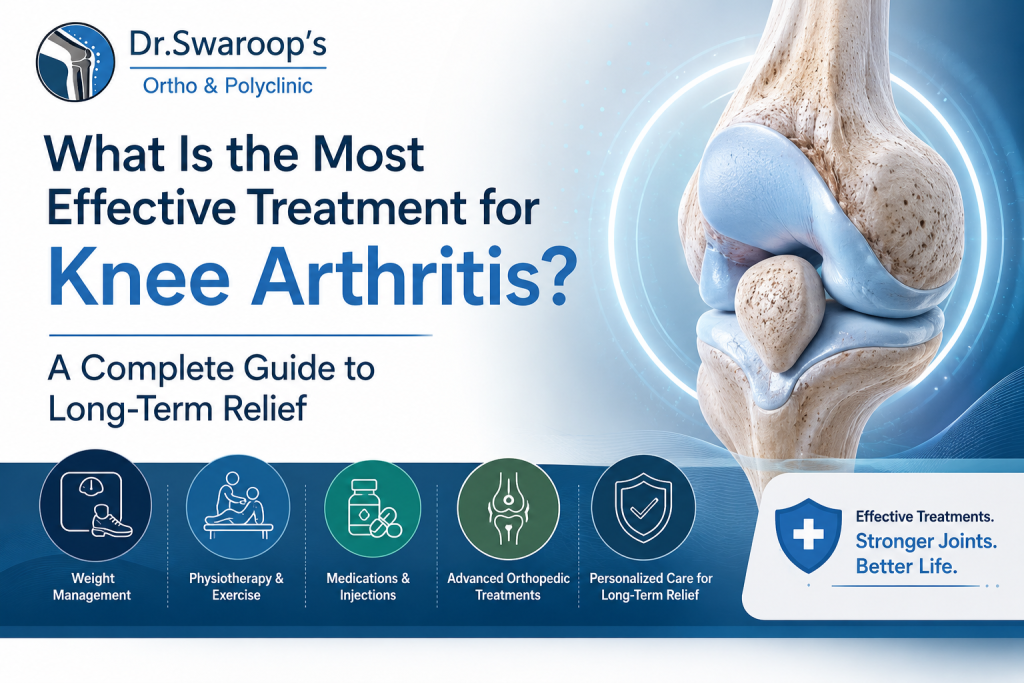
Knee arthritis is one of the most common causes of chronic knee pain and reduced mobility among adults. Whether the discomfort begins as mild stiffness while climbing stairs or progresses into severe pain affecting daily activities, arthritis of the knee can significantly impact quality of life. The good news is that several effective treatment options are available today — ranging from lifestyle modifications and physiotherapy to advanced injections and knee replacement surgery.
Understanding the most effective treatment for knee arthritis depends on the severity of the condition, age, activity level, weight, overall health, and the type of arthritis affecting the knee joint.
In this detailed guide, we will explain everything patients need to know about knee arthritis treatment, including symptoms, causes, diagnosis, non-surgical options, advanced therapies, and surgical solutions.
What Is Knee Arthritis?
Knee arthritis is a degenerative condition in which the cartilage cushioning the knee joint gradually wears away. Cartilage acts as a shock absorber between bones. When it deteriorates, the bones begin rubbing against each other, causing pain, swelling, stiffness, and difficulty in movement.
The knee joint is one of the most heavily used joints in the body, making it highly vulnerable to arthritis over time.
- Swelling
- Joint damage
- Deformity over time
The inflammation destroys cartilage and surrounding tissues, leading to chronic pain and stiffness. Other autoimmune conditions may also contribute to knee joint inflammation.
How Is Knee Arthritis Diagnosed?
Early diagnosis helps slow disease progression and improve outcomes.
- Physical Examination
An orthopedic specialist evaluates:
- Joint movement
- Swelling
- Tenderness
- Walking pattern
- Joint alignment
2. X-Rays
X-rays help identify:
- Joint space narrowing
- Bone spurs
- Cartilage loss
- Deformities
3. MRI Scan
MRI may be recommended to assess:
- Ligaments
- Meniscus
- Cartilage condition
- Soft tissue damage
4. Blood Tests
These are mainly used to diagnose rheumatoid arthritis or inflammatory conditions.
What Is the Most Effective Treatment for Knee Arthritis?
There is no single treatment suitable for everyone. The most effective treatment depends on the stage of arthritis and the patient’s lifestyle goals.
Treatment generally falls into two categories:
- Non-surgical treatment
- Surgical treatment
Non-Surgical Treatment for Knee Arthritis
Most patients with early or moderate arthritis can manage symptoms effectively without surgery.
1. Weight Loss and Lifestyle Changes
Weight reduction is one of the most effective natural treatments for knee arthritis.
Even losing 5–10% of body weight can significantly reduce knee pain because the knees bear multiple times the body weight during walking.
Helpful Lifestyle Modifications:
- Avoid prolonged standing
- Use supportive footwear
- Avoid high-impact exercises
- Take breaks during physical activity
- Maintain proper posture
2. Physiotherapy for Knee Arthritis
Physiotherapy is considered one of the best long-term treatments for knee arthritis.
A physiotherapist helps strengthen muscles surrounding the knee, reducing pressure on the joint.
Benefits of Physiotherapy:
- Improves mobility
- Reduces stiffness
- Strengthens quadriceps muscles
- Enhances balance
- Decreases pain naturally
Effective Exercises Include:
- Straight leg raises
- Hamstring stretches
- Quadriceps strengthening
- Cycling
- Water exercises
Consistency is essential for long-term improvement.
3. Medications for Knee Arthritis
Medications help control pain and inflammation.
Commonly Prescribed Medicines:
- Paracetamol
- NSAIDs (Ibuprofen, Diclofenac)
- Topical pain relief gels
- Anti-inflammatory drugs
However, long-term use should be monitored due to possible side effects on the stomach, kidneys, or heart.
4. Knee Braces and Support Devices
Knee braces help stabilize the joint and reduce pressure during movement.
Benefits:
- Better walking support
- Reduced pain
- Improved knee alignment
- Increased confidence during activity
Walking sticks may also help reduce stress on the affected knee.
5. Corticosteroid Injections
Steroid injections help reduce inflammation inside the knee joint.
Advantages:
- Fast pain relief
- Reduced swelling
- Improved movement
Limitations:
- Temporary relief
- Repeated injections may affect cartilage health
Doctors usually limit the number of steroid injections given annually.
6. Hyaluronic Acid Injections
These injections improve lubrication inside the knee joint.
They are often recommended for moderate osteoarthritis patients who do not respond adequately to medicines or physiotherapy.
Benefits:
- Reduced joint friction
- Better mobility
- Temporary pain relief
Results may last several months in some patients.
7. PRP Therapy for Knee Arthritis
Platelet-Rich Plasma (PRP) therapy is an advanced regenerative treatment gaining popularity.
In PRP therapy:
- Blood is drawn from the patient
- Platelets are concentrated
- The solution is injected into the knee joint
Potential Benefits:
- Reduced inflammation
- Tissue healing support
- Pain reduction
- Improved function
PRP is commonly used in early arthritis cases.
Is Exercise Good for Knee Arthritis?
Many patients fear movement due to pain, but controlled exercise is actually beneficial.
Best Exercises for Knee Arthritis:
- Walking on flat surfaces
- Swimming
- Cycling
- Yoga
- Stretching exercises
Exercises to Avoid:
- Jumping
- Running on hard surfaces
- Deep squats
- Heavy weight lifting
Low-impact exercise improves circulation and joint flexibility.
Diet for Knee Arthritis
Diet plays an important role in inflammation control and weight management.
Foods That May Help:
- Fatty fish rich in omega-3
- Nuts and seeds
- Green leafy vegetables
- Fruits rich in antioxidants
- Whole grains
Foods to Limit:
- Processed foods
- Sugary beverages
- Excess salt
- Fried foods
Maintaining a healthy diet can support overall joint health.
Advanced Knee Arthritis Treatment Options
When conservative treatments fail, advanced interventions may be recommended.
1. Arthroscopy
Arthroscopy involves inserting a small camera into the knee joint to treat specific problems.
However, arthroscopy is not usually effective for advanced osteoarthritis.
It may help in:
- Meniscus tears
- Loose cartilage fragments
- Early degenerative changes
2. Osteotomy Surgery
This procedure involves reshaping bones to shift weight away from the damaged knee area.
It is mainly recommended for:
- Younger patients
- Limited arthritis in one knee compartment
3. Partial Knee Replacement
If arthritis affects only one section of the knee, partial knee replacement may be suitable.
Benefits:
- Smaller incision
- Faster recovery
- More natural knee movement
- Less bone removal
4. Total Knee Replacement Surgery
For severe arthritis with significant pain and disability, total knee replacement is often considered the most effective long-term treatment.
During surgery:
- Damaged cartilage is removed
- Artificial implants replace the joint surfaces
Consult Dr. Swaroop Solunke – Leading Orthopedic Surgeon in Wakad, PCMC & Pune
If you are suffering from chronic knee pain, stiffness, difficulty walking, or advanced knee arthritis, early consultation with an experienced orthopedic specialist can help prevent further joint damage and improve your quality of life.
One of the trusted names for advanced orthopedic and joint care in Wakad, PCMC, and Pune is Dr. Swaroop Solunke, known for his patient-focused approach, accurate diagnosis, and advanced treatment solutions for knee arthritis, joint pain, sports injuries, ligament problems, and orthopedic conditions.
With years of experience in orthopedic and joint replacement care, Dr. Swaroop Solunke provides both non-surgical and surgical treatment options tailored to the patient’s condition, age, lifestyle, and mobility goals.
Why Patients Trust Dr. Swaroop Solunke for Knee Arthritis Treatment
Patients from Wakad, Hinjawadi, Pimple Saudagar, Ravet, Punawale, Nigdi, Pimpri, Chinchwad, and various areas of Pune visit Dr. Swaroop Solunke for comprehensive orthopedic care.
Expertise in:
- Knee arthritis treatment
- Knee replacement surgery
- Joint pain management
- Sports injury treatment
- Ligament injury treatment
- Back pain and neck pain
- Fracture management
- Hip and shoulder pain treatment
- Orthopedic rehabilitation guidance
Advanced Solutions for Knee Arthritis
Dr. Swaroop Solunke focuses on providing personalized treatment plans based on the severity of arthritis and the patient’s daily activity requirements.
Non-Surgical Knee Arthritis Treatments
For early and moderate arthritis cases, treatment may include:
- Physiotherapy guidance
- Lifestyle modifications
- Weight management strategies
- Pain management medications
- Knee strengthening exercises
- Joint injections
- Mobility improvement programs
These treatments aim to reduce pain, improve flexibility, and delay surgery whenever possible.
Surgical Treatment for Severe Knee Arthritis
For patients with advanced arthritis and severe joint damage, surgical intervention may provide long-term relief.
Surgical Solutions Include:
- Partial knee replacement
- Total knee replacement
- Arthroscopic procedures
- Ligament reconstruction procedures
Modern surgical techniques help improve:
- Joint movement
- Walking ability
- Knee stability
- Overall quality of life
Importance of Early Orthopedic Consultation
Many patients ignore knee pain in the early stages and seek treatment only when movement becomes severely restricted. Early diagnosis and timely orthopedic care can:
- Slow arthritis progression
- Prevent severe joint deformity
- Improve mobility
- Reduce long-term complications
- Delay or avoid surgery in some cases
Persistent knee pain should never be ignored, especially if it affects walking, climbing stairs, or daily activities.
Patient-Focused Orthopedic Care
Dr. Swaroop Solunke emphasizes:
- Detailed patient evaluation
- Clear explanation of treatment options
- Conservative treatment whenever possible
- Advanced surgical care when required
- Long-term rehabilitation guidance
The goal is not only pain relief but also restoring confidence, movement, and independence in daily life.
Book Your the First Free Appointment to the Dr. Swaroop Solunke

Dr. Swaroop Solunke
- Fellowship in Arthroplasty (Germany)- Bruderkrankenhaus St. Josef Paderborn, Germany.
- Fellowship in Primary and Revision Hip Replacement – Dr. Luigi Zagra IRCCS Instituto Orthopedia Galeazzi, Milan, Italy.
- Fellowship in Arthroplasty (Germany)- Bruderkrankenhaus St. Josef Paderborn, Germany.
- Fellowship in Robotic Knee Replacement – The Stone Research Foundation, San Francisco, California, USA.
- MS - Orthopaedics (Gold Medalist) – MGM Medical College and Hospital.
- MBBS – Dr. DY Patil University, Navi Mumbai.
- Member of Indian Medical Association (IMA)