
Key Takeaways
- Exercises after knee replacement start within 24 hours of surgery and continue for 3 to 6 months
- Phase 1 focuses on circulation and basic activation, not strength
- Knee replacement exercises follow a clear weekly progression tied to healing stages
- A structured physical therapy program significantly improves long-term outcomes
- Nutrition, sleep, and consistency outside the gym matter as much as the exercises themselves
- Mild soreness is normal; sharp or worsening pain during exercise is not
Recovery from knee replacement is real work. Some days the progress feels invisible. Some sessions feel like going backward. That is normal. What matters is the cumulative effect of consistent effort over months, not how any single session feels. The patients who come out the other side with strong, functional knees are almost always the ones who showed up every day, did the exercises, and trusted the process.
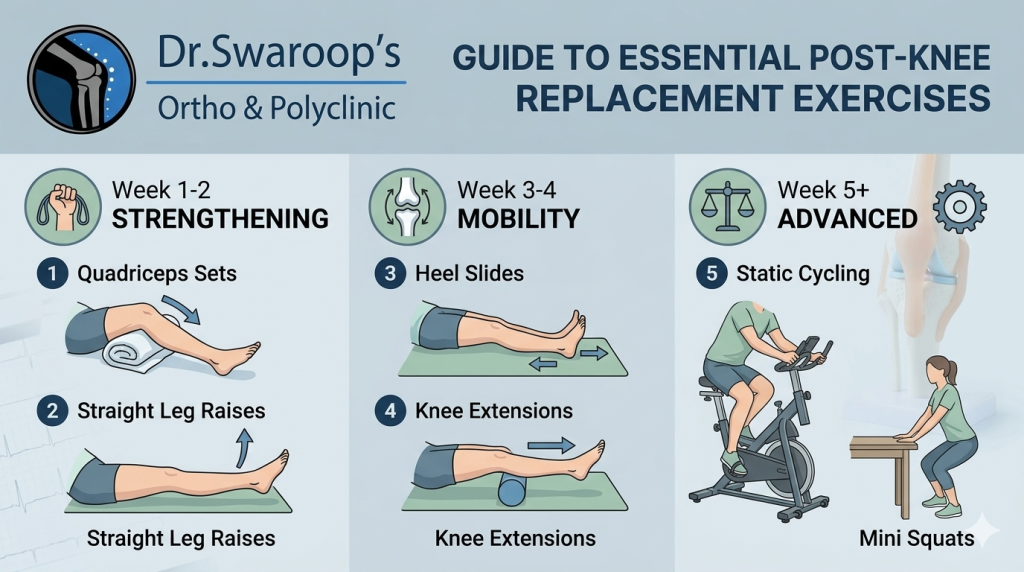
Exercises after knee replacement begin within 24 hours of surgery and follow a structured phase-based timeline. Week 1 focuses on gentle range-of-motion movements like quad sets and heel slides. Weeks 2-6 introduce walking and standing exercises. From week 6 onward, strengthening exercises like mini squats and step-ups take over. Full recovery takes 3-6 months with consistent daily effort.
Why Exercises After Knee Replacement Make or Break Your Recovery
Most people walk into knee replacement surgery expecting the procedure itself to do the heavy lifting. The truth is, the surgery is only half the equation. What happens in the weeks and months after the operation — the daily effort, the consistency, the willingness to push through discomfort — determines how well you actually recover.
The new joint needs movement to heal properly. When you stay still for too long, scar tissue builds up quickly around the surgical site. Stiffness follows. Range of motion drops. And once that happens, gaining it back takes significantly more time and effort than it would have if you had kept moving from the start.
Knee replacement exercises serve three clear purposes:
- Restore range of motion so the knee bends and straightens through its full functional arc
- Rebuild quadriceps and hamstring strength that declines both before surgery (from arthritis pain) and during recovery
- Support circulation to reduce post-surgical swelling and lower the risk of deep vein thrombosis
Research consistently shows that patients who follow a structured exercise program after knee replacement report better pain scores, better functional outcomes, and greater long-term satisfaction with their surgery. Skipping or shortcutting the rehab is one of the main reasons people feel let down by their results.
Phase 1: Days 1 to 7 — Early Hospital and Home Exercises
The first week of exercises after knee replacement is less about building strength and more about keeping the body moving and preventing complications. These movements are simple. They are also more important than most patients expect.
Ankle Pumps
Lie flat on your back. Point your toes toward the ceiling, then pull them back toward your shin. Repeat this pumping motion 10 to 20 times every hour you are awake. Ankle pumps keep blood moving through the lower leg and are one of the primary defenses against post-surgical blood clots.
Quad Sets
With your surgical leg flat on the bed, tighten the quadriceps muscle on the top of your thigh by pressing the back of your knee gently downward into the mattress. Hold for 5 to 10 seconds, then release. Aim for 10 to 15 repetitions, three to four times per day. This reactivates the quad muscle, which often shuts down after surgery due to pain and swelling.
Heel Slides
Slowly slide your heel along the bed toward your buttocks, bending the knee as far as it will comfortably allow. Hold briefly at the end range, then slide it back to flat. Repeat 10 to 15 times per session. This directly works on recovering flexion and will feel tight. That tightness is expected and normal.
Straight Leg Raises
Bend your non-surgical knee with that foot flat on the bed. Tighten the quad on your surgical leg and lift it about 12 inches off the surface. Hold 2 to 3 seconds, then lower slowly. Ten repetitions per set. This exercise activates the hip flexors and builds basic leg control without stressing the new joint.
Seated Knee Flexion and Extension
Sit upright on the edge of a bed or chair. Let gravity assist as you slowly lower your surgical leg, bending the knee. Then straighten it back up slowly. This is one of the most effective early exercises after knee replacement for recovering the bending motion.
What to expect in week one: Swelling, warmth around the knee, and general soreness after exercise are all normal. Apply ice for 15 to 20 minutes after sessions. If pain intensifies significantly during or after exercise and does not settle within 30 minutes, let your medical team know.
Phase 2: Weeks 2 to 6 — Mobility, Balance, and Walking
By the start of week two, most patients are moving with a walker and transitioning to outpatient physical therapy. The knee replacement exercises at this stage become more functional, targeting real movements used in daily life.
Short Arc Quads
Place a rolled towel or foam roll under your knee, elevating it 6 to 8 inches. Tighten the quad and extend the leg fully straight. Hold 5 seconds, then lower slowly. This targets the final degrees of knee extension where the quad is typically weakest after surgery.
Standing Knee Bends
Stand near a wall or countertop for support. Slowly lift your heel behind you, bending the surgical knee. Try to work toward 90 degrees of bend. Hold for 2 to 3 seconds, then lower. This builds active flexion strength in a standing position, which is closer to how the knee actually works during daily activity.
Seated Knee Extensions
Sit in a firm chair. Slowly straighten the surgical leg as much as possible, hold briefly, then lower. This builds quad strength through the same movement pattern used every time you rise from a chair or climb a step.
Stair Training
Your physical therapist will guide your stair technique. The standard approach is: lead with the non-surgical leg going up, lead with the surgical leg going down. “Up with the good, down with the bad.” It sounds straightforward, but getting this right protects the joint and reduces the risk of falls.
Structured Walking Program
Short, frequent walks are both exercise and therapy at this stage. Start with 5 to 10 minutes, two or three times daily on flat surfaces. Add a few minutes each week as tolerated. Use your walker or crutches until your therapist clears you to reduce support.
Phase 3: Weeks 6 to 12 — Building Functional Strength
This phase marks the transition from rehabilitation to real strengthening. The joint is more stable, swelling is reducing, and the muscles around the knee are ready to handle more load. The knee replacement exercises here directly mirror the movements of everyday life.
Mini Squats
Stand with feet shoulder-width apart, hands resting lightly on a counter or chair for balance. Bend both knees to about 30 to 45 degrees, hold 5 seconds, then rise back up. Start with 10 repetitions and build gradually. Keep your knees tracking over your toes and avoid letting them cave inward.
Step-Ups
Using a low step (4 to 6 inches to start), lead with the surgical leg stepping up. Bring the other foot up to meet it. Step back down. This exercise is fundamental for stairs, curbs, and getting into and out of vehicles. Work toward 15 to 20 repetitions as strength builds.
Terminal Knee Extensions with Resistance Band
Anchor a resistance band at knee height. Loop it around your surgical knee and stand facing the anchor point. Bend the knee slightly into the band’s resistance, then fully straighten. This isolates the final degrees of extension where the quad tends to stay weakest longest.
Calf Raises
Stand at a counter. Rise onto the balls of both feet, hold 2 seconds, then lower slowly. This strengthens the lower leg, supports overall balance, and continues to help with circulation.
Stationary Cycling
One of the most effective exercises after knee replacement from week 6 onward. The bike builds quadriceps strength and knee flexion simultaneously with very low joint impact. Set the seat height so the knee bends only slightly at the bottom of the pedal stroke. Start with no resistance for the first few sessions and add gradually over weeks.
Hamstring Curls
Stand at a counter or wall. Bend the surgical knee slowly, bringing your heel upward behind you. Hold briefly, lower. This targets the hamstring, which is often neglected during early rehab but critical for full knee stability.
Phase 4: Months 3 to 6 — Returning to Active Life
At this point most patients are walking unassisted and noticing week-over-week progress. The knee replacement exercises shift toward fitness rather than rehab, blending into a broader active lifestyle.
Key focus areas in this phase include:
- Strength progression: Leg press machine, shallow lunges, single-leg balance exercises
- Cardiovascular fitness: Extended walks, outdoor cycling, swimming
- Flexibility and mobility: Daily hamstring and quad stretching, foam rolling the surrounding muscles
Aquatic therapy is worth considering here if it is available. Pool walking and water-based exercise remove most of the load from the joint while still allowing meaningful resistance work. Many patients make faster progress in the water than on land during this phase.
The goal by month six is not just pain-free walking. It is confidence across varied terrain, the ability to handle stairs without hesitation, and getting back to the activities that mattered before the arthritis got bad.
How to Know If You Are Progressing Normally
Recovery timelines vary from person to person, but there are general benchmarks worth knowing:
| Timeframe | Expected Milestone |
|---|---|
| Day 1-3 | Walking short distances with walker, basic exercises started |
| Week 2 | Moving with walker, starting outpatient PT |
| Week 4-6 | Walking with single cane or unassisted on flat ground |
| Week 8-10 | Climbing stairs with minimal support |
| Month 3 | Most daily activities manageable without significant pain |
| Month 6 | Near-full function for most patients |
If you are consistently behind these milestones, it does not necessarily mean something is wrong. But it is a good reason to check in with your surgeon or physical therapist.
Common Mistakes That Slow Recovery
Even patients who are genuinely committed to their rehab fall into these patterns:
Doing too much too soon. The first two weeks are not the time to push hard. Overloading the joint during early healing increases inflammation and swelling, which actually delays progress.
Skipping the early exercises because they feel too easy. Ankle pumps and quad sets feel like nothing. They are foundational for everything that comes after.
Long periods of sitting without movement. Even brief walks every hour in the early days matter. Prolonged sitting increases stiffness and swelling.
Stopping physical therapy early. A full course of PT typically runs 6 to 8 weeks minimum. Stopping at 3 or 4 weeks because things feel acceptable leaves significant strength and mobility gains unrealized.
Comparing recovery to others. Age, pre-surgery fitness, weight, overall health, and the type of replacement all influence recovery speed. Someone else’s six-week milestone is not your benchmark.
Nutrition and Sleep: The Overlooked Parts of Recovery
Exercise alone does not rebuild the body. Adequate protein intake supports muscle repair and rebuild after surgery. Most orthopedic specialists recommend 1.2 to 1.5 grams of protein per kilogram of body weight during active recovery. Anti-inflammatory foods including leafy greens, oily fish, and berries can support the healing environment.
Sleep is where much of the actual tissue repair happens. Pain management in the early weeks often disrupts sleep, but protecting as much sleep quality as possible genuinely accelerates the recovery process.
Frequently Asked Questions
Q: How soon after knee replacement should I start exercising? Most patients begin exercises after knee replacement within 12 to 24 hours of surgery, starting with ankle pumps and quad sets in the hospital bed. Early movement is a planned part of the surgical recovery protocol, not an optional add-on.
Q: What are the best exercises after knee replacement for regaining full bend? Heel slides, seated knee flexion, and stationary cycling are the most consistently effective knee replacement exercises for recovering flexion. Consistency across weeks matters more than intensity in any single session.
Q: How long does it take to walk normally after knee replacement? Most people walk with a normal gait pattern by 6 to 8 weeks post-surgery, though this varies based on pre-surgery fitness, body weight, and exercise adherence.
Q: Can I overdo exercises after knee replacement? Yes. Training through sharp or severe pain, or attempting high-impact activity too early, can cause inflammation setbacks. The practical guide: mild muscle soreness is normal and expected. Sharp joint pain or pain that worsens after exercise and does not settle is a reason to stop and speak with your therapist.
Q: Is stationary cycling good after knee replacement? It is one of the most recommended exercises after knee replacement from week 6 onward. Low impact, effective for both strength and range of motion, and easy to control for intensity. Most surgeons clear outdoor cycling around the 3-month mark.
Q: What exercises should be avoided after knee replacement? Running, jumping, and racquet sports are generally restricted for at least 6 months. Deep squats, lunges past 90 degrees, and direct kneeling on the surgical site should be discussed individually with your surgeon before attempting.
Q: How many times a day should I do knee replacement exercises? In the first few weeks, most exercises are performed 3 to 4 times daily in shorter sessions. From weeks 4 to 6 onward, one or two longer structured sessions per day is the standard. Your physical therapist will build a specific schedule based on your progress.
Q: When can I return to work after knee replacement? Patients with desk jobs typically return to work within 4 to 6 weeks. Those with physically demanding jobs may need 3 months or more. This should always be discussed with your surgeon based on the specific demands of your role.
Ready to Get Expert Guidance on Your Knee Recovery?
Reading about exercises after knee replacement is a good start. But every patient is different, every surgery is different, and getting your recovery plan right from day one makes a real difference in how far you get.
Dr. Swaroop Solunke is an experienced orthopedic specialist providing expert care in joint replacement, knee rehabilitation, and orthopedic treatment in PCMC. If you or someone in your family has recently had a knee replacement, or is planning one, getting the right guidance from a specialist can help you recover faster and more completely.
Know more about orthopedic services and book your consultation with Dr. Swaroop Solunke.
Visit: orthopedicclinicinpcmc Website
Take the first step toward a stronger, pain-free recovery today.

Dr. Swaroop Solunke
- Fellowship in Arthroplasty (Germany)- Bruderkrankenhaus St. Josef Paderborn, Germany.
- Fellowship in Primary and Revision Hip Replacement – Dr. Luigi Zagra IRCCS Instituto Orthopedia Galeazzi, Milan, Italy.
- Fellowship in Arthroplasty (Germany)- Bruderkrankenhaus St. Josef Paderborn, Germany.
- Fellowship in Robotic Knee Replacement – The Stone Research Foundation, San Francisco, California, USA.
- MS - Orthopaedics (Gold Medalist) – MGM Medical College and Hospital.
- MBBS – Dr. DY Patil University, Navi Mumbai.
- Member of Indian Medical Association (IMA)