
Reviewed by: Dr. Swaroop Solunke, Orthopedic Surgeon and Knee Replacement Surgeon (Robotic-Assisted and Traditional Techniques)
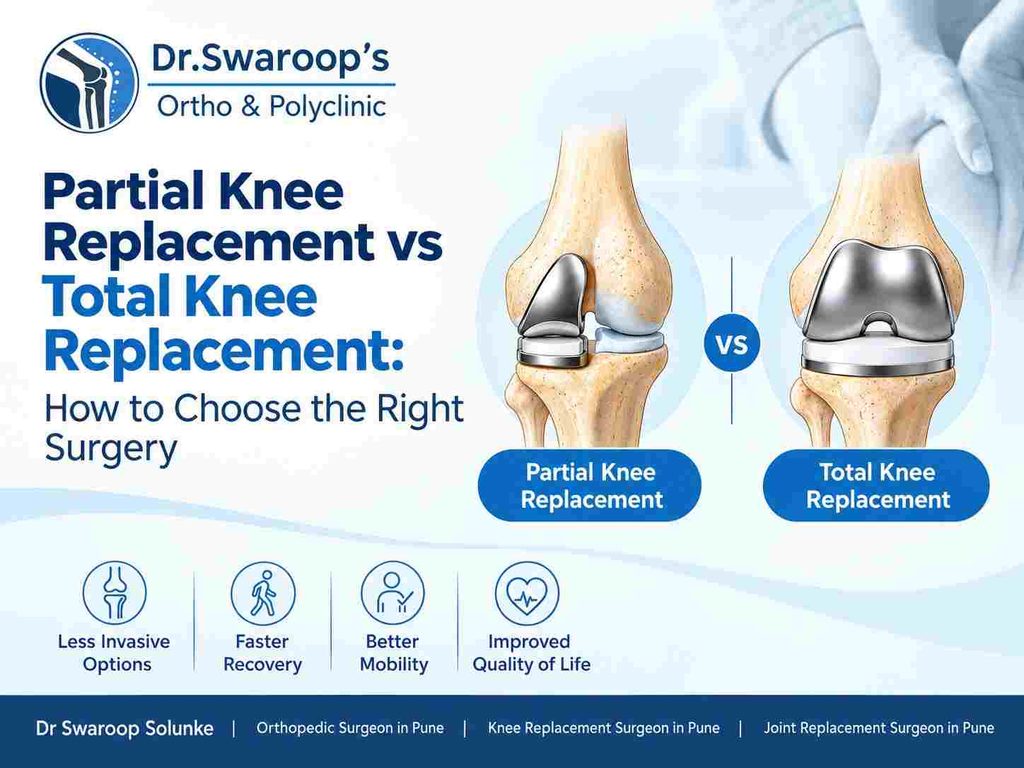
Partial knee replacement vs total knee replacement depends on how far arthritis has spread. A partial replacement resurfaces one damaged compartment and keeps your own ligaments. A total replacement resurfaces the whole joint. Your surgeon decides after an examination, standing X-rays and a ligament assessment.
Key Takeaways
- Partial knee replacement vs total knee replacement comes down to scope. Partial resurfaces one damaged compartment of the knee. Total resurfaces all three.
- The condition of your knee decides the choice. Arthritis in one compartment with a working ligament points towards a partial replacement. Wider arthritis points towards a total replacement.
- Early recovery tends to be quicker after a partial replacement.
- Robotic-assisted and traditional techniques can both be used for either operation.
- Dr. Swaroop Solunke performs both techniques such as partial knee replacement surgery in pune and total knee replacement surgery in pune advises on the choice after examination and imaging.
Quick Facts
- Partial knee replacement surgery in pune : one compartment resurfaced, your own ACL retained.
- Total replacement surgery in pune: all three compartments resurfaced, ACL usually removed.
- Techniques offered by Dr. Solunke: robotic-assisted and traditional.
- Common reason for surgery: arthritis pain that has not settled with medicines, injections or physiotherapy.
- Core question: partial knee replacement vs total knee replacement depends on how many compartments are worn.
Knee pain that limits stairs, walking and sleep leads many people to one question: does the whole knee need replacing or only part of it? Surgery is usually considered after medicines, injections, weight management and physiotherapy stop controlling the pain. The answer to partial knee replacement vs total knee replacement does not rest on age or preference alone. It rests on what the inside of your knee looks like. This guide explains each operation, who suits each one, how recovery and durability compare and where robotic assistance fits. Dr. Swaroop Solunke, who performs both robotic-assisted and traditional knee replacement, reviewed it.
What Is Partial Knee Replacement and What Is Total Knee Replacement?
Understanding partial knee replacement vs total knee replacement starts with anatomy. The knee has three compartments: the inner (medial) compartment, the outer (lateral) compartment and the kneecap (patellofemoral) compartment. Cartilage can wear out in one, two or all three.
Partial knee replacement, also called unicompartmental knee arthroplasty, replaces the worn surfaces of one compartment with metal and plastic implants. The rest of the joint stays untouched. Total knee replacement resurfaces the ends of the thigh bone and shin bone and usually the back of the kneecap.
Most total replacements involve removing the anterior cruciate ligament (ACL), and the implant design supplies the stability instead. A partial replacement keeps your own ACL, which is one reason many patients describe the knee as feeling more natural.
How Does Partial Knee Replacement vs Total Knee Replacement Compare Side by Side?
The table below sets the main points side by side.
| Point | Partial knee replacement | Total knee replacement |
| Area treated | One compartment | All three compartments |
| Bone removed | Less bone and cartilage | More bone and cartilage |
| ACL | Kept | Usually removed |
| Incision | Smaller | Longer |
| Early recovery | Tends to bring less blood loss and a shorter time on walking aids | Takes longer to regain comfort |
| Long-term record | Higher revision rates in registries | Lower revision rates in registries |
| Arthritis pattern | One compartment | Two or three compartments or inflammatory arthritis |
| Later surgery | Can be converted to a total replacement | A revised total is a larger operation |
Who Is a Suitable Candidate for Partial Knee Replacement?
In partial knee replacement vs total knee replacement, candidacy depends on the condition of the knee more than on age, occupation or activity level. A partial replacement usually suits a patient who has:
- Arthritis in one compartment, most often the inner side, confirmed on standing X-rays or MRI.
- A working ACL, because the partial implant relies on it for stability.
- A knee that bends and straightens well, with only a mild fixed bend or deformity.
Several findings point away from a partial replacement. Rheumatoid and other inflammatory arthritis affects the whole joint lining. Arthritis in two or three compartments, a torn ACL and a stiff knee also favour a total replacement. Industry estimate: roughly one in four patients with knee arthritis fits the pattern for a partial replacement, and about nine in ten knee replacements performed are total replacements.
Surgeons sometimes find wider damage during the operation than imaging showed. The surgeon may then move to a total replacement, so you should discuss and consent to that possibility before surgery.
Who Needs a Total Knee Replacement Instead?
A total replacement is the standard choice when arthritis spreads across the joint, which shifts the balance in partial knee replacement vs total knee replacement. It suits patients with damage in two or three compartments, marked deformity such as bow legs or knock knees, inflammatory arthritis or a ligament-deficient knee.
Because the whole joint is resurfaced, no untreated cartilage remains to wear out later. This is the main reason total replacement has the longer and more predictable record. Surgeons commonly advise a well-matched total replacement over a poorly matched partial one.
Partial Knee Replacement vs Total Knee Replacement: How Does Recovery Differ?
Both operations need physiotherapy from day one. A partial replacement disturbs less bone and soft tissue, so early pain, swelling and blood loss tend to be lower and walking aids come off sooner.
One published surgeon account describes a walking aid for about two weeks after a partial and three to four weeks after a total. The same account describes roughly 80 to 90 percent recovery by two to three months after a partial, against four to five months after a total. Recovery varies with fitness, body weight and commitment to exercises.
In the clinic’s experience, most knee replacement patients walk with support on day one and climb stairs by week three. A subvastus knee replacement spares the thigh muscle, which supports early movement after a total replacement.
Partial Knee Replacement vs Total Knee Replacement: Which Lasts Longer?
The numbers show a trade-off, and the drawbacks of partial replacement deserve attention first.
- Revision rate: a meta-analysis of 124 studies covering 374,934 knee replacements, published in The Knee, found annual revision rates of 0.49 percent for total replacement and 1.07 percent for medial partial replacement. That is roughly double.
- Conversion: a Danish registry study covering 1997 to 2017 found a total replacement performed after a failed partial had a 15-year implant survival of 78 percent, against 94 percent for a first-time total replacement.
- Surgeon volume: an analysis of 459,280 records from the National Joint Registry for England and Wales found eight-year survival of 88 percent for surgeons performing fewer than ten partial replacements a year and 92 percent for those performing thirty or more.
On the other side of partial knee replacement vs total knee replacement sit the benefits. The TOPKAT trial randomised 962 people with inner-compartment arthritis to partial or total replacement. A 2026 report in Lancet Rheumatology found partial replacement more cost-effective, with higher health benefit at lower cost. Some patients accept the higher revision rate in return for a quicker early recovery and a more natural-feeling knee.
Where Does Robotic-Assisted Surgery Fit in Partial Knee Replacement vs Total Knee Replacement?
Robotic-assisted surgery uses a three-dimensional plan of your knee to guide bone cuts and implant position. The plan is built from imaging or from measurements taken during surgery, depending on the system. The surgeon still performs the operation. Traditional surgery uses mechanical cutting guides together with the surgeon’s measurements and judgement.
The evidence reads as follows:
- Alignment: a meta-analysis of seven randomised trials covering 1,942 knees found closer implant alignment with robotic total replacement.
- Function and complications: the same analysis found clinical scores, functional scores and complication rates statistically similar to traditional surgery.
- Operating time: a separate review found longer operating time with robotic assistance.
- Partial replacement: the same review found stronger short-term function after robotic partial replacement than after conventional partial replacement.
- Follow-up: researchers ask for longer-term trials with newer systems.
Robotic assistance refines placement in both halves of partial knee replacement vs total knee replacement. It is not essential for either operation. The clinic lists robotic knee replacement at about Rs. 50,000 above the standard price, so the choice deserves a clear discussion of what it adds for your knee.
How Does Dr. Swaroop Solunke Approach Partial Knee Replacement vs Total Knee Replacement?
Dr. Swaroop Solunke is a fellowship-trained orthopedic surgeon in pune and knee replacement surgeon in pune . He performs robotic-assisted and traditional knee replacement and operates himself. His training includes a robotic knee replacement fellowship at the Stone Research Foundation in San Francisco, an arthroplasty fellowship at St. Josef Hospital in Paderborn, Germany and an MS in Orthopaedics (gold medalist) from MGM Medical College and Hospital.
The first consultation takes about 30 minutes and ends with a written plan. The assessment covers:
- History and examination: pain location, walking distance, stairs, night pain and knee stability.
- Imaging: standing X-rays and, when needed, MRI to map which compartments are worn.
- Ligament check: whether the ACL is intact.
- Technique: a discussion of robotic-assisted knee replacement surgery in pune and traditional options with their costs.
- Contingency: consent that covers a switch to total replacement if surgery shows more damage than imaging.
What Does Knee Replacement Cost?
The clinic lists a single knee replacement at Rs. 1.7 to 2.5 lakh and both knees at Rs. 4.3 to 5.5 lakh. Robotic assistance adds about Rs. 50,000. Final cost depends on implant brand, hospital category and length of stay. The clinic accepts most major insurance plans and corporate mediclaim. Ask for a written quote for your specific operation, because pricing in partial knee replacement vs total knee replacement can differ with implant choice.
What Should You Ask Before Choosing Partial Knee Replacement vs Total Knee Replacement?
- Which compartments are worn on my imaging?
- Is my ACL intact?
- How many partial knee replacements do you perform each year?
- What happens if surgery shows more damage than imaging?
- What does robotic assistance add for my knee, and what does it cost?
- What does the physiotherapy plan look like in the first six weeks?
Frequently Asked Questions
What is the main difference in partial knee replacement vs total knee replacement?
Scope. A partial replacement treats one worn compartment and keeps your ACL. A total replacement treats the whole joint. Scope shapes the incision, the recovery pattern and the long-term record.
Is partial knee replacement better than total knee replacement?
Neither suits every knee. A partial replacement suits arthritis in one compartment with a working ACL and offers quicker early recovery. A total replacement suits wider arthritis and shows lower revision rates in registries. The condition of your knee decides.
Can a partial knee replacement be converted to a total knee replacement?
Yes. If arthritis spreads or the partial implant loosens, surgeons convert it to a total replacement. Registry data show converted knees have lower implant survival than first-time total replacements, so the decision deserves careful thought at the start.
Is partial knee replacement less painful than total knee replacement?
Many patients report less pain in the early weeks after a partial replacement because the incision is smaller and less tissue is disturbed. Pain varies from person to person, and recovery after total replacement has also improved with muscle-sparing approaches.
Does robotic knee replacement suit both partial and total surgery?
Yes. Robotic-assisted systems are used for both. Trials found closer alignment with robotic total replacement but similar clinical scores, and one review found stronger short-term function after robotic partial replacement. Longer operating time and extra cost are the trade-offs.
a Consultation
Dr. Swaroop Solunke examines your knee, reviews your imaging and explains whether partial knee replacement vs total knee replacement fits your arthritis.
To schedule a consultation, call +91 7385486860 or message the clinic on WhatsApp.
Read about joint replacement surgery in pune at the clinic.

Dr. Swaroop Solunke
- Fellowship in Arthroplasty (Germany)- Bruderkrankenhaus St. Josef Paderborn, Germany.
- Fellowship in Primary and Revision Hip Replacement – Dr. Luigi Zagra IRCCS Instituto Orthopedia Galeazzi, Milan, Italy.
- Fellowship in Arthroplasty (Germany)- Bruderkrankenhaus St. Josef Paderborn, Germany.
- Fellowship in Robotic Knee Replacement – The Stone Research Foundation, San Francisco, California, USA.
- MS - Orthopaedics (Gold Medalist) – MGM Medical College and Hospital.
- MBBS – Dr. DY Patil University, Navi Mumbai.
- Member of Indian Medical Association (IMA)