
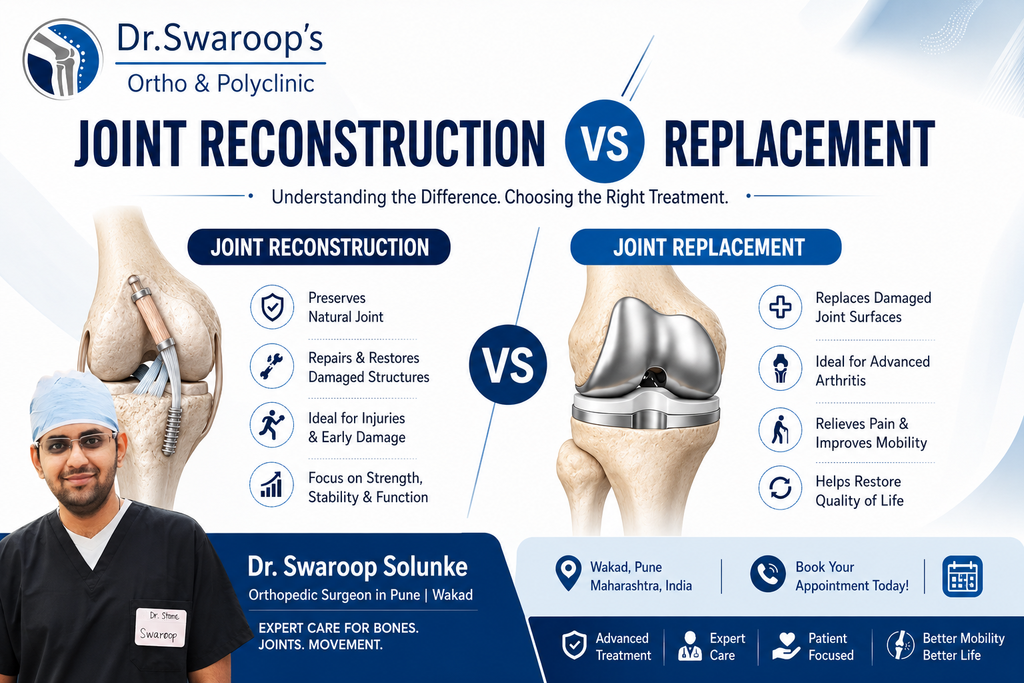
When a joint becomes painful, stiff, unstable, or difficult to move, patients are often told about different surgical options. Two terms that can cause confusion are joint reconstruction and joint replacement. Although both procedures aim to improve joint function and reduce pain, they are not the same treatment and are used for different types and stages of joint damage.
In simple terms, joint reconstruction generally focuses on repairing, restoring, preserving, or rebuilding the patient’s own joint structures, while joint replacement involves replacing damaged joint surfaces with artificial components. The appropriate approach depends on factors such as the extent of joint damage, age, activity level, bone quality, symptoms, previous injuries or surgeries, and overall health.
If you are experiencing persistent joint pain or have been advised to consider surgery, consultation with an experienced orthopedic specialist can help determine whether joint-preserving reconstruction, replacement, or non-surgical treatment is appropriate.
For patients looking for an orthopedic surgeon in Pune Wakad, Dr. Swaroop Solunke provides orthopedic evaluation and treatment based on the individual’s condition, joint damage, functional goals, and medical history.
What Is Joint Reconstruction?
Joint reconstruction is a broad term used for procedures designed to repair, restore, stabilize, or preserve a damaged joint rather than replacing the joint surfaces entirely.
Depending on the problem, reconstruction may involve repairing damaged ligaments, tendons, cartilage, bones, or other structures around a joint. Some reconstruction procedures are performed using minimally invasive or arthroscopic techniques, while more complex injuries may require open surgery.
Examples can include:
- Ligament reconstruction after certain sports injuries
- Cartilage restoration procedures
- Meniscus repair or reconstruction
- Joint-preserving procedures
- Bone realignment procedures
- Complex fracture reconstruction
- Revision or complex reconstruction around a previously operated joint
- Selected procedures designed to preserve as much of the natural joint as possible
The exact procedure depends on which part of the joint is damaged and whether the remaining joint surfaces are healthy enough to preserve.
The goal of reconstruction
The primary objective is generally to restore the function and stability of the existing joint while preserving the patient’s natural anatomy whenever appropriate. However, reconstruction does not automatically mean that a joint can be saved in every case. When cartilage loss or joint destruction is advanced, replacement may become a more appropriate surgical option.
What Is Joint Replacement?
Joint replacement, also called arthroplasty, involves removing or resurfacing damaged portions of a joint and using artificial components to restore the joint surface and movement. Hip and knee replacements are among the most common examples, although replacement procedures are also performed for joints such as the shoulder and ankle.
For example, in knee replacement, damaged portions of the knee joint may be removed and replaced with artificial surfaces. Total knee replacement replaces the damaged surfaces of the joint, while partial knee replacement may be considered when arthritis is limited to a particular compartment of the knee.
The goal of joint replacement
The goals can include:
- Reducing persistent joint pain
- Improving mobility
- Improving the ability to perform daily activities
- Correcting certain deformities or alignment problems
- Improving joint function
- Helping patients return to appropriate activities following rehabilitation
Joint replacement is commonly considered when joint damage is advanced and symptoms significantly affect everyday life despite appropriate non-surgical treatment.
Joint Reconstruction vs Replacement: Key Difference
The easiest way to understand the difference is to consider what the surgeon is trying to preserve or replace.
| Factor | Joint Reconstruction | Joint Replacement |
|---|---|---|
| Main objective | Repair, restore, stabilize, or preserve the existing joint | Replace damaged joint surfaces with artificial components |
| Natural joint | Attempts to preserve more of the patient’s natural structures when suitable | Damaged joint surfaces are replaced or resurfaced |
| Common situations | Ligament injury, cartilage problems, selected fractures, instability and joint-preserving conditions | Advanced arthritis, severe joint damage, certain fractures and end-stage joint conditions |
| Implant | May or may not require implants depending on the procedure | Requires an artificial joint component or components |
| Suitable damage | Often considered when useful natural joint structures remain | Often considered when joint surfaces are severely damaged |
| Age | Depends on the specific condition rather than age alone | Depends on symptoms, joint damage, health, activity and other factors |
| Recovery | Varies greatly according to the reconstruction performed | Varies according to the joint, procedure and individual recovery |
| Rehabilitation | Usually an important part of restoring strength, stability and movement | Essential for regaining movement, strength and functional ability |
| Long-term plan | Focuses on preserving or restoring the patient’s joint where possible | Focuses on providing a functional artificial joint surface |
| Decision | Based on injury pattern, tissue quality, joint condition and patient goals | Based on severity of joint damage, symptoms, function and overall suitability |
Important: There is no universal rule that reconstruction is preferable to replacement or vice versa. The appropriate procedure depends on the patient’s diagnosis and the condition of the joint.
When May Joint Reconstruction Be Considered?
Joint reconstruction may be discussed when the joint has a problem that can potentially be repaired, stabilized, or preserved. For example, a patient with a significant ligament injury may require reconstruction to restore stability. Similarly, selected cartilage or meniscal problems may be managed with repair or restoration procedures depending on the location and severity of the damage.
Reconstruction may be particularly relevant when:
- The joint still has usable healthy structures
- The primary problem is instability
- A ligament or tendon needs repair or reconstruction
- There is a repairable cartilage or meniscal injury
- A fracture requires anatomical restoration
- Joint preservation is considered clinically appropriate
- The patient has a specific structural injury rather than widespread end-stage arthritis
However, not every painful joint can be reconstructed. A detailed clinical examination and appropriate imaging are important before deciding.
When May Joint Replacement Be Considered?
Joint replacement may be considered when damage to the joint has become extensive enough that preserving the original joint surface is unlikely to provide adequate relief or function. Advanced arthritis can progressively damage the cartilage covering the joint surfaces. In severe knee arthritis, for example, cartilage can become significantly worn, resulting in pain, stiffness, reduced mobility and difficulty with daily activities.
A doctor may discuss replacement when a patient has:
- Persistent joint pain
- Significant cartilage loss
- Advanced arthritis
- Difficulty walking or performing daily activities
- Persistent stiffness
- Joint deformity or alignment problems
- Symptoms that have not improved adequately with appropriate conservative treatment
- Joint damage that is not suitable for joint-preserving surgery
Importantly, having arthritis does not automatically mean that a joint replacement is required. The decision depends on the severity of symptoms, examination findings, imaging, functional limitations, overall health and response to other treatments.
Joint Reconstruction vs Replacement for Knee Problems
The knee is one of the most common joints where patients hear about both reconstruction and replacement.
Reconstruction
Knee reconstruction may be considered for structural problems such as certain ligament injuries or other injuries where preserving the patient’s own joint is appropriate.
For example, an athlete with a significant ligament injury may require ligament reconstruction to restore knee stability.
Replacement
Knee replacement is generally considered for advanced joint damage, particularly when arthritis has caused substantial cartilage deterioration and persistent symptoms.
There are different forms of knee replacement, including:
- Total knee replacement
- Partial knee replacement
- Patellofemoral replacement in selected patients
A partial replacement may be an option when arthritis is confined to a specific compartment of the knee rather than affecting the entire joint.
This is one reason why a detailed evaluation is important: two patients with knee pain may require completely different treatments.
Joint Reconstruction vs Replacement for Hip Problems
- The hip is a ball-and-socket joint and can develop problems because of arthritis, trauma, fractures, cartilage damage and other conditions.
- In selected situations, hip-preserving procedures may be considered. One example is hip resurfacing, which preserves more of the natural bone than a traditional total hip replacement and is appropriate only for certain patients.
- For advanced hip arthritis or severe joint damage, total hip replacement may be recommended.
- A total hip replacement replaces the damaged joint surfaces with artificial components.
- The choice between preserving the joint and replacing it depends on the patient’s anatomy, bone quality, extent of damage, age, activity requirements and other clinical factors.
Joint Reconstruction vs Replacement for Shoulder Problems
Shoulder treatment can also involve reconstruction or replacement depending on the underlying problem.
Some shoulder conditions may be treated using procedures that repair or reconstruct tendons, ligaments or other structures. In selected patients with advanced arthritis or severe joint damage, shoulder replacement may be considered.
There are also different types of shoulder replacement. For example, anatomic and reverse shoulder replacement use different implant configurations, and the condition of the rotator cuff is an important consideration when choosing between them.
This illustrates an important point:
Replacement is not one single operation.
The type of replacement depends on the joint, the damaged structures and the patient’s individual anatomy and functional requirements.
What Factors Determine Reconstruction or Replacement?
An orthopedic surgeon does not make this decision based on an X-ray alone.
Several factors are considered together.
1. Extent of joint damage
The severity and location of cartilage, bone, ligament or soft-tissue damage can strongly influence treatment selection.
2. Symptoms
Imaging findings do not always correspond perfectly with symptoms. The amount of pain, stiffness and functional limitation matters.
3. Age and activity level
Age can be one consideration, but it should not be the only factor. Activity requirements, bone health and the condition of the joint also matter.
4. Previous injuries or surgeries
Previous fractures, ligament injuries, operations or implants can change the anatomy and affect treatment planning.
5. Bone and soft-tissue quality
The quality of the bone, ligaments, tendons and surrounding tissues can influence whether reconstruction or replacement is technically appropriate.
6. Overall health
Medical conditions, medications, fitness, weight, smoking status and other health factors may influence surgical planning and recovery.
7. Functional goals
A patient’s work, lifestyle, mobility requirements and expectations should be discussed with the surgeon.
8. Response to non-surgical treatment
Depending on the diagnosis, treatment may begin with options such as physiotherapy, activity modification, medication or other appropriate conservative measures. Surgery is not automatically the first option.
Can Joint Reconstruction Delay Joint Replacement?
- In some carefully selected cases, joint-preserving treatment may help maintain joint function and potentially delay the need for replacement.
- However, this should not be treated as a guaranteed outcome.
- The success of a reconstruction depends on the underlying diagnosis, tissue quality, extent of damage, rehabilitation and other individual factors.
- Some patients may benefit from reconstruction, while others with advanced joint degeneration may have better treatment options with replacement.
- This is why an orthopedic assessment should focus on the actual condition of the joint rather than simply choosing the procedure that sounds less invasive.
What Happens During an Orthopedic Evaluation?
When you consult an orthopedic doctor in Pune, the evaluation may include:
Medical history
The doctor may ask about:
- When the pain started
- Previous injuries
- Previous surgeries
- Pain during walking or activity
- Stiffness
- Swelling
- Instability
- Difficulty performing daily activities
- Previous treatments
Physical examination
The orthopedic specialist evaluates:
- Joint movement
- Strength
- Stability
- Alignment
- Tenderness
- Gait
- Muscle function
- Functional limitations
Imaging
Depending on the suspected problem, imaging may include X-rays, MRI, CT or other investigations.
The purpose is to understand what structure is damaged and how severe the damage is, rather than choosing surgery based solely on symptoms.
Recovery: Reconstruction vs Replacement
Recovery varies significantly between procedures. A ligament reconstruction, cartilage procedure, fracture reconstruction and joint replacement all have different rehabilitation protocols.
After joint replacement, rehabilitation commonly focuses on:
- Restoring movement
- Reducing swelling
- Improving muscle strength
- Walking safely
- Regaining independence
- Gradually returning to appropriate activities
After reconstruction, rehabilitation may focus more specifically on restoring stability, protecting the repaired structure and progressively rebuilding strength and movement. The recovery timeline depends on the specific surgery, the joint involved, the patient’s health, rehabilitation participation and the surgeon’s protocol.
Why Rehabilitation Matters After Surgery
Surgery is only one part of recovery.
Rehabilitation can be essential for:
- Regaining strength
- Improving flexibility
- Restoring movement
- Improving balance
- Learning safe movement patterns
- Returning to daily activities
- Gradually resuming appropriate physical activity
Patients should follow their surgeon’s and physiotherapist’s instructions rather than comparing their recovery timeline with another patient’s.
Questions to Ask Your Orthopedic Surgeon
Before deciding on reconstruction or replacement, consider asking:
- What exactly is damaged in my joint?
- How severe is the damage?
- Can the joint reasonably be preserved?
- What are my non-surgical treatment options?
- Why are you recommending reconstruction or replacement?
- What type of surgery would be performed?
- What are the potential risks and complications?
- How long might rehabilitation take?
- What activities can I expect to return to?
- What happens if I delay surgery?
- Are there alternative procedures suitable for my condition?
- What should I do before surgery to improve my recovery?
These questions can help you understand the reasoning behind the recommended treatment.
Joint Reconstruction vs Replacement: The Bottom Line
- The difference between joint reconstruction vs replacement comes down primarily to the condition of the joint and the goal of treatment.
- Joint reconstruction aims to repair, restore, stabilize or preserve existing joint structures when appropriate.
- Joint replacement uses artificial components to replace or resurface damaged joint surfaces when the original joint has sustained significant damage.
- Neither procedure is universally appropriate for every patient. The correct choice depends on the joint involved, severity and location of damage, symptoms, activity level, bone and soft-tissue condition, previous treatments and overall health.
- If you have persistent knee, hip, shoulder or other joint pain, an evaluation by an orthopedic specialist can help determine whether conservative treatment, reconstruction, replacement or another approach may be appropriate.
Consult Dr. Swaroop Solunke for Orthopedic Evaluation in Wakad, Pune
If joint pain is affecting your walking, work, exercise, sleep or everyday activities, getting the condition evaluated early can help you understand your treatment options.
Dr. Swaroop Solunke – Orthopedic Surgeon in Pune, Wakad provides orthopedic consultation and evaluation for patients dealing with joint pain, injuries, arthritis and other musculoskeletal problems.
Whether you are searching for an orthopedic surgeon in Pune Wakad, an orthopedic doctor in Pune, or an orthopedic clinic in Wakad, a personalized evaluation is important before deciding between joint reconstruction, joint replacement or non-surgical treatment.
Book an Orthopedic Consultation
Dr. Swaroop Solunke
Orthopedic Surgeon in Pune, Wakad
Orthopedic Doctor in Pune
Orthopedic Clinic in Wakad
Don’t ignore persistent joint pain or assume that replacement is your only option. Get your joint evaluated and understand the treatment choices available for your specific condition.
Call today to schedule a consultation with Dr. Swaroop Solunke.
Frequently Asked Questions
Is joint reconstruction the same as joint replacement?
No. Reconstruction generally refers to repairing, restoring, stabilizing or preserving damaged joint structures, whereas joint replacement involves replacing damaged joint surfaces with artificial components.
Is joint reconstruction better than replacement?
There is no universally better procedure. The appropriate treatment depends on the type and severity of joint damage, symptoms, patient factors and treatment goals.
Does everyone with arthritis need joint replacement?
No. Arthritis can often be managed with non-surgical treatments depending on its severity and the patient’s symptoms. Replacement may be considered when joint damage and symptoms become significant and other appropriate treatments do not provide sufficient relief.
Can joint reconstruction preserve my natural joint?
Some reconstruction procedures are specifically designed to preserve or restore natural joint structures. Whether this is possible depends on the type and extent of damage.
How do I know whether I need reconstruction or replacement?
A clinical examination, medical history and appropriate imaging can help an orthopedic surgeon determine the condition of your joint and discuss suitable treatment options.
Is joint replacement a permanent solution?
Joint implants can provide long-term function, but they are not guaranteed to last forever. Implant longevity varies according to factors such as the joint replaced, implant type, patient factors and activity. Some patients may eventually require revision surgery.
Can I avoid surgery for joint pain?
Depending on the diagnosis, non-surgical treatment may include physiotherapy, exercise, activity modification, medication or other treatments. The appropriate approach depends on the cause and severity of the problem.
When should I see an orthopedic doctor?
Consider an orthopedic evaluation when joint pain is persistent, recurrent, worsening, associated with swelling or instability, or interfering with walking, work, sleep, exercise or daily activities.

Dr. Swaroop Solunke
- Fellowship in Arthroplasty (Germany)- Bruderkrankenhaus St. Josef Paderborn, Germany.
- Fellowship in Primary and Revision Hip Replacement – Dr. Luigi Zagra IRCCS Instituto Orthopedia Galeazzi, Milan, Italy.
- Fellowship in Arthroplasty (Germany)- Bruderkrankenhaus St. Josef Paderborn, Germany.
- Fellowship in Robotic Knee Replacement – The Stone Research Foundation, San Francisco, California, USA.
- MS - Orthopaedics (Gold Medalist) – MGM Medical College and Hospital.
- MBBS – Dr. DY Patil University, Navi Mumbai.
- Member of Indian Medical Association (IMA)