
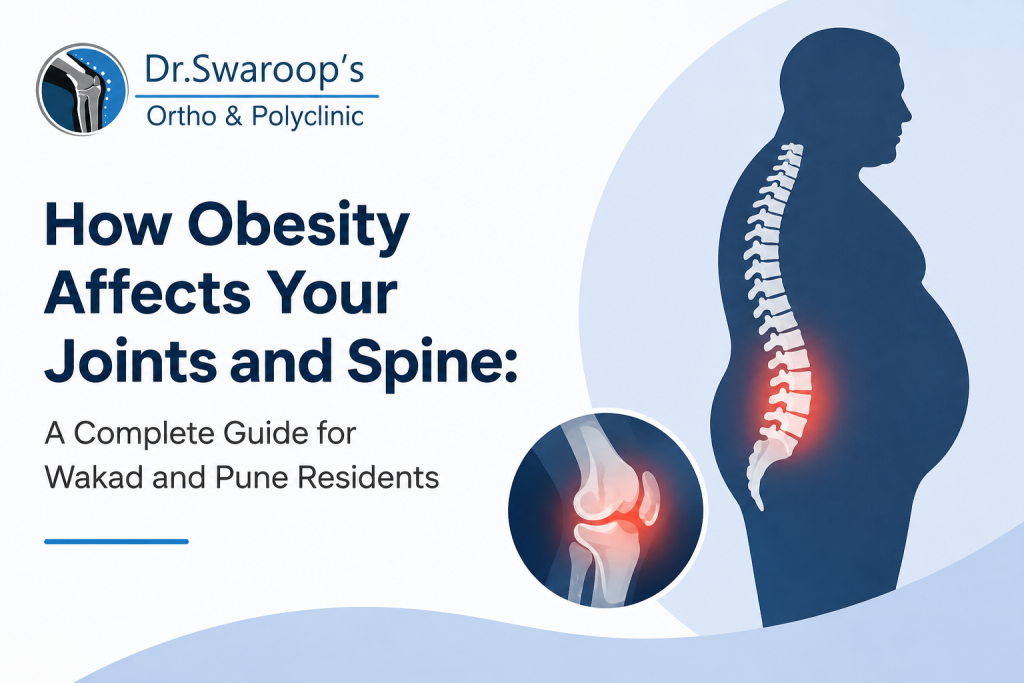
Obesity increases pressure on the knees, hips and spine, which speeds up cartilage wear and causes chronic back pain. Every extra kilogram adds multiplied load on the knees while walking. Consulting an orthopedic specialist early, alongside weight management, helps prevent osteoarthritis, disc problems and the eventual need for surgery.
Key Takeaways
- Every extra kilogram of body weight adds multiplied pressure on the knees while walking and climbing stairs
- Excess weight speeds up cartilage breakdown and raises the risk of osteoarthritis at a younger age
- Obesity alters posture and spinal alignment, which leads to chronic lower back pain
- Long desk hours common in Wakad and Hinjawadi’s IT offices add to the weight and joint problem
- Timely orthopedic consultation combined with a structured weight management plan reduces pain and can delay or avoid surgery
- Every 1 kg of excess body weight adds close to 4 kg of extra pressure on the knees during movement (industry estimate from biomechanical studies)
- Obesity is strongly linked with higher rates of knee and hip osteoarthritis
- Excess abdominal weight shifts the body’s centre of gravity forward and increases lower back strain
- A weight loss of 5 to 10 percent of body weight can meaningfully reduce joint pain and improve mobility (industry estimate)
- Working professionals in Wakad, Hinjawadi and Baner are increasingly reporting desk related weight gain along with joint stiffness
Obesity and Joint Health: Key Statistics
| Metric | Finding | Source |
| Knee load increase per kg of body weight | Roughly four times body weight during walking | Industry estimate, biomechanics research |
| Osteoarthritis risk in obese adults | Significantly higher than in adults of normal weight | WHO |
| Global overweight and obese adult population | More than one in eight adults worldwide classified as obese | WHO |
| Low back pain prevalence with obesity | Higher prevalence reported among obese individuals | NHP India |
| Effect of ten percent weight loss on knee pain | Noticeable improvement in pain and function | Industry estimate |
Understanding the Weight and Joint Connection
Your knees, hips and spine carry your body weight every time you stand, walk or climb stairs. When body weight increases beyond a healthy range, these joints absorb far more mechanical load than they are designed for. This is only part of the problem. Fat tissue, especially around the abdomen, is metabolically active and releases inflammatory chemicals called cytokines. These chemicals travel through the bloodstream and damage cartilage even in joints that do not bear much weight, such as the hands. This means obesity harms joints through two separate routes at once, mechanical overload and internal inflammation, which together speed up joint degeneration.
How Excess Weight Damages Your Knees
The knee is usually the first joint to show signs of wear in people carrying excess weight. Extra load compresses the cartilage that cushions the joint, and over time this cartilage thins and cracks. Ligaments and the meniscus also come under greater strain, which raises the risk of tears during ordinary activities like getting up from a chair or descending stairs.
Early Symptoms to Watch For Knee pain
- Stiffness in the knees first thing in the morning
- Pain while climbing or descending stairs
- Mild swelling around the knee after long periods of standing or walking
- A grinding or clicking sensation during movement
Left unaddressed, these early signs often progress into knee osteoarthritis, sometimes appearing in patients in their early forties rather than the more typical sixties.
The Hip Joint and Obesity
The hip joint also bears significant weight and is affected in similar ways. Patients with obesity related hip osteoarthritis often notice groin pain, stiffness after sitting and a reduced range of motion. In an Indian household context, this frequently shows up as difficulty sitting cross legged on the floor for meals or prayer, or discomfort while getting up from a low seat, which are activities many patients do not initially connect to their weight.
Obesity and Spinal Health: Understanding Chronic Back Pain
Excess weight, particularly around the abdomen, pulls the upper body forward and increases the natural curve of the lower spine. To compensate, the lower back muscles work harder to keep the body upright, which leads to chronic fatigue and pain in these muscles. Over time, the added pressure also accelerates degeneration of the spinal discs, raising the risk of disc bulges and sciatica, where pain radiates down the leg.
1. Posture and Desk Work Compound the Problem
Poor posture while sitting for long hours adds further strain to an already overloaded spine. Slouched sitting flattens the natural curve of the lower back and shifts even more pressure onto the discs, which is a common pattern among office workers who combine long sitting hours with limited physical activity.
2. Desk Jobs and Weight Gain in Pune’s IT Corridor
Wakad, Hinjawadi and Baner host a large concentration of IT and technology professionals, many of whom spend eight to ten hours a day at a desk. Long sitting hours, frequent food delivery orders, late working hours and reduced outdoor activity have combined to push weight gain and related joint stiffness into a younger age group than before. Orthopedic clinics in this belt are increasingly seeing professionals in their late twenties and thirties presenting with knee stiffness and lower back pain that would traditionally have appeared much later in life. Recognising this pattern early makes a meaningful difference to long term joint health.
3. Warning Signs You Should Not Ignore
- Joint pain that persists for more than two weeks
- Morning stiffness lasting longer than thirty minutes
- Visible swelling around a joint
- Reduced mobility or difficulty with everyday movements
- Numbness or tingling radiating into the legs
- Pain that disturbs sleep at night
Diagnosis: What to Expect During Your Orthopedic Consultation
An orthopedic consultation in pune for obesity related joint or spine pain typically begins with a detailed clinical examination, including a review of gait, posture and range of motion. Your BMI and weight history are assessed alongside your symptoms. X-rays are commonly used to check joint space narrowing and alignment, while an MRI may be recommended for spine related complaints to evaluate the discs and nerves in more detail. This assessment allows Dr. Swaroop Solunke to build a treatment plan suited to the specific joint involved and the stage of damage present.
Treatment Options for Obesity Related Joint and Spine Pain
| Approach | What It Involves | Best Suited For |
| Weight management and physiotherapy | Structured diet guidance combined with supervised, joint friendly exercise | Early stage joint pain and prevention |
| Medication and pain management | Anti inflammatory medication and joint support supplements | Moderate pain with visible inflammation |
| Bracing and mobility support | Knee braces or lumbar support belts during daily activity | Support during active recovery |
| Minimally invasive procedures | Arthroscopy or targeted joint injections | Cartilage damage not responding to conservative care |
| Joint replacement surgery | Knee or hip replacement surgery | Advanced osteoarthritis with severe joint damage |
Weight Management Tips That Support Joint Health
| Tip | Why It Helps |
| Low impact exercise such as swimming or cycling | Builds strength and burns calories without adding joint stress |
| A balanced diet with adequate protein and fibre | Supports steady weight loss while maintaining muscle mass |
| Short walking breaks during the workday | Reduces the stiffness that builds up from prolonged sitting |
| Adequate hydration | Supports cartilage health and joint lubrication |
| Consistent sleep and stress management | Helps regulate the hormones that influence weight and inflammation |
Orthopedic Care for Weight Related Joint and Spine Pain in Wakad and Nearby Areas
Dr. Swaroop Solunke’s orthopedic clinic in Wakad is easily accessible for residents and working professionals across Wakad, Hinjawadi, Baner, Pimple Saudagar, Punawale, Ravet and Thergaon. Given the concentration of IT parks along this corridor, many patients seek a consultation close to their office or home rather than travelling into central Pune. The clinic offers a straightforward path from initial diagnosis to a personalised weight and joint management plan, with surgical options available for patients whose joint damage has progressed further.
Frequently Asked Questions
1. Can losing weight really reduce joint pain?
Yes. Reducing body weight lowers the mechanical load on the knees and hips directly, and it also reduces the inflammatory chemicals released by fat tissue. Many patients notice reduced pain and improved movement even with modest weight loss.
2. How much weight loss is needed to see improvement in knee pain?
A weight loss of around five to ten percent of body weight is generally enough to produce a noticeable improvement in knee pain and function, according to industry estimates. The exact benefit varies from patient to patient based on the stage of joint damage.
3. Is walking safe if I already have knee pain due to excess weight?
Walking on a flat surface at a comfortable pace is usually safe and beneficial, but it should be assessed on an individual basis. Patients with significant pain or swelling should have their knee evaluated before starting or continuing an exercise routine.
4. At what BMI does joint damage risk increase significantly?
Risk rises progressively as BMI increases beyond the normal range, with a more noticeable jump in osteoarthritis risk once a patient falls into the obese category. An orthopedic assessment can clarify individual risk based on weight, joint condition and activity level.
5. Can obesity related back pain be treated without surgery?
Most cases of obesity related back pain respond well to weight management, physiotherapy and posture correction. Surgery is generally considered only when conservative treatment does not relieve symptoms or when there is significant nerve involvement.
6. When should I see an orthopedic doctor for weight related joint pain?
You should book a consultation if joint pain lasts more than two weeks, disturbs your sleep, causes swelling or limits your daily activities. Early evaluation allows for simpler, non surgical treatment in most cases.
Book Your Consultation
If excess weight is affecting your knees, hips or back, do not wait for the pain to worsen. Book a consultation with Dr. Swaroop Solunke, Orthopedic Specialist in Wakad, PCMC, for a personalised assessment and treatment plan.
Visit our Dr.Swaroop’s Ortho & Polyclinic Wakad to book your appointment today.

Dr. Swaroop Solunke
- Fellowship in Arthroplasty (Germany)- Bruderkrankenhaus St. Josef Paderborn, Germany.
- Fellowship in Primary and Revision Hip Replacement – Dr. Luigi Zagra IRCCS Instituto Orthopedia Galeazzi, Milan, Italy.
- Fellowship in Arthroplasty (Germany)- Bruderkrankenhaus St. Josef Paderborn, Germany.
- Fellowship in Robotic Knee Replacement – The Stone Research Foundation, San Francisco, California, USA.
- MS - Orthopaedics (Gold Medalist) – MGM Medical College and Hospital.
- MBBS – Dr. DY Patil University, Navi Mumbai.
- Member of Indian Medical Association (IMA)