
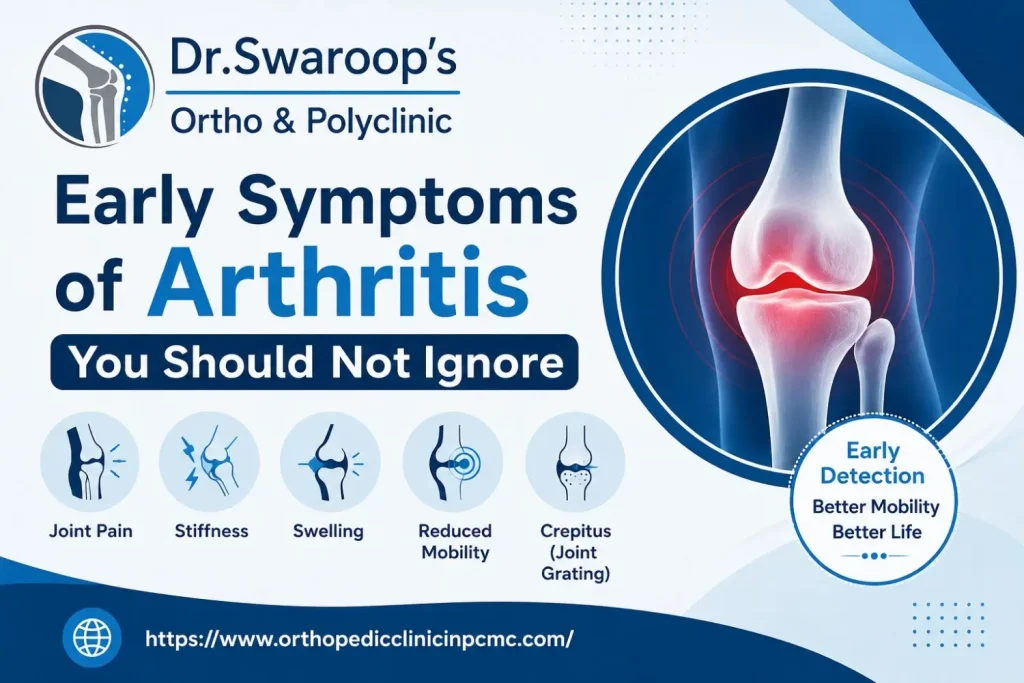
Most people in Pimpri-Chinchwad who develop arthritis do not recognize it for what it is in the first year. knee pain as tiredness after a long shift at the plant near Bhosari. They assume the stiff fingers every morning are from sleeping in an awkward position. They tell themselves it will pass.
It usually does not pass. It gets quieter for a few weeks and then comes back a little louder.
The window for effective early treatment is real. Joint damage from untreated arthritis is cumulative and largely irreversible. What you do in the first one to two years matters enormously. That is what this article is about.
What Arthritis Actually Is (Before We Talk About Symptoms)
Arthritis is not one disease. It is a word for joint inflammation and the damage that follows. There are over 100 types, but the ones most commonly seen in patients from the PCMC area fall into two main categories.
Osteoarthritis is the wear-and-tear type. Cartilage — the cushioning tissue between bones — breaks down gradually. It is most common in people over 40 and affects the knees, hips and spine most often.
Rheumatoid arthritis is autoimmune. The body’s own immune system attacks the joint lining. It tends to appear earlier, often in the 30s and 40s, and affects joints symmetrically, meaning both hands or both knees tend to be involved at the same time.
Both types share some early warning signs. Knowing those signs is the entire point of this article
Top 8 Early Symptoms of Arthritis Most People Miss
1. Morning Stiffness That Takes More Than 30 Minutes to Go Away
This is one of the most reliable early indicators. You wake up and your fingers, knees or hips feel locked up. Normal post-sleep stiffness clears within 10 to 15 minutes once you start moving. Arthritis-related stiffness, especially from rheumatoid arthritis, lingers well past the half-hour mark.
Key takeaway: If your joints take longer than 30 minutes to loosen up in the morning on most days, that is worth discussing with an orthopedic specialist.
2. Joint Pain That Is Worse After Rest Than After Activity
This seems backwards to most people. They expect pain to worsen with movement. But early osteoarthritis often produces what doctors call “start-up pain,” a sharp or aching discomfort in the knee or hip when you stand up after sitting for a long time. The pain eases once you walk around for a few minutes.
If you recognize this pattern — pain on starting, relief after moving — do not dismiss it as normal aging.
3. Swelling Around a Specific Joint
Visible puffiness or fullness around the knee, the base of the thumb or the knuckles is a sign that the joint lining is inflamed. In early rheumatoid arthritis, the small joints of the hands and feet are often the first affected. In osteoarthritis, the knees are frequently the first joints to show visible change.
The swelling from early arthritis may be mild. It may not look dramatic. But it will be consistent and will tend to worsen after activity or late in the day.
4. A Warm or Tender Feeling Over the Joint
Run your hand along the side of your knee or over a finger joint. In inflamed arthritis, the skin over the affected joint often feels warmer than the surrounding tissue. The joint may feel tender when pressed, even with light pressure.
This warmth is the physical sign of ongoing inflammation. Inflammation that goes unmanaged is what drives the cartilage damage.
5. Reduced Range of Motion
Can you bend your knee fully? Can you make a complete fist without discomfort? Early arthritis causes gradual tightening of the joint capsule and surrounding soft tissues. People often notice this first when they reach for something overhead, kneel down for prayer or try to squat at the squat toilet that is still common in many homes in the older parts of Pimpri.
The loss of range is subtle at first. Patients often only recognize it when they try to do something specific and find they cannot do it the way they used to.
6. Clicking, Crunching or Grinding Sensations
The medical term is crepitus. It is the grating or cracking sound and sensation that comes when cartilage has roughened or is thinning. Not all joint sounds are concerning — knuckle cracking from gas release is harmless. But consistent grinding in the knee when you climb stairs, or a crunching sound at the shoulder when you raise your arm, can signal cartilage wear.
On its own, crepitus is not necessarily painful in the early stages. Combined with any of the other signs on this list, it becomes more significant.
7. Fatigue That Comes With Joint Pain
This one surprises many patients. Arthritis, particularly the rheumatoid type, is a systemic inflammatory condition. When the body is fighting widespread joint inflammation, it draws on energy reserves. The result is a persistent, low-grade tiredness that does not improve fully with sleep.
If you are consistently fatigued and your joints ache regularly, mention both symptoms to your doctor. The combination tells a more complete story than either symptom alone.
8. Grip Weakness or Difficulty With Small Tasks
Struggling to open a jar, difficulty turning a key in a lock, trouble holding a pen for extended writing — these functional limitations often go unmentioned because patients feel they are too trivial to raise with a doctor. They are not trivial. They are early functional indicators of joint involvement in the hand.
For two-wheeler commuters in PCMC who grip handlebars through long rides on Dehu Road or the Bhosari industrial corridor, this weakness also shows up as hand fatigue or pain after riding.
Why Patients in Pimpri-Chinchwad Tend to Present Late
This is a local pattern worth naming directly.
The majority of patients who walk into Dr. Solunke’s orthopedic clinic in PCMC have been managing symptoms on their own for one to three years before seeking a formal evaluation. There are a few consistent reasons:
- Pain medication bought over the counter at the medical shops near Pimpri Railway Station or Chinchwad market provides temporary relief. The pain quiet period feels like a cure.
- Heavy physical work at the automotive and manufacturing units in Bhosari, Chakan or Talegaon means workers attribute joint pain to “occupational tiredness” rather than disease.
- Awareness of what early arthritis actually looks like is low. People expect arthritis to look like the severe deformities they have seen in elderly relatives. The mild early symptoms do not match that mental image.
- Access to a specialist orthopedic clinic in PCMC has historically meant traveling to Pune city, which adds time and cost. That gap has narrowed considerably with specialized orthopedic practices now established within Pimpri-Chinchwad itself.
The cost of waiting is real. Cartilage does not regenerate on its own. Every year of unmanaged inflammation advances the structural damage.
When Should You Actually See an Orthopedic Doctor?
A lot of people search online for this question. The honest answer is earlier than you think.
You should book an evaluation if:
- Joint pain or stiffness has lasted more than 6 weeks continuously
- You have noticed visible swelling around a knee or finger joint
- Morning stiffness takes more than 30 minutes to clear
- Over-the-counter painkillers are becoming a regular part of your daily routine rather than occasional use
- The pain is affecting your sleep, your ability to walk distances you used to cover easily or your work performance
- You have a family history of rheumatoid arthritis or early joint disease
An orthopedic evaluation at this stage typically involves a physical examination of the affected joints, targeted X-rays and in some cases blood tests to check inflammatory markers like CRP or ESR. The investigation is straightforward. The value of doing it early is that the treatment options at this stage are considerably simpler and more effective than at advanced stages.
What Early Arthritis Treatment Looks Like at Dr. Solunke’s Clinic
Dr. Swaroop Solunke completed his orthopedic training at MGM Medical College Kamothe, followed by a fellowship in arthroplasty at St. Josef Hospital in Paderborn, Germany and further sub-specialty training at Breach Candy Hospital Mumbai. He also holds a robotic knee replacement fellowship from the Stone Research Foundation in San Francisco, one of the few US-trained robotic arthroplasty fellowships available to international surgeons.
That background matters in this context because it shapes the treatment philosophy. A surgeon trained at that level in joint replacement develops a very clear picture of what joint damage looks like at its end stage. That picture makes early intervention more compelling, not less.
For patients presenting with early arthritis symptoms, the treatment pathway is almost always non-surgical:
Structured physiotherapy programs target the muscles around the affected joint to reduce load on cartilage and improve joint stability. For knee osteoarthritis, quadriceps strengthening is particularly effective at slowing progression.
Anti-inflammatory medication managed appropriately reduces the synovial inflammation that drives cartilage damage. The goal is to use the lowest effective dose for the shortest necessary period, not to create a dependency on daily pain relief.
Intra-articular injections such as corticosteroids or hyaluronic acid can provide meaningful symptomatic relief for early to moderate knee osteoarthritis and buy time for lifestyle modifications to take effect.
Weight management guidance is given directly. Excess body weight increases load on the knee joint disproportionately. For every additional kilogram of body weight, the force across the knee during walking increases by approximately 4 kilograms. In a city where sedentary work at IT parks in Hinjewadi has become common for residents who commute from Pimpri-Chinchwad, this is a practical and actionable intervention.
Activity modification and joint protection strategies are discussed at the first visit. These are practical recommendations, not generic advice — how to get up from a floor position safely, how to adjust riding posture on a two-wheeler, whether walking surfaces around Pawna Lake or Talawade IT park are appropriate for your current joint condition.
Surgery — whether partial knee replacement, total knee replacement or robotic-assisted knee surgery — is the option available when conservative management has reached its limits. At early presentation, that conversation is still far away for most patients.
Arthritis and Age: What Is Normal and What Is Not
Patients frequently ask whether their symptoms are just part of getting older. It is a fair question, particularly in PCMC where a large working population is moving through their 40s and 50s.
Some degree of joint change with age is expected. Cartilage does thin over time. Some mild stiffness after prolonged inactivity is common.
What is not normal at any age:
- Joint pain that disrupts sleep
- Swelling that does not resolve within 24 to 48 hours after activity
- Morning stiffness lasting longer than 30 minutes
- Progressive loss of ability to walk distances or climb stairs
- Any joint pain in a person under 40 that has lasted more than a few weeks
Age is not a reason to accept joint pain as inevitable. It is a reason to be more attentive to the early signals.
Frequently Asked Questions About Early Arthritis Symptoms
1. What is the earliest sign of arthritis that most people in PCMC ignore?
The most commonly missed early sign is morning stiffness in the finger joints or knees that takes more than 30 minutes to improve. People in Pimpri-Chinchwad often attribute this to the cold winters or to lying in one position during sleep. When it occurs consistently over several weeks, it is worth a proper orthopedic evaluation.
2. Can arthritis develop in people in their 30s or 40s in Pimpri-Chinchwad?
Yes. Rheumatoid arthritis, which is autoimmune in origin, commonly presents between the ages of 30 and 50. Residents in PCMC who work in physically demanding roles in the Bhosari or Chakan industrial areas can also develop early osteoarthritis from repetitive joint loading. Age over 60 is not a requirement for arthritis to start.
3. Is there an orthopedic specialist in PCMC who handles early arthritis without surgery?
Dr. Swaroop Solunke at his orthopedic clinic in Pimpri-Chinchwad provides complete non-surgical management of early to moderate arthritis, including physiotherapy planning, injection therapy and lifestyle-based joint protection strategies. Surgery is discussed only when conservative treatment has been fully explored.
4. How is arthritis diagnosed — do I need an MRI or just an X-ray?
For most early arthritis presentations, standard X-rays combined with a physical examination are sufficient to make an initial diagnosis. Blood tests for inflammatory markers (ESR, CRP, rheumatoid factor) are added when rheumatoid arthritis is suspected. MRI is used for specific cases where soft tissue detail is needed, such as assessing meniscus involvement in the knee alongside early osteoarthritis. Your orthopedic doctor will determine what is actually needed at your consultation.
5. What should I do if I have joint pain but it comes and goes — is that still arthritis?
Intermittent joint pain that comes and goes is one of the classic early patterns of arthritis, particularly osteoarthritis. The pain often flares with activity or cold weather and settles with rest. The fact that it resolves between episodes does not mean the underlying joint changes are reversing. If intermittent joint pain has been occurring for six weeks or more, consult an orthopedic specialist. Early diagnosis is much simpler and more effective than late diagnosis.
Book Your Consultation At best Orthopeadic Doctor in PCMC, Wakad, Baner
Dr. Swaroop Solunke
- Fellowship in Arthroplasty (Germany)- Bruderkrankenhaus St. Josef Paderborn, Germany.
- Fellowship in Primary and Revision Hip Replacement – Dr. Luigi Zagra IRCCS Instituto Orthopedia Galeazzi, Milan, Italy.
- Fellowship in Arthroplasty (Germany)- Bruderkrankenhaus St. Josef Paderborn, Germany.
- Fellowship in Robotic Knee Replacement – The Stone Research Foundation, San Francisco, California, USA.
- MS - Orthopaedics (Gold Medalist) – MGM Medical College and Hospital.
- MBBS – Dr. DY Patil University, Navi Mumbai.
- Member of Indian Medical Association (IMA)