
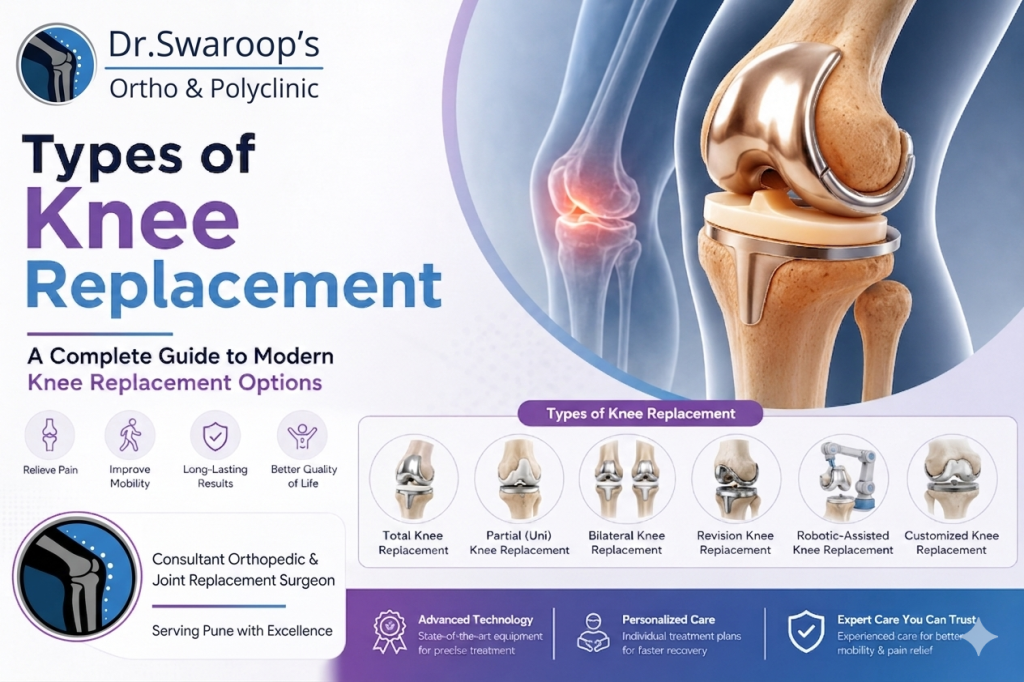
Understanding the different types of knee replacement procedures is important for patients who are considering surgery. Every knee condition is different, and modern orthopedic surgery now offers multiple treatment options depending on the severity of damage, age of the patient, activity level, and overall health condition.
Knee pain is one of the most common orthopedic problems affecting people of different age groups. For some individuals, the pain may start gradually and become worse over time, while others may experience severe discomfort after an injury or due to arthritis. When medications, physiotherapy, exercise, and lifestyle modifications no longer provide relief, doctors may recommend knee replacement surgery.
Today, advanced surgical techniques, robotic assistance, and modern implants have significantly improved the success rate of knee replacement procedures. This detailed guide explains the major types of knee replacement, their benefits, recovery process, risks, and how patients can choose the right treatment for long-term relief.
What Is Knee Replacement Surgery?
Knee replacement surgery, also known as knee arthroplasty, is a surgical procedure performed to replace damaged portions of the knee joint with artificial implants. The damaged cartilage and bone are removed and replaced with specially designed prosthetic components that help restore smooth joint movement.
The main purpose of knee replacement surgery is to:
- Reduce chronic knee pain
- Improve joint function
- Correct deformity
- Enhance mobility
- Improve quality of life
The surgery is commonly recommended for people suffering from severe arthritis or advanced joint damage that affects daily activities.
Why Understanding the Types of Knee Replacement Is Important
There are several types of knee replacement surgeries available today, and not every patient requires the same procedure. Some individuals may have damage only in one part of the knee, while others may have complete joint degeneration requiring full replacement.
Choosing the right type of surgery helps in:
- Faster recovery
- Better implant performance
- Improved knee movement
- Reduced complications
- Long-term pain relief
An experienced orthopedic surgeon evaluates the condition carefully before recommending the most suitable procedure.
Conditions That May Require Knee Replacement Surgery
Patients suffering from the following conditions may need one of the different types of knee replacement procedures:
- Osteoarthritis
Osteoarthritis is the most common reason for knee replacement surgery. It occurs when the cartilage cushioning the knee joint gradually wears away, causing pain and stiffness.
- Rheumatoid Arthritis
This autoimmune condition causes inflammation inside the joint, leading to cartilage damage and joint deformity.
- Post-Traumatic Arthritis
Previous fractures, ligament injuries, or accidents can damage the knee joint and eventually lead to arthritis.
- Severe Knee Injury
Sports injuries or major trauma may permanently damage the knee structure.
- Avascular Necrosis
Loss of blood supply to the bone can cause joint collapse and severe pain.
Main Types of Knee Replacement
There are different types of knee replacement surgeries performed depending on the patient’s condition and severity of joint damage.
- Total Knee Replacement – The Most Common Type of Knee Replacement
Total Knee Replacement (TKR) is one of the most widely performed orthopedic procedures worldwide. In this surgery, the damaged surfaces of the knee joint are removed and replaced with artificial implants.
Among all types of knee replacement, this procedure is considered highly effective for severe arthritis and chronic knee pain.
How Total Knee Replacement Is Performed
The surgeon removes damaged cartilage and bone from:
- The lower end of the thigh bone (femur)
- The upper surface of the shin bone (tibia)
- The underside of the kneecap if necessary
These surfaces are then replaced with prosthetic components made from metal and medical-grade plastic.
Benefits of Total Knee Replacement
The advantages of total knee replacement include:
- Significant reduction in pain
- Improved walking ability
- Better knee stability
- Enhanced quality of life
- Long-lasting results
Most patients can return to normal daily activities after rehabilitation.
Types of Total Knee Replacement
There are several types of total knee replacement surgeries based on implant fixation and surgical approach.
- Cemented Total Knee Replacement
Cemented knee replacement is one of the most common types of total knee replacement performed today. Special bone cement is used to fix the implant securely to the bone.
Advantages of Cemented Knee Replacement
- Immediate implant fixation
- Reliable long-term outcomes
- Faster mobility after surgery
- Suitable for elderly patients
This method has shown excellent success rates over many years.
- Cementless Total Knee Replacement
In cementless replacement, the implant is designed with a porous surface that allows the bone to grow naturally into the implant over time.
Benefits of Cementless Replacement
- Natural biological fixation
- Long-term implant stability
- Better for younger active patients
- Reduced risk of cement-related loosening
Patients with strong bone quality are often ideal candidates.
- Hybrid Total Knee Replacement
Hybrid replacement combines both cemented and cementless techniques. One part of the implant may be cemented while another part remains cementless.
Advantages
- Improved implant fixation
- Better balance between stability and natural bone growth
- Customized approach based on patient condition
2. Partial Knee Replacement – A Minimally Invasive Type of Knee Replacement
Partial Knee Replacement, also called unicompartmental knee replacement, is recommended when arthritis affects only one section of the knee.
Unlike total replacement, only the damaged compartment is replaced while healthy portions of the knee are preserved.
Among the different types of knee replacement, this procedure is less invasive and allows quicker recovery.
Benefits of Partial Knee Replacement
Patients may experience:
- Smaller surgical incision
- Less blood loss
- Reduced pain after surgery
- Faster rehabilitation
- More natural knee movement
- Shorter hospital stay
Who Is Eligible for Partial Knee Replacement?
This surgery is suitable for patients who have:
- Arthritis limited to one compartment
- Good knee ligament stability
- Minimal deformity
- Healthy surrounding cartilage
Not every patient qualifies for partial replacement, which is why proper evaluation is important.
3) Bilateral Knee Replacement
Some patients suffer from severe arthritis in both knees simultaneously. In such cases, doctors may recommend bilateral knee replacement.
This is one of the advanced types of knee replacement procedures for patients requiring surgery on both knees.
Simultaneous Bilateral Knee Replacement
In this procedure, both knees are replaced during the same operation.
Advantages
- Single anesthesia
- One hospitalization period
- Single rehabilitation process
- Faster overall recovery
However, careful patient selection is essential.
Staged Bilateral Knee Replacement
In staged surgery, one knee is replaced first, followed by the second surgery after a few months.
Benefits
- Lower stress on the body
- Safer for elderly patients
- Easier recovery management
The decision depends on the patient’s overall health and surgeon’s recommendation.
Revision Knee Replacement
Revision surgery is performed when a previous knee replacement fails or develops complications.
Among all types of knee replacement, revision procedures are more complex and require specialized orthopedic expertise.
Reasons for Revision Knee Replacement
Revision surgery may be needed due to:
- Implant loosening
- Infection
- Implant wear
- Knee instability
- Fracture around implant
- Persistent pain
Challenges in Revision Surgery
Revision procedures are technically demanding because surgeons may need to:
- Remove old implants
- Reconstruct damaged bone
- Correct alignment problems
- Manage scar tissue
Advanced planning and surgical precision are important for successful outcomes.
4) Robotic-Assisted Types of Knee Replacement
Robotic-assisted surgery is one of the most advanced developments in orthopedic care. Many modern hospitals now use robotic technology for different types of knee replacement procedures.
How Robotic Knee Replacement Works
Before surgery, advanced imaging technology creates a 3D model of the patient’s knee. During surgery, robotic systems assist the surgeon in accurate implant placement.
Benefits of Robotic Knee Replacement
- Greater surgical precision
- Better implant alignment
- Reduced damage to healthy tissue
- Less pain after surgery
- Faster recovery
- Improved implant longevity
Robotic surgery helps achieve highly personalized treatment.
5) Minimally Invasive Types of Knee Replacement
Minimally invasive surgery uses smaller incisions and specialized instruments to reduce trauma to muscles and tissues.
Among the modern types of knee replacement, minimally invasive techniques are becoming increasingly popular.
Advantages of Minimally Invasive Knee Replacement
- Smaller scars
- Less blood loss
- Reduced post-operative pain
- Faster rehabilitation
- Shorter hospital stay
Patients often regain mobility more quickly compared to traditional surgery.
Customized Knee Replacement
Customized knee replacement uses patient-specific implants designed using MRI or CT scan data.
This is one of the most advanced types of knee replacement available today.
Benefits of Customized Knee Replacement
- Better implant fit
- More natural knee movement
- Reduced implant mismatch
- Personalized treatment
- Enhanced comfort
Customized implants may improve long-term satisfaction for some patients.
6) Gender-Specific Knee Replacement
Some implants are specially designed for female anatomy because women may have different knee dimensions compared to men.
Advantages
- Improved anatomical fit
- Better comfort
- Enhanced movement
However, surgeons decide suitability based on individual anatomy rather than gender alone.
Recovery After Different Types of Knee Replacement
Recovery varies depending on the type of surgery performed and the patient’s health condition.
Immediate Recovery After Surgery
Patients are encouraged to begin movement soon after surgery to prevent stiffness and improve circulation. Walking usually starts within 24 hours using support devices like walkers.
Physical Therapy After Knee Replacement
Physical therapy plays a crucial role in recovery after all types of knee replacement surgeries.
Therapy helps patients:
- Strengthen muscles
- Improve flexibility
- Restore walking ability
- Increase range of motion
Consistent rehabilitation improves surgical outcomes significantly.
General Recovery Timeline
| Recovery Stage | Approximate Duration |
| Standing and walking | 1–3 days |
| Return to basic activities | 4–6 weeks |
| Improved mobility | 3 months |
| Full recovery | 6–12 months |
Recovery speed may vary between individuals.
Risks Associated With Types of Knee Replacement
Like any major surgery, knee replacement carries certain risks.
Possible Complications
- Infection
- Blood clots
- Implant loosening
- Nerve injury
- Stiffness
- Persistent pain
Fortunately, modern surgical methods and improved medical care have reduced complication rates significantly.
Life After Knee Replacement Surgery
Most patients experience major improvements after surgery.
Benefits often include:
- Better mobility
- Reduced pain
- Improved sleep
- Increased independence
- Enhanced quality of life
Patients are generally advised to avoid high-impact activities but can safely enjoy walking, cycling, and swimming.
How to Choose the Right Type of Knee Replacement
The ideal procedure depends on several factors such as:
- Severity of arthritis
- Age
- Bone quality
- Body weight
- Lifestyle
- Physical activity level
- Overall medical condition
Consulting an experienced orthopedic specialist helps determine the most suitable treatment.
Importance of Choosing an Experienced Orthopedic Surgeon
Successful outcomes depend greatly on surgical expertise.
A skilled orthopedic surgeon provides:
- Accurate diagnosis
- Advanced treatment planning
- Modern surgical techniques
- Personalized rehabilitation guidance
- Better long-term outcomes
Patients should always choose a trusted orthopedic specialist with experience in joint replacement surgery.
Dr. Swaroop Solunke – Best Orthopedic Doctor in Wakad and Pune
Dr. Swaroop Solunke is recognized as one of the best orthopedic doctors in Wakad and across Pune for advanced orthopedic and joint replacement treatments. He specializes in diagnosing and managing complex knee conditions using modern orthopedic techniques and patient-focused care.
With extensive experience in different types of knee replacement procedures, including total knee replacement, robotic-assisted knee surgery, partial knee replacement, and revision surgery, Dr. Swaroop Solunke focuses on helping patients regain mobility and live pain-free lives.
Patients trust Dr. Swaroop Solunke for:
- Detailed orthopedic evaluation
- Personalized treatment planning
- Advanced surgical expertise
- Compassionate patient care
- Comprehensive rehabilitation support
Whether treating arthritis, sports injuries, chronic knee pain, or severe joint degeneration, Dr. Swaroop Solunke aims to provide effective and long-lasting orthopedic solutions for patients in Wakad and all over Pune.
Conclusion
Understanding the various types of knee replacement surgeries helps patients make informed decisions about their joint health. From total knee replacement and partial knee replacement to robotic-assisted and customized procedures, modern orthopedic surgery offers advanced solutions for different knee conditions.
Early consultation with an experienced orthopedic surgeon can help prevent worsening joint damage and improve long-term mobility. With proper treatment, rehabilitation, and expert care, knee replacement surgery can significantly improve quality of life and help patients return to daily activities with confidence.
If chronic knee pain is affecting your routine life, consulting a trusted orthopedic specialist may be the first step toward a healthier and more active future.
Book Your Free Consultation with Swaroop Solunke
Frequently Asked Questions About Types of Knee Replacement
1.What are the main types of knee replacement?
The main types of knee replacement include Total Knee Replacement, Partial Knee Replacement, Bilateral Knee Replacement, Revision Knee Replacement, Robotic-Assisted Knee Replacement, and Customized Knee Replacement. The best option depends on the severity of knee damage and the patient’s overall condition.
2. What is the difference between total knee replacement and partial knee replacement?
In Total Knee Replacement, the entire knee joint surface is replaced with artificial implants. In Partial Knee Replacement, only the damaged compartment of the knee is replaced while healthy portions are preserved. Partial replacement is suitable for patients with limited joint damage.
3. Which type of knee replacement is best?
The best among the different types of knee replacement depends on factors such as age, arthritis severity, activity level, bone quality, and overall health. An orthopedic surgeon evaluates the knee condition before recommending the most suitable procedure.
4. What are the different types of total knee replacement?
The major types of total knee replacement include:
- Cemented Total Knee Replacement
- Cementless Total Knee Replacement
- Hybrid Total Knee Replacement
- Robotic-Assisted Total Knee Replacement
Each technique has specific advantages depending on patient needs.
5. How long does knee replacement surgery last?
Most knee replacement surgeries take around 1 to 2 hours. However, the duration may vary depending on the complexity of the procedure and the type of surgery performed.
6. How long do knee replacement implants last?
Modern knee implants can last 15 to 25 years or even longer with proper care, healthy weight management, and regular follow-up with the orthopedic surgeon.
7.Is robotic knee replacement better than traditional knee replacement?
Robotic-assisted surgery offers greater precision in implant placement and joint alignment. Many patients experience improved recovery, less pain, and better long-term outcomes compared to traditional surgery.
8. Who is a good candidate for knee replacement surgery?
Patients with severe arthritis, chronic knee pain, stiffness, difficulty walking, and reduced mobility who do not improve with medications or physiotherapy may be suitable candidates for knee replacement surgery.
9. What is the recovery time after knee replacement surgery?
Recovery varies depending on the patient and the types of knee replacement performed. Most patients resume basic activities within 4 to 6 weeks, while complete recovery may take several months.
10. Is knee replacement surgery painful?
Patients may experience temporary discomfort after surgery, but pain management techniques and physiotherapy help control post-operative pain effectively. Most patients experience significant long-term pain relief after recovery.
11.Can both knees be replaced at the same time?
Yes, bilateral knee replacement allows both knees to be replaced during the same surgery in selected patients. However, the suitability depends on age, fitness, and overall health condition.
12. What are the risks associated with knee replacement surgery?
Possible risks include:
- Infection
- Blood clots
- Implant loosening
- Stiffness
- Nerve injury
- Persistent pain
Modern surgical techniques have significantly reduced complication rates.
13. How soon can I walk after knee replacement surgery?
Most patients start walking with support within 24 hours after surgery. Early movement helps improve circulation and recovery.
14. Can I climb stairs after knee replacement surgery?
Yes, patients can usually climb stairs after recovery and physiotherapy. Strengthening exercises play an important role in restoring mobility.
15.What activities should be avoided after knee replacement?
High-impact activities such as jumping, running, and heavy sports should generally be avoided. Walking, swimming, cycling, and light exercise are usually recommended.
16. What is revision knee replacement?
Revision knee replacement is a second surgery performed when an old knee implant fails due to wear, loosening, infection, or instability.
17.Is age a factor in deciding the types of knee replacement?
Yes, age plays an important role. Younger active patients may benefit from cementless or customized implants, while older patients often undergo cemented knee replacement procedures.
18.What is minimally invasive knee replacement?
Minimally invasive knee replacement uses smaller incisions and specialized surgical techniques to reduce tissue damage, pain, and recovery time.
19. How successful are modern types of knee replacement surgeries?
Modern knee replacement surgeries have a very high success rate. Most patients experience major pain relief, improved mobility, and better quality of life after surgery.
20.Why should I consult an experienced orthopedic surgeon for knee replacement?
An experienced orthopedic surgeon can accurately diagnose the knee condition, recommend the most suitable types of knee replacement, and ensure better surgical outcomes with personalized rehabilitation guidance.

Dr. Swaroop Solunke
- Fellowship in Arthroplasty (Germany)- Bruderkrankenhaus St. Josef Paderborn, Germany.
- Fellowship in Primary and Revision Hip Replacement – Dr. Luigi Zagra IRCCS Instituto Orthopedia Galeazzi, Milan, Italy.
- Fellowship in Arthroplasty (Germany)- Bruderkrankenhaus St. Josef Paderborn, Germany.
- Fellowship in Robotic Knee Replacement – The Stone Research Foundation, San Francisco, California, USA.
- MS - Orthopaedics (Gold Medalist) – MGM Medical College and Hospital.
- MBBS – Dr. DY Patil University, Navi Mumbai.
- Member of Indian Medical Association (IMA)