
If you have started waking up at night because of a deep ache in your shoulder, or you can no longer reach behind your back to fasten a hook or pull out a wallet, you may be dealing with a frozen shoulder. It is one of the most common shoulder complaints we see at our orthopedic clinic in Pune and PCMC, and it is also one of the most misunderstood. Many patients spend months assuming the stiffness will pass on its own, only to find their range of movement getting worse week after week.
This guide explains what a frozen shoulder actually is, why it develops, how it progresses through distinct stages, and the full range of treatment options available, from simple physiotherapy to surgery in stubborn cases. The aim is to help you understand your condition clearly so you can make an informed decision about your care.
What Is a Frozen Shoulder?
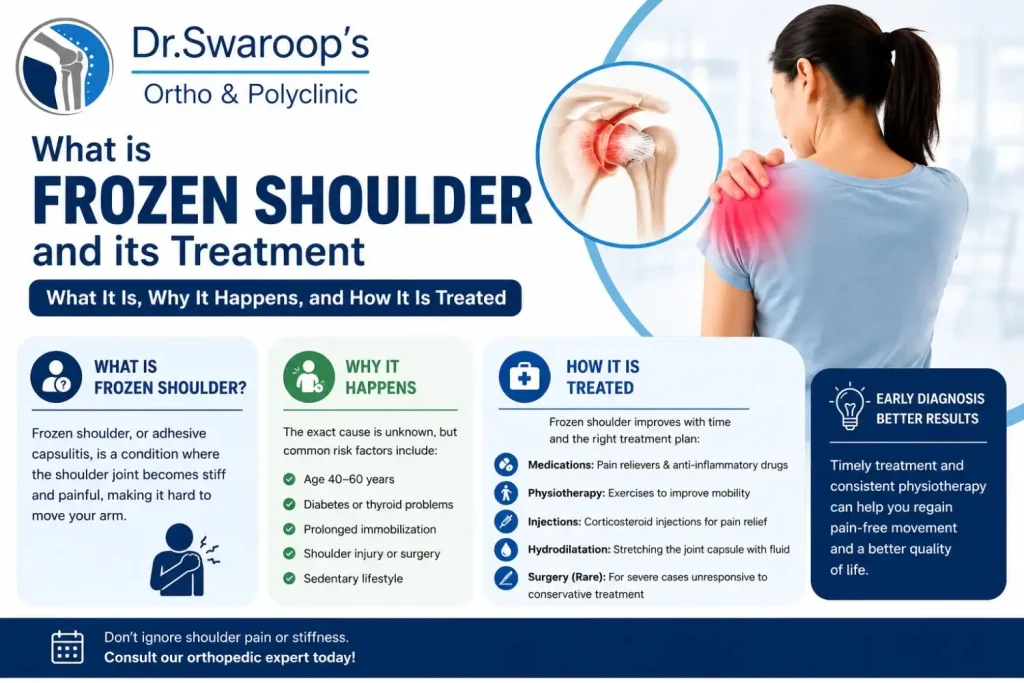
Frozen shoulder, known in medical terms as adhesive capsulitis, is a condition in which the shoulder joint becomes painful and progressively stiff. The shoulder is a ball-and-socket joint surrounded by a band of connective tissue called the joint capsule. In a frozen shoulder, this capsule thickens, tightens, and forms bands of scar tissue called adhesions. As the capsule shrinks, there is simply less room for the upper arm bone to move, which is why the joint feels locked.
The hallmark of the condition is that both active and passive movement are restricted. In other words, you cannot lift your arm yourself, and even when someone else tries to move it for you, it will not go further. This is what separates a true frozen shoulder from many other shoulder problems, where pain limits movement but the joint itself can still be moved passively.
What Causes a Frozen Shoulder?
In many cases, a frozen shoulder develops without any obvious trigger. This is referred to as a primary frozen shoulder. In other situations, it follows an event that kept the shoulder still for a period of time, which is called a secondary frozen shoulder. Common contributing factors include:
- Prolonged immobility after an injury, fracture, or surgery, where the arm has been kept in a sling or rested for weeks.
- Diabetes, which is the single strongest risk factor. People with diabetes are significantly more likely to develop a frozen shoulder, and their cases often last longer and respond more slowly.
- Thyroid disorders, both underactive and overactive, which are linked to a higher incidence.
- Age and gender, with the condition most common between 40 and 60 years of age, and more frequent in women.
- Other health conditions such as cardiovascular disease, Parkinson’s disease, and a history of stroke.
Understanding the underlying cause matters, because a frozen shoulder in a person with uncontrolled diabetes is approached differently from one that follows a minor injury in an otherwise healthy patient.
The Three Stages of a Frozen Shoulder
A frozen shoulder does not appear and disappear overnight. It typically moves through three overlapping stages, and recognising which stage you are in helps guide treatment.
Stage 1: The Freezing Stage
This is the painful phase. It usually lasts anywhere from six weeks to nine months. Pain builds gradually and is often worse at night, disturbing sleep. As the pain increases, you instinctively start moving the shoulder less, and the range of motion begins to shrink. Many patients first come to see us during this stage because the night pain becomes unbearable.
Stage 2: The Frozen Stage
During this stage, which can last from four months to a year, the pain may actually ease somewhat, but the stiffness becomes the dominant problem. Everyday tasks such as combing your hair, reaching for a seatbelt, or putting on a shirt become genuinely difficult. The shoulder feels mechanically stuck, and this is the phase where structured physiotherapy becomes most important.
Stage 3: The Thawing Stage
In the final stage, movement slowly returns. This recovery can take anywhere from six months to two years. While the natural history of the condition is that most shoulders eventually improve, leaving it entirely untreated can mean a needlessly long and uncomfortable journey, and some patients never regain their full range without intervention.
How a Frozen Shoulder Is Diagnosed
Diagnosis begins with a careful clinical examination. At the first visit, we ask about the history of your symptoms, any underlying conditions such as diabetes or thyroid problems, and any recent injury or surgery. The most telling part of the examination is testing both active and passive movement. When passive movement is just as restricted as active movement, this strongly points to adhesive capsulitis.
Imaging is usually used to rule out other causes rather than to confirm a frozen shoulder. An X-ray helps exclude arthritis or a bony problem, while an MRI may be ordered in unclear cases to look at the soft tissues and rule out a rotator cuff tear, which can mimic some of the same symptoms. A blood test to check sugar and thyroid levels is often sensible, particularly if these have not been assessed recently.
Treatment Options for Frozen Shoulder
The good news is that the vast majority of frozen shoulders can be treated without surgery. Treatment is tailored to the stage of the condition, the severity of symptoms, and the patient’s overall health. Below are the main approaches, generally moving from the simplest to the most involved.
1. Pain Relief and Anti-inflammatory Medication
In the early, painful freezing stage, the first priority is to control pain so that you can sleep and participate in physiotherapy. Anti-inflammatory medication is commonly used for short periods. Pain relief is not a cure on its own, but it creates the window needed for the more important work of restoring movement.
2. Physiotherapy and a Structured Stretching Programme
Physiotherapy is the cornerstone of frozen shoulder treatment. A guided stretching programme, performed consistently, gradually coaxes the tight capsule to release. The key word is guided. Aggressive, unsupervised stretching during the painful stage can make things worse, while gentle, progressive movement under the direction of a physiotherapist produces steady gains. We provide on-site physiotherapy and post-treatment rehabilitation under one roof, which makes it far easier for patients to stay consistent.
3. Corticosteroid Injections
For patients with significant pain and stiffness, a corticosteroid injection placed precisely into the shoulder joint can reduce inflammation and pain considerably. When given during the freezing stage and combined with physiotherapy, injections often accelerate recovery and make the stretching programme more tolerable and effective.
4. Hydrodilatation
In selected cases, a procedure called hydrodilatation may be used. Here, a sterile fluid is injected into the joint capsule to gently stretch and expand it from the inside, helping to break up adhesions. It is a minimally invasive option that can improve movement in stubborn cases without resorting to surgery.
5. Manipulation Under Anaesthesia
If the shoulder remains severely stuck despite months of conservative treatment, manipulation under anaesthesia may be considered. While you are asleep, the surgeon carefully moves the shoulder through its full range to break the adhesions. Because the muscles are completely relaxed under anaesthesia, this can free the joint where stretching alone has failed.
6. Arthroscopic Surgery
Surgery is reserved for the small number of cases that do not respond to any of the above. Shoulder arthroscopy is a keyhole procedure in which a small camera and fine instruments are inserted through tiny incisions to cut and release the tight portions of the capsule directly. It is minimally invasive, most patients go home the same day or the next morning, and it is followed by a focused rehabilitation programme to protect the new range of movement that has been gained.
Can a Frozen Shoulder Be Prevented?
Not every frozen shoulder can be prevented, especially the primary type that appears without warning. However, you can reduce your risk and avoid making an existing problem worse:
- Keep moving after any shoulder injury or surgery. Within the limits your doctor allows, gentle movement prevents the capsule from stiffening.
- Control your blood sugar if you are diabetic. Good diabetic control lowers both the risk and the severity of a frozen shoulder.
- Address shoulder pain early rather than waiting it out. The sooner stiffness is treated, the shorter and easier the recovery tends to be.
- Follow your rehabilitation programme fully after any shoulder procedure, even once it starts to feel better.
When Should You See a Specialist?
You should consult an orthopedic surgeon if your shoulder pain has lasted more than a few weeks, if stiffness is getting worse rather than better, if night pain is disturbing your sleep, or if everyday tasks like dressing and grooming have become difficult. Early assessment makes a real difference, because treatment started in the freezing stage is usually far more effective than treatment started after the shoulder has fully locked.
Frozen shoulder is also commonly confused with other conditions such as rotator cuff problems, shoulder arthritis, and neck-related pain. A proper clinical examination ensures you are treated for the right problem from the start. You can read more about our approach to frozen shoulder treatment and our broader range of orthopedic services on our website.
Frequently Asked Questions
Q1. How long does a frozen shoulder last?
Left entirely untreated, a frozen shoulder can take one to three years to resolve through its natural stages. With appropriate treatment, including physiotherapy and, where needed, injections, recovery is usually faster and more comfortable.
Q2. Is frozen shoulder treatment painful?
The condition itself is painful, particularly in the early stage. Treatment is designed to reduce that pain. Physiotherapy involves some discomfort as movement is restored, but it should be progressive and tolerable, not aggressive.
Q3. Will I definitely need surgery for a frozen shoulder?
No. The large majority of patients recover with non-surgical treatment such as physiotherapy and corticosteroid injections. Surgery is reserved for the small number of cases that do not improve after months of conservative care.
Q4. Why is frozen shoulder so common in people with diabetes?
Diabetes is associated with changes in connective tissue that make the joint capsule more prone to thickening and scarring. Frozen shoulder in people with diabetes can also be more persistent, which is why good blood sugar control is an important part of treatment.
Consult Dr. Swaroop Solunke in Pune and PCMC
If you are struggling with a stiff, painful shoulder, you do not need to wait it out alone. A clear diagnosis and a structured plan can shorten your recovery considerably. Dr. Swaroop Solunke evaluates and treats frozen shoulder at clinics across Wakad, Aundh, Hinjewadi, Pimple Saudagar and Shivajinagar, with on-site physiotherapy available for ongoing rehabilitation.
To book a consultation, call +91 7385486860 or visit our contact page to request an appointment online. No referral is needed, and if you have any prior X-rays or MRI scans, carrying them to your first visit helps speed up diagnosis.
Dr. Swaroop Solunke is a fellowship-trained orthopedic surgeon based in Pune with over sixteen years of experience in joint replacement, trauma surgery, and arthroscopy. He completed a fellowship in robotic knee replacement at The Stone Research Foundation, San Francisco, and fellowships in hip and knee arthroplasty in Germany and Italy. An MS Orthopaedics gold medalist, he has performed more than 2,500 joint replacement and trauma surgeries across Pune and PCMC. He practises at Dr. Swaroop’s Ortho & Polyclinic in Wakad, with additional clinic locations in Aundh, Hinjewadi, Pimple Saudagar and Shivajinagar, and is a member of the Indian Medical Association.
Email: dr.swaroopsolunke@gmail.com

Dr. Swaroop Solunke
- Fellowship in Arthroplasty (Germany)- Bruderkrankenhaus St. Josef Paderborn, Germany.
- Fellowship in Primary and Revision Hip Replacement – Dr. Luigi Zagra IRCCS Instituto Orthopedia Galeazzi, Milan, Italy.
- Fellowship in Arthroplasty (Germany)- Bruderkrankenhaus St. Josef Paderborn, Germany.
- Fellowship in Robotic Knee Replacement – The Stone Research Foundation, San Francisco, California, USA.
- MS - Orthopaedics (Gold Medalist) – MGM Medical College and Hospital.
- MBBS – Dr. DY Patil University, Navi Mumbai.
- Member of Indian Medical Association (IMA)