
Hip joint surgery – whether a total hip replacement, hemi-arthroplasty or hip resurfacing – is one of the most effective orthopaedic procedures performed today. The surgery itself is only half the story. What you do in the weeks that follow determines how completely and how quickly you recover.
The most common question patients ask Dr. Swaroop Solunke at his clinic in Wakad, Pune is: when can I start moving again and what exercises should I be doing? The answer is earlier than most people expect.
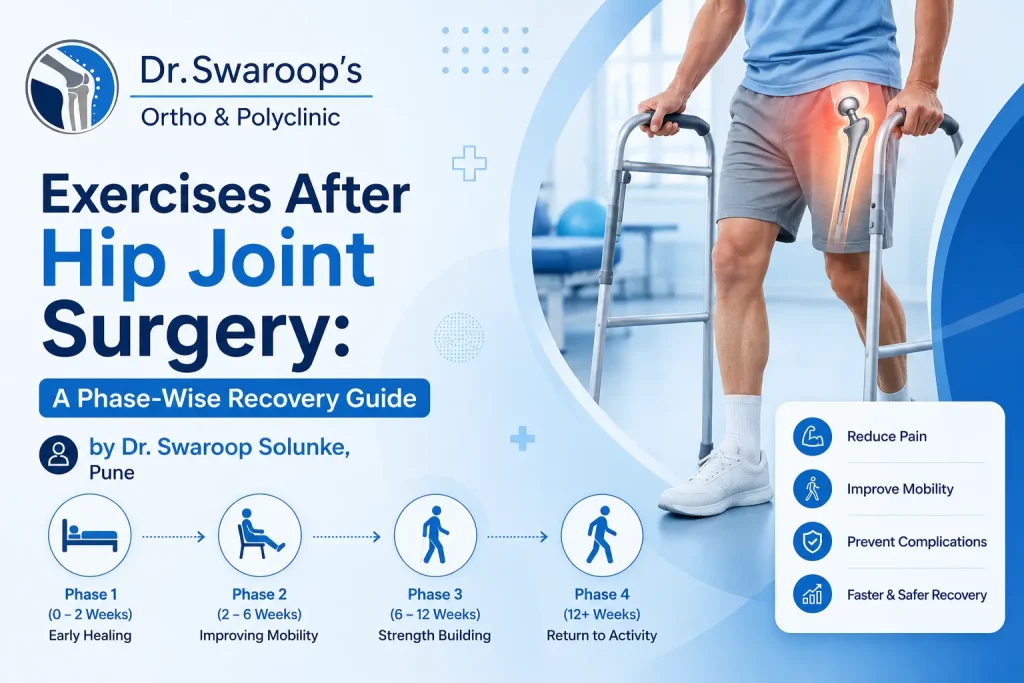
Recovery after hip surgery is not about staying still. It is about moving the right way at the right time. Exercises after hip joint surgery are structured progressively across four distinct phases, each with its own goals and safe boundaries.
This guide, put together from clinical practice at Dr. Swaroop’s Ortho and Polyclinic in Wakad and Nigdi-Pradhikaran, walks you through exactly which exercises are safe at each stage, what to avoid and why early movement is the single biggest contributor to a good surgical outcome.
Exercises After Hip Joint Surgery: What to Expect at Each Stage
Hip replacement patients typically begin gentle exercises within 24 hours of surgery, while still in the hospital. The full recovery programme spans 10 to 12 weeks and is divided into four phases: immediate post-operative, early rehabilitation, strengthening and return to activity. Your physiotherapist will guide the pace based on your individual progress.
Here is the phase-wise overview at a glance:
| Phase / Timeline | Recommended Exercises | Key Goal |
| Phase 1 Days 1 to 4 | Ankle pumps, quad sets, heel slides, deep breathing, assisted standing | Prevent blood clots, restore basic muscle activation |
| Phase 2 Week 1 to 3 | Short-distance walking with walker, sitting to standing, hip abduction lying | Restore independent ambulation and safe transfers |
| Phase 3 Week 4 to 8 | Walking without walker, mini-squats, hip strengthening, stationary cycling | Rebuild muscle strength and walking endurance |
| Phase 4 Week 9 to 12+ | Stair climbing, resistance band exercises, progressive walking distance | Return to full daily activity and long-term joint health |
Phase 1 – Immediately After Hip Surgery (Days 1 to 4)
Within hours of coming out of the operating theatre, your physiotherapist will visit your hospital bed and begin the first exercises. This is not unusual – it is best clinical practice.
The primary risks immediately after hip surgery are deep vein thrombosis (blood clots in the leg) and muscle wasting. Both are reduced significantly by gentle movement started early.
Ankle Pumps
Lie flat on your back. Flex your foot so your toes point toward the ceiling, hold for 3 seconds, then point your toes away from you and hold again. This simple movement activates the calf muscle pump, which pushes blood back toward the heart and dramatically reduces clot risk.
- 10 repetitions per foot, every hour while awake
- Can be done in bed from day one
- Continue until you are walking regularly
Quadriceps Sets (Quad Sets)
Lying flat, press the back of your operated knee gently into the bed by tightening your thigh muscle. Hold for 5 to 10 seconds and release. This reactivates the quadriceps which switch off rapidly after surgery.
- 10 repetitions, 3 times per day
- Can be alternated with ankle pumps
Heel Slides
Lying on your back, slowly slide your heel toward your buttocks by bending your knee. Slide only as far as comfortable and return slowly. This restores hip flexion range without putting strain on the new joint.
- 10 repetitions, 2 times daily
- Stop if you feel sharp pain rather than mild stretch
Gluteal Squeezes
Squeeze your buttock muscles together, hold for 5 seconds and release. Simple but effective. The glutes are the primary stabilisers of the hip and reactivating them early prevents the limp that commonly develops in poorly managed hip replacement recoveries.
- 10 repetitions, 3 times per day
Assisted Standing and First Steps
By day one or day two, your physiotherapist will help you stand at the bedside with a walker. Standing upright, even for 30 seconds, has measurable benefits for circulation, lung function and the psychological confidence that recovery is already underway.
Phase 2 – Early Rehabilitation at Home (Week 1 to 3)
Once you are discharged from hospital (typically day 3 to 5 after a primary hip replacement), your recovery continues at home. This phase is about building safe independence.
You will be using a walker for all mobility during this phase. Your physiotherapist will have shown you how to use it correctly, how to sit down and stand up safely and which hip positions to avoid based on the surgical approach used.
HIP PRECAUTIONS: Depending on the surgical approach (posterior, anterior or lateral), you will have specific movement restrictions for the first 6 weeks. The most common restrictions include: do not cross your legs, do not bend your hip beyond 90 degrees and do not rotate your foot inward. Your surgeon will confirm which precautions apply to your case. Never exercise beyond these boundaries without medical clearance.
Walking Progressively with a Walker
Start with short distances – from room to room in your house. Increase distance every 2 to 3 days as comfort allows. Aim for 3 to 4 short walking sessions per day rather than one long walk.
- Day 5 to 7: 50 to 100 metres per session
- Day 8 to 14: 150 to 200 metres per session
- Week 3: transitioning toward 300 to 400 metres with good gait pattern
Sitting to Standing Practice
Use a chair with armrests. Slide to the edge of the seat, keep your operated leg slightly forward and push up through your arms and unaffected leg. Sit down in the reverse sequence. Practise this 5 to 10 times daily.
Hip Abduction – Lying
Lie on your back with both legs straight. Slowly slide your operated leg out to the side and return it. Keep toes pointing toward the ceiling throughout. This targets the hip abductor muscles which are critical for a smooth, non-limping gait.
- 10 repetitions, 2 times daily
- Only within the range allowed by your surgeon’s precautions
Short Arc Quads
Roll a towel under the thigh of your operated leg to raise it slightly off the bed. Straighten your knee fully, hold for 5 seconds and lower. This builds quad strength without hip flexion stress.
- 10 repetitions, 3 times per day
Phase 3 – Building Strength (Week 4 to 8)
By week 4, most patients are cleared by their surgeon to progress movement. Hip precautions may begin to be relaxed, walking aids may transition from a walker to a single crutch or walking stick and the exercise load increases significantly.
This phase is when physiotherapy attendance (at a clinic in Wakad, Pimple Saudagar, Aundh or PCMC) becomes especially important because exercises need to be monitored for quality of movement, not just completion.
Mini-Squats at the Kitchen Counter
Stand facing a kitchen counter with both hands resting lightly on the surface for balance. Slowly bend both knees to 20 to 30 degrees (a quarter squat) and straighten. Do not allow your knees to travel forward beyond your toes.
- 10 repetitions, 2 to 3 sets per day
- Stop if you feel sharp pain or clicking at the hip
Standing Hip Abduction
Stand on your non-operated leg beside a counter. Slowly lift your operated leg out to the side to about 30 degrees, hold for 2 seconds and return. This directly strengthens the gluteus medius which controls pelvic stability during walking.
- 10 to 15 repetitions, 2 sets per day
- Ensure the pelvis stays level throughout
Standing Hip Extension
Standing at a counter, slowly move your operated leg backward (hip extension) while keeping your back straight and your knee straight. Hold briefly and return. This activates the gluteus maximus and hip flexor mobility.
- 10 repetitions, 2 sets per day
Stationary Cycling
A stationary bicycle is one of the best exercises after hip replacement from week 5 or 6. The circular motion puts the hip through its full range in a controlled, low-impact way. Seat height should be adjusted so the operated hip does not flex beyond 90 degrees.
- Start: 10 minutes at low resistance
- Build to 20 to 30 minutes by week 8
- Confirmed as safe with your surgeon before starting
Aquatic Therapy (Hydrotherapy)
If available in Pune or PCMC, hydrotherapy sessions in a warm pool provide resistance training with significantly reduced joint loading. Water buoyancy takes 80 to 90% of body weight off the hip, making exercises comfortable even before full strength returns.
Patients of Dr. Swaroop Solunke in Wakad and Pimple Saudagar who are cleared for hydrotherapy by week 6 consistently report faster return to normal gait and reduced pain scores during the strengthening phase.
Phase 4 – Return to Activity (Week 9 to 12 and Beyond)
By week 10 to 12, most straightforward hip replacement patients are walking independently, climbing stairs and returning to light household activity. The goal of this phase is to consolidate strength gains and build long-term joint health.
Stair Climbing
Lead with your good leg going up and your operated leg going down. Use the handrail throughout. Your physiotherapist will practise this with you in clinic before you attempt stairs at home without supervision.
Resistance Band Exercises
Looped resistance bands add progressive load to hip abduction, extension and flexion exercises from week 10. Start with a light band and increase resistance gradually over 4 to 6 weeks.
Progressive Walking
Aim to extend your walking distance by 10 to 15% per week. Walking on uneven surfaces like grass or slight inclines builds the proprioceptive awareness that protects the new joint in real-world conditions.
- Week 10: target 1 km per session
- Week 12: target 2 to 3 km per session
- After 3 months: most patients can walk without fatigue at normal pace
Long-term joint health after hip replacement depends on maintaining the muscle strength built during rehabilitation. Stopping exercise completely after discharge is the most common reason patients develop a limp or reduced activity tolerance 2 to 3 years after an otherwise successful surgery.
Exercises and Activities to Avoid After Hip Surgery
As important as what you should do is what you should not attempt during recovery:
- Do not run or jog until cleared by your surgeon (typically not before 3 to 4 months)
- Avoid high-impact activities including jumping, aerobics and contact sports
- Do not sit on low chairs, low sofas or Indian-style floor seating during the first 6 weeks
- Avoid crossing your legs or rotating the operated hip inward (posterior approach patients)
- Do not exercise beyond pain: mild discomfort is expected but sharp or increasing pain is a signal to stop
- Avoid lifting heavy objects during the first 6 weeks as this increases abdominal pressure and hip stress
About Dr. Swaroop Solunke – Orthopedic Surgeon in Pune and PCMC
Dr. Swaroop Solunke is a fellowship-trained Orthopedic Surgeon and Joint Replacement Specialist with 16 years of clinical experience and over 2,500 joint replacement and trauma surgeries performed across Pune and PCMC. He is the only orthopaedic surgeon in the region with fellowships from three international centres in Germany, Italy and the United States.
- Fellowship in Arthroplasty – Bruderkrankenhaus St. Josef Paderborn, Germany
- Fellowship in Primary and Revision Hip Replacement – IRCCS Instituto Ortopedia Galeazzi, Milan, Italy
- Fellowship in Robotic Knee Replacement – Stone Research Foundation, San Francisco, USA
- MS Orthopaedics (Gold Medalist) – MGM Medical College and Hospital
- MBBS – Dr. DY Patil University, Navi Mumbai
Dr. Solunke performs every procedure himself. The surgeon you meet at your consultation is the one who operates and follows up with you personally throughout recovery.
Clinic Locations and Contact
- Primary Clinic: Dr. Swaroop’s Ortho and Polyclinic, Wakad, Pune
- Also available at: Kush Neuro Cardiac Hospital, Wakad and Joint Aura Ortho and Polyclinic, Nigdi-Pradhikaran
- Serving patients from Aundh, Baner, Hinjewadi, Pimple Saudagar, Pimpri, Shivaji Nagar and across PCMC
Appointment Contact: 7385486860
Email: dr.swaroopsolunke@gmail.com
Book a Consultation with Dr. Swaroop Solunke, Pune
If you or a family member has recently had hip joint surgery, or if you are planning one and want to understand the recovery process in detail, Dr. Solunke’s team is available for a direct consultation at the Wakad clinic.
You can also seek a second opinion if your current recovery feels stalled. Many patients from Pimpri, Aundh, Hinjewadi and Baner have found significant improvement in their rehabilitation trajectory after switching to a structured, phase-based exercise programme.
Book an Appointment – Call 7385486860
Dr. Swaroop’s Ortho & Polyclinic, Wakad, Pune | dr.swaroopsolunke@gmail.com
Frequently Asked Questions: Exercises After Hip Joint Surgery
Q1. When can I start exercising after hip replacement surgery?
Most patients begin gentle exercises on the day after surgery, while still in the hospital. Ankle pumps, quad sets and heel slides are typically started within 24 hours. Assisted standing and first steps with a walker happen on day one or two under physiotherapy supervision. The key is that early movement is not optional – it is a core part of the surgical outcome.
Q2. How long does it take to walk normally after hip joint surgery?
Most patients walk short distances with a walker within 3 to 5 days of surgery. By 4 to 6 weeks, many are walking with a single crutch or walking stick. By week 8 to 10, most patients walk independently over shorter distances without any aid. Walking at a normal pace without fatigue or limp is typically achieved between 2 to 3 months, provided the rehabilitation programme is followed consistently.
Q3. What exercises should I avoid after hip replacement surgery?
Avoid all high-impact activities during the first 3 to 4 months including running, jumping and aerobics. Do not sit on low surfaces such as low sofas or floor seating. Avoid crossing your legs (for posterior approach patients). Do not attempt stair climbing or uneven terrain without physiotherapy clearance. Sharp or increasing pain during any exercise is a reason to stop immediately and consult your surgeon.
Q4. Is cycling safe after hip replacement?
Stationary cycling is generally safe from around week 5 to 6 after hip replacement, with your surgeon’s clearance. The seat must be adjusted so the hip does not flex beyond 90 degrees. It is one of the best exercises for hip replacement recovery because it provides range-of-motion work, cardiovascular fitness and light muscle loading all in a low-impact format. Outdoor cycling on roads is typically allowed from month 3 onward.
Q5. What is the most important exercise after hip surgery?
If one exercise had to be named, it would be hip abductor strengthening – particularly the standing hip abduction and gluteus medius exercises. The hip abductors control pelvic stability during every step you take. Weakness here is the primary cause of the post-hip replacement limp. Patients who prioritise abductor strengthening from week 2 onward consistently show better gait quality and long-term function outcomes.

Dr. Swaroop Solunke
- Fellowship in Arthroplasty (Germany)- Bruderkrankenhaus St. Josef Paderborn, Germany.
- Fellowship in Primary and Revision Hip Replacement – Dr. Luigi Zagra IRCCS Instituto Orthopedia Galeazzi, Milan, Italy.
- Fellowship in Arthroplasty (Germany)- Bruderkrankenhaus St. Josef Paderborn, Germany.
- Fellowship in Robotic Knee Replacement – The Stone Research Foundation, San Francisco, California, USA.
- MS - Orthopaedics (Gold Medalist) – MGM Medical College and Hospital.
- MBBS – Dr. DY Patil University, Navi Mumbai.
- Member of Indian Medical Association (IMA)