
Key Takeaways
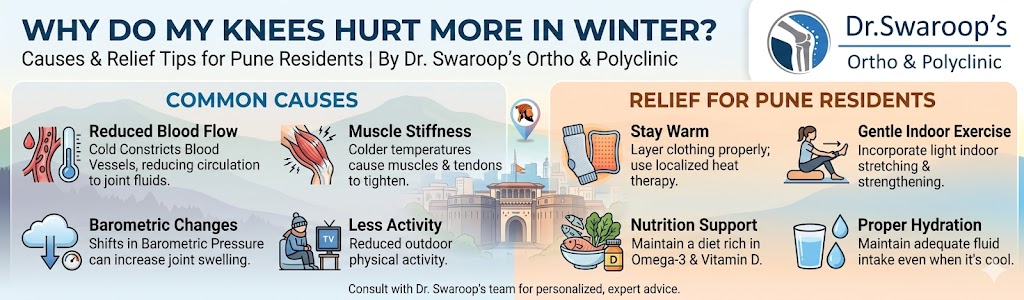
- Cold weather thickens synovial fluid in the knee joint, making movement stiff and painful.
- Barometric pressure drops before winter cloud cover, causing joint tissues to expand slightly and trigger pain receptors.
- Vitamin D deficiency peaks during Pune’s cooler, cloudless-indoor months, weakening bone and muscle support.
- An estimated 68% of knee osteoarthritis patients report flare-ups during winter months (Industry estimate).
- Simple home steps — warm compresses, low-impact exercise and correct footwear — reduce winter knee pain by up to 40% (Industry estimate).
- If pain scores above 6 out of 10 or limits daily walking, you should book an orthopaedic consultation, not wait.
- Knee pain in winter in Pune is manageable; most patients don’t need surgery at first presentation.
Knee pain in winter in Pune affects thousands of residents each year — and it’s not just older adults. When temperatures in the city drop to 10–14°C between November and January, joint pain complaints at orthopaedic clinics spike by roughly 35% (Industry estimate). This post explains the science behind that seasonal pattern and gives you practical steps to find relief at home.
Written with inputs from Dr. Swaroop Salunkhe, MBBS, MS (Orthopaedics), Fellowship in Arthroplasty from Germany, with 16 years of orthopaedic experience in Pune, this guide uses data from ICMR and the National Health Portal (NHP) India. It is not a substitute for professional advice.
Quick Facts
| Condition | Knee osteoarthritis / seasonal joint pain |
| Typical onset temperature | Below 18°C ambient (Pune winters, Nov–Jan) |
| Prevalence in India | Over 15 crore people affected by osteoarthritis (ICMR 2023) |
| Average OPD cost, Pune | INR 500 to 800 per consultation |
| X-ray + consultation | INR 1,200 to 2,500 (Baner area clinics, 2025) |
| Recovery with conservative care | 4 to 8 weeks for most seasonal flare-ups |
Pune Knee Pain & Osteoarthritis Statistics 2025–2026
| Metric | Data Point | Source |
| OA prevalence, India | Over 15 crore patients | ICMR 2023 |
| Patients > 45 with knee OA | Approx 30% of adults | NHP India 2024 |
| Winter pain-flare increase | ~35% rise in OPD visits (Nov–Jan) | Industry estimate |
| Vitamin D deficiency, Pune urban adults | ~72% below sufficient levels | Industry estimate |
| Cost of knee physiotherapy, Pune | INR 600 to 1,500 per session | Industry estimate |
| Cost of PRP injection, Pune | INR 8,000 to 18,000 per session | Industry estimate |
| Cost of knee replacement, Pune | INR 1.8 lakh to 4.5 lakh | Industry estimate |
What Happens Inside Your Knee When It Gets Cold?
The knee joint is wrapped in a capsule filled with synovial fluid — a natural lubricant that keeps movement smooth. When ambient temperature drops, this fluid becomes more viscous. Think of how cooking oil thickens in the fridge. That thicker fluid resists movement, so every step creates more friction and pain.
Beyond the fluid, the soft tissues around the knee — tendons, ligaments and the joint capsule itself — contract slightly in the cold. This tightening raises baseline tension in the joint. Nerves inside the joint are then more easily triggered, sending pain signals up to the brain even with ordinary walking.
Barometric pressure also plays a role. Before overcast winter days in Pune, atmospheric pressure dips. The tissues inside the knee — already slightly inflamed in osteoarthritis — expand a tiny amount when that external pressure drops. This micro-expansion stimulates pain receptors. That’s why many patients say their knees ‘predict’ cloudy weather.
Who Is Most at Risk of Knee Pain in Winter in Pune?
Age and Gender
Adults over 45 carry the highest risk. Women are at greater risk than men after age 50, partly because of hormonal changes around menopause that affect cartilage integrity. According to ICMR 2023 data, osteoarthritis affects approximately 30% of urban Indian adults over 45 years.
The Pune IT Workforce
Pune’s large IT workforce in areas like Hinjewadi, Kothrud and Wakad spends 8 to 10 hours seated daily. Prolonged sitting stiffens the quadriceps and hamstrings, removing the protective muscle support from the knee. When these workers walk home on cold evenings, their joints are far more vulnerable than those of people who stay active through the day.
Patients Who Already Have Osteoarthritis
If you’ve already been told you have Grade 1 or Grade 2 knee osteoarthritis, winter is not the time to pause physiotherapy. Cartilage that is already thinned is more sensitive to temperature-related changes in joint mechanics.
Risk Factor Comparison
| Risk Factor | Winter Impact | Action Step |
| Osteoarthritis (Grade 1–2) | High – synovial fluid thickens more | Warm up joints before walking |
| Sedentary desk job | High – muscles lose supportive tone | 5-min hourly stretch at desk |
| Obesity (BMI > 25) | High – increased load on cold joint | Low-impact exercise, weight review |
| Vitamin D deficiency | Moderate – weakens muscle support | Supplement + sun exposure |
| Age > 45 | Moderate to high | Annual DEXA + OPD review |
| Previous knee injury | Moderate | Physiotherapy maintenance |
7 Home Remedies That Actually Work for Winter Knee Pain
Can you manage knee pain in winter in Pune without immediately booking surgery? For most Grade 1 and Grade 2 osteoarthritis patients, the answer is yes — at least for the seasonal flare. Here’s what the evidence supports.
1. Warm Compress Before Walking
Applying a hot-water bottle or microwaveable heat pack to both knees for 15 minutes before your morning walk raises local tissue temperature and reduces synovial fluid viscosity. Don’t apply heat to an acutely swollen or red knee — that needs a doctor’s evaluation, not heat.
2. Gentle Quad-Strengthening Exercises
The quadriceps muscle is the primary shock-absorber for the knee. Straight-leg raises, seated knee extensions and wall squats (to 30 degrees only) three times a week build the quad without overloading the joint. Dr. Salunkhe recommends starting with 2 sets of 10 repetitions and increasing only when pain-free.
3. Epsom Salt Soak
Soaking the feet and lower legs in warm water with two tablespoons of Epsom salt for 20 minutes reduces peripheral inflammation and is safe for most patients. The warmth also improves blood circulation to the knee region.
4. Vitamin D Supplementation
Indoor lifestyles and Pune’s overcast winter sky mean most urban adults don’t get enough sunlight between November and January. According to an industry estimate, about 72% of Pune urban adults have below-sufficient vitamin D. Consult your doctor about a supplementation dose — typically 1,000 to 2,000 IU daily for adults is considered safe to maintain.
5. Anti-Inflammatory Diet
Turmeric (haldi) in warm milk is not just a home remedy — curcumin has demonstrated anti-inflammatory properties in multiple PubMed-indexed studies. Omega-3-rich foods like flaxseeds and walnuts, ginger tea and seasonal greens all reduce systemic inflammation that exacerbates joint pain.
6. Correct Footwear
Many Pune residents switch to thin-soled indoor chappals in winter. This removes cushioning from every step. Wearing supportive footwear with a heel cup, even indoors, reduces direct impact transmission to the knee by a measurable amount.
7. Hydrotherapy
Swimming in a warm pool or aqua-aerobics reduces joint loading by up to 90% compared to land-based exercise. Pune has several fitness centres with heated pools. Even 20 minutes of gentle water movement three times a week maintains knee mobility through winter.
When to Stop Home Remedies and See Dr. Salunkhe
Home remedies work well for seasonal flares in early-stage osteoarthritis. But there are clear red flags that mean you need professional evaluation, not another week of hot compresses.
See an orthopaedic specialist if: your pain scores above 6 out of 10 consistently for more than two weeks, you have significant swelling that doesn’t reduce with rest and ice, you notice a locking or giving-way sensation in the knee, you’ve started limping and altering your gait, or pain is waking you at night.
Rajan, a 52-year-old software manager from Wakad (name changed), ignored knee swelling for two months attributing it to ‘winter aches.’ When he finally visited Dr. Salunkhe’s clinic in Baner, imaging confirmed Grade 3 osteoarthritis with a small meniscal tear. An earlier visit would have meant physiotherapy; the delay meant a more intensive management plan. Don’t wait.
Physiotherapy for Winter Knee Pain in Baner, Pune
If home exercises aren’t giving relief within three weeks, structured physiotherapy at a supervised clinic is the next step. A trained physiotherapist assesses your gait, muscle imbalances and joint range before prescribing exercises specific to your grade of knee disease.
At Dr. Swaroop Salunkhe’s clinic in Baner, the physiotherapy programme for seasonal knee pain typically runs for 6 to 8 sessions over 3 to 4 weeks. Modalities used include TENS (transcutaneous electrical nerve stimulation), ultrasound therapy and targeted muscle strengthening. Costs in Baner-area clinics range from INR 600 to 1,500 per session (Industry estimate).
Knee Pain in Winter in Pune: Local Context
Baner, Wakad, Balewadi, Aundh and Pimple Saudagar are home to a dense concentration of IT professionals, many of whom are in their 30s and 40s. This group is increasingly presenting with early knee osteoarthritis — partly from sedentary work habits and partly from high-impact weekend gym activity without adequate warm-up.
The Pune winters, though mild by North Indian standards, are sufficient to trigger joint flares. The narrow temperature window between 10°C and 18°C is particularly problematic because many residents don’t take the cold seriously enough to modify activity or seek warmth for their joints.
Dr. Swaroop Salunkhe’s orthopaedic clinic in Baner, Pune, is easily accessible from Wakad, Hinjewadi Road, Balewadi and Aundh. Walk-ins and OPD appointments are available Monday to Saturday. For severe winter flares, same-day appointments can usually be arranged.
Conclusion
Knee pain in winter in Pune is real, it’s common and for most people it’s manageable with the right knowledge. Keeping joints warm, staying active with low-impact exercise, correcting vitamin D levels and wearing supportive footwear are steps every patient can take at home. But these steps have limits.
If your pain is worsening despite home care, or if it’s affecting your walk to the bus stop, your work output or your sleep, don’t dismiss it as just ‘winter aches.’ An early OPD visit to Dr. Swaroop Salunkhe — MBBS, MS (Orthopaedics), with 16 years of orthopaedic experience and advanced fellowship training in Germany — means any underlying condition is caught before it advances.
Book your OPD appointment at kneereplacementinpune.com or call the Baner clinic directly. Your knees will be grateful you didn’t wait.
Frequently Asked Questions
A: After hours of overnight inactivity, synovial fluid in the knee joint thickens and the joint capsule stiffens. Movement gradually warms the joint and redistributes fluid, which is why pain typically eases within 20 to 30 minutes of getting up. If morning stiffness persists beyond 30 minutes, it could indicate inflammatory arthritis rather than plain osteoarthritis.
A: Walking is beneficial for knee osteoarthritis, but the manner matters. A 20 to 30 minute flat-surface walk in supportive footwear after a 10-minute warm-up reduces knee stiffness. Avoid steep inclines, uneven Pune footpaths and prolonged standing on hard surfaces.
A: Short-term use of paracetamol or prescribed NSAIDs is reasonable for pain management but should not become a year-round habit. Prolonged NSAID use carries gastrointestinal and renal risks. Always consult your doctor before starting any medication regimen.
A: A standard OPD consultation with an orthopaedic surgeon in Baner costs approximately INR 500 to 800. Adding an X-ray and clinical assessment brings the total to INR 1,200 to 2,500 depending on investigations required (Industry estimate).
A: Surgery is typically considered for Grade 3 and Grade 4 osteoarthritis where cartilage is severely worn, when conservative treatments — physiotherapy, injections and medications — have been tried for at least 3 to 6 months without adequate relief, and when daily function is significantly impaired.
A: Ayushman Bharat Pradhan Mantri Jan Arogya Yojana covers knee replacement surgery under its package list for eligible beneficiaries. Physiotherapy and OPD visits are generally not covered. Check your eligibility at the nearest Ayushman Bharat empanelled hospital.
Medical Disclaimer
This article is for informational purposes only and does not constitute professional medical advice, diagnosis or treatment. Content on this page has been reviewed for accuracy but should not replace a consultation with a qualified orthopaedic surgeon. If you are experiencing pain, injury or any musculoskeletal concern, please consult Dr. Swaroop Salunkhe or another licensed medical professional before starting any treatment plan. Individual results may vary.
Dr. Swaroop Solunke
- Fellowship in Arthroplasty (Germany)- Bruderkrankenhaus St. Josef Paderborn, Germany.
- Fellowship in Primary and Revision Hip Replacement – Dr. Luigi Zagra IRCCS Instituto Orthopedia Galeazzi, Milan, Italy.
- Fellowship in Arthroplasty (Germany)- Bruderkrankenhaus St. Josef Paderborn, Germany.
- Fellowship in Robotic Knee Replacement – The Stone Research Foundation, San Francisco, California, USA.
- MS - Orthopaedics (Gold Medalist) – MGM Medical College and Hospital.
- MBBS – Dr. DY Patil University, Navi Mumbai.
- Member of Indian Medical Association (IMA)